

The Technical AEO Checklist: Schema, llms.txt & Structured Data for 2026
-
Author
Neha Garg -
Publish
June 15, 2026 12:24 pm -
Read Time
8 Min
 Lets talk










Fill in the Form below for a no-string attached free technical discussion.
AI answer engines ChatGPT, Gemini, Perplexity are now where your buyers research vendors. If a machine cannot read your page cleanly, it quotes a competitor instead. This checklist covers the nine technical fixes that determine whether AI engines can find, parse and cite your site: opening your robots.txt to AI crawlers, serving real HTML instead of JavaScript shells, adding JSON-LD schema, writing answers before context, staying indexed in Bing, building entity signals, keeping pages fast and publishing an llms.txt. Fix the first three and you close most of the gap. The rest is finishing work.
Search has split into two jobs. People still type queries into Google, but more of them now ask ChatGPT, Gemini, Perplexity or Claude and read the answer without clicking anything. For a business in India, that shift is not theoretical. ChatGPT crossed 180 million monthly users here at the start of 2026 and Gemini was close behind at 118 million. India also reports the highest AI adoption rate of any major market at 59 percent. The buyers you want are already asking machines first.
Most AI-visibility problems are not content problems. They are technical. A page can be well-written and still be invisible to ChatGPT, Perplexity or Google AI Overviews because a crawler cannot reach it, cannot parse it, or cannot trust what it finds. This checklist walks your dev team through each fix, ordered by impact, so if you only ship the first few items you still close most of the gap.
TL;DR
AEO (Answer Engine Optimisation) is the practice of structuring your site so AI engines can extract, verify and cite your content. The technical layer is the foundation. Get it wrong and nothing else you do matters. Schema and structured data carry most of the weight; answer-first content and llms.txt complete the picture.
AI search referrals are growing 130 to 150 percent year over year as of early 2026. Google AI Overviews now appear on more than 40 percent of queries. Technology, SaaS and finance lead this shift; local service businesses trail behind, which means early movers in those categories have real room to win.
Picture how a buyer researches a vendor today. They open ChatGPT, ask for the top NetSuite partners in India and read a short list with reasons. They may never visit a search results page. A NetSuite partner in Mumbai or a fintech in Bengaluru that gets cited by ChatGPT today builds an advantage that is hard to copy later. Schema and clean structure are how you get into those answers.
Start here, because if the bots cannot fetch you, nothing else counts. Check your robots.txt for accidental blocks on these agents:
A useful distinction: training crawlers (GPTBot, ClaudeBot) feed model training, while search crawlers (OAI-SearchBot, Claude-SearchBot, PerplexityBot) fetch content to answer live user questions. If you want to appear in AI answers but not contribute to model training, you can allow the search bots and block the training ones. Decide on purpose do not let a default security rule decide for you.
Pro tip: Run a quick grep on your robots.txt for ‘Disallow: /’ with no user-agent filter. That single line blocks every bot including AI crawlers. It is the most common reason a well-built site never appears in AI answers.
This is the single biggest technical failure teams overlook. As of mid-2026, none of the major AI crawlers execute JavaScript not GPTBot, OAI-SearchBot, ClaudeBot or PerplexityBot. They read your raw HTML and leave. Google’s Gemini is the main exception, since it borrows Googlebot’s rendering pipeline.
If your site is a client-rendered React, Vue or Angular app, AI crawlers often see an empty shell a div tag and some script references. Your content never loads for them. The fix is to render your important content server-side (SSR) or with static generation (SSG) so the words exist in the initial HTML response. This is the highest-leverage change on the list after crawler access.
What to check
View source on your homepage in a browser (Ctrl+U). If the body contains only script tags and an empty root div, AI crawlers see the same empty page. SSR or SSG puts real text in that initial response.
Schema markup is code, usually written in JSON-LD, that labels what your content means. It tells an answer engine that a block of text is a question, a price, an author or a business. Pages with FAQPage markup are around 3.2 times more likely to appear in Google AI Overviews. Sites with complete, accurate structured data get cited noticeably more often by one analysis, up to 3.1 times more.
Use JSON-LD, the format the industry standardised on (around 90 percent share). It sits in a script tag, decoupled from your visible HTML, so bots extract it cleanly. Ship these types as your baseline:
TL;DR
Schema does not boost rankings on its own. It makes your content machine-readable, which raises your odds of being the page an AI quotes. Start with FAQPage, Article, Organization and Product.
AI engines now cross-check your markup against your visible content. Schema that claims a price, rating or fact the page does not show can cause the whole page to be skipped. Two rules apply:
Run pages through Google’s Rich Results Test and the Schema.org validator before shipping. A practical example: a SaaS firm publishes a pricing page in plain prose with no markup. An answer engine has to infer the price, the plan names and the currency from sentences. Add Product and Offer schema and the same engine reads the price as a labelled value it can quote with confidence. Same content, very different machine confidence.
Schema labels your content. Formatting decides whether the content is worth lifting. The pattern that works in 2026 is straightforward: answer the question in the first one or two sentences of every section, in about 40 to 60 words, then add the detail below.
Think about how an engine reads a page. It scans for a clean, self-contained answer it can quote. A section that opens with three paragraphs of background gives it nothing to grab. A section that opens with a direct answer gives it exactly what it needs. This habit helps human readers too, since a clear opening respects their time and reduces bounce.
Pro tip: Write each H2 as a real question your buyer asks, then answer it in the first sentence. ‘What does NetSuite implementation cost in India?’ beats ‘Pricing considerations.’ The question matches how people speak to AI, and the answer sits ready to be quoted. This single habit can double your AI citation rate on existing content.
Two frequently missed signals:
AI engines want to know what and who your brand is, with confidence. Help them by treating your organization as a defined entity:
Consistent entity signals reduce the chance an AI describes you incorrectly or confuses you with a similarly named brand. For Indian B2B firms, this is especially important: a Bengaluru fintech and a Singapore firm with similar names can look identical to a model that lacks clear sameAs anchors.
AI crawlers are impatient. Many use tight timeouts of roughly one to five seconds and will not wait for a slow page. If your server is slow or your critical content loads late, the bot may skip you entirely. Treat Core Web Vitals, server response time and overall page speed optimisation as AEO signals, not only UX metrics.
llms.txt is a plain text file you place at the root of your domain. It links to your most important pages with short descriptions so AI agents can find them quickly. Jeremy Howard of Answer.AI proposed it in late 2024 and it sits alongside robots.txt rather than replacing it.
Here is the honest picture as of May 2026. Adoption sits near 10 percent of sites. Crawler logs show that the major AI crawlers including GPTBot, ClaudeBot and PerplexityBot, mostly skip it and read your HTML directly. Google has compared it to the old meta keywords tag. But the cost is half a day of work and the upside is genuine optionality. Coding agents like Cursor, Claude Code and GitHub Copilot already fetch llms.txt when pointed at documentation.
Pro tip: Generate llms.txt from a single source of truth and rebuild it on every deploy. A stale file pointing to dead pages is worse than no file at all.
Ordered by impact. Ship the first three and you close most of the gap before you touch anything else.
Both get lumped together as AI optimisation. They solve different problems, so the order matters.
If you have limited hours this quarter, the order is clear: fix schema, rewrite your answers, then add llms.txt as a finishing touch.
Does schema markup directly improve Google rankings?
No. Google has confirmed schema is not a ranking factor. What it does is make your content eligible for rich results and far easier for AI engines to read and cite. The ranking benefit is indirect through higher click-through rates and stronger AI visibility.
Why isn’t my well-built site appearing in ChatGPT answers?
The two most common technical causes are a robots.txt block on AI crawlers and client-side JavaScript rendering that leaves AI bots an empty page. Check both first. Bing indexability is a frequent third cause, since roughly 92 percent of ChatGPT search answers draw on Bing’s index. Verify your site in Bing Webmaster Tools.
Which schema type matters most for AI search?
FAQPage tends to give the best return because it pairs questions with short answers that engines can quote directly. Article and Organization schema come next, since they build the author and brand trust that E-E-A-T relies on. For commerce pages, Product and Offer schema is essential.
Is llms.txt worth adding in 2026?
Yes, with realistic expectations. Most AI crawlers do not read it yet and it will not lift your traffic this quarter. But it costs little to set up and coding agents already use it, so it is sensible insurance for the agentic web that is forming. Ship it after items 1 through 8 are solid.
How often should we audit our structured data?
Quarterly is a sensible cadence. Schema decays as your content and products change, and stale or mismatched markup can cause pages to be skipped. Re-validate after any significant template or content change.
How do I measure whether AEO work is paying off?
Track AI-specific signals, not only keyword positions. Watch AI Overview impressions in Search Console, run your target questions through ChatGPT, Gemini and Perplexity to see whether you are cited, and monitor referral traffic from AI sources. Citations are the new rankings.
Technical AEO is not a rebrand of SEO. It is the layer that decides whether a machine can read your work and trust it enough to repeat it. Schema and structured data carry most of the weight. Answer-first writing makes your content easy to lift. llms.txt is a small, smart bet on where search is heading.
The brands that win AI visibility in India will not be the loudest. They will be the clearest. AEO success is mostly unglamorous engineering: open the right crawlers, serve real HTML, ship accurate JSON-LD, stay in Bing, write answers first and keep your pages fast. Do those well and you have solved most of the visibility problem before you touch a single trendy tactic.
At White Bunnie we treat that clarity as an engineering problem our AI SEO work is clean schema, sharp answers and a site an answer engine can navigate without friction. Work through the checklist above, fix the gaps and you give every major engine a reason to quote you instead of the next result.

Neha founded White Bunnie in 2018. The agency specializes in SEO, AEO, and GEO for B2B IT services, SaaS, and ITES companies targeting global markets. Their work has helped brands move from zero visibility to consistent AI citations across various popular AI platforms like ChatGPT, Perplexity, and Gemini.

Most B2B websites have a content problem that looks different from what they expect. The problem is not too little […]
Read Post »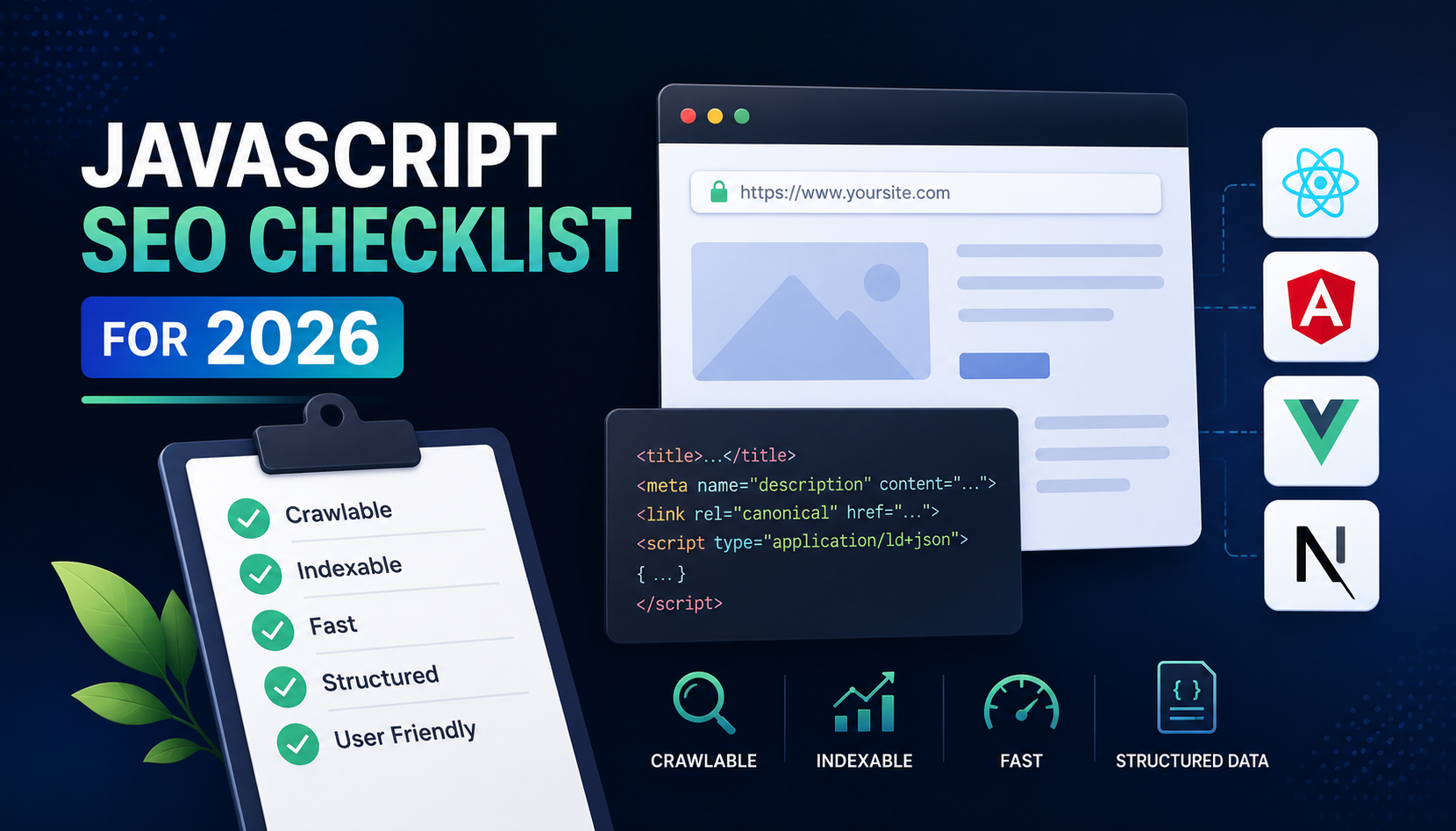
Quick summary: Google now reads JavaScript well, so that half of the old problem is mostly solved. The new problem […]
Read Post »
SEO is not just a buzzword anymore but more of a tool that helps businesses with visibility. However, on this […]
Read Post »
Copyright © 2026 White Bunnie -All Rights Reserved