

The Complete Guide to GEO and AI SEO for B2B SaaS Companies
-
Author
Neha Garg -
Publish
May 30, 2026 9:37 am -
Read Time
12 Min

 Lets talk










Fill in the Form below for a no-string attached free technical discussion.
Three years ago, a B2B SaaS company in India could reach US enterprise buyers with a steady stream of well-optimised blog posts, solid backlinks, and a clean technical setup. That playbook still matters. But it no longer tells the whole story.
Search behaviour shifted faster than most marketing teams anticipated. Google’s AI Overviews now summarise answers at the top of the results page before a user clicks a link. ChatGPT, Perplexity, and Gemini are fielding millions of commercial research queries every week. Buyers are asking AI engines which ERP integrations work best for Salesforce, which offshore ITES vendors have the strongest compliance track record, or which SaaS HR platforms support multi-entity payroll in India.
If your product or company is not showing up in those AI-generated answers, you are invisible to a growing share of your addressable market, regardless of where you rank on page one.
This guide covers two interconnected disciplines that now sit at the centre of B2B SaaS search strategy: Generative Engine Optimisation (GEO) and AI SEO. You will understand what each one involves, how they interact, and what a structured implementation looks like for a SaaS or ITES business targeting enterprise buyers in the US, UK, UAE, or Canada.
Generative Engine Optimisation (GEO) is the practice of structuring your content, authority signals, and brand presence so that AI language models and generative search engines cite, reference, or recommend your company in their responses.
Unlike traditional SEO, where you are optimising for ranking positions in a list of blue links, GEO is about being cited inside a narrative. When an AI engine writes a paragraph explaining which SaaS platforms offer the best API-first architecture for enterprise integration, you want your product to appear in that paragraph, not as an ad, but as a credible reference.
The core difference is in the output format. SEO produces ranked links. GEO produces inclusion in AI-generated prose. That changes what matters:
AI SEO refers to the set of practices that optimise content and site structure specifically for AI-driven search experiences: Google’s AI Overviews, AI-generated featured snippets, and large language model search engines like Perplexity, ChatGPT Search, and Gemini.
AI SEO combines content strategy, entity optimisation, schema implementation and technical SEO to ensure that AI systems can accurately understand, extract, and reference your company’s information.
This is distinct from using AI tools to write content or automate keyword research. AI SEO is about making your content legible and authoritative to AI systems that decide what to surface to users.
For a B2B SaaS company, this typically means:
Enterprise SaaS buying in 2026 typically starts with a research phase that happens entirely inside AI engines. A VP of Operations at a mid-market US company evaluating HR software will often ask Perplexity or ChatGPT to give them a shortlist before they type a company name into Google.
Gartner research found that B2B buyers complete more than 60% of their purchase decision research before contacting a vendor. (External link placeholder: Gartner B2B buyer journey report.) As AI search accelerates that research phase, the window for vendor-influenced discovery shrinks further.
What this means for Indian SaaS and ITES companies targeting international markets:
AI engines favour sources that cover a topic comprehensively, not sources that rank for isolated keywords. A SaaS company selling cloud ERP solutions needs to own the full topic cluster: what cloud ERP means for mid-market manufacturers, how implementation timelines compare across vendors, what integration challenges arise with legacy accounting systems, and so on.
This is different from producing blog posts targeting individual search terms. Topical authority means your site has the depth and breadth that signals genuine expertise to both Google’s algorithms and the language models training on web content.
AI Overviews and LLM citations heavily favour content structured for extraction. This means:
Structured data tells AI crawlers exactly what your content is about. For B2B SaaS, the most valuable schema types are:
Language models are essentially entity databases. They store associations between brand names, product categories, industries, geographies, and attributes. The stronger and more consistent your entity presence across authoritative third-party sources, the more confidently an AI model will include you in relevant answers.
For an Indian SaaS company targeting the US market, entity-building involves:
One of the strongest signals AI engines rely on is brand mentions in generative AI results and across authoritative third-party websites. Consistent references to your company in reviews, industry reports, media publications, and trusted directories help reinforce your authority and increase the likelihood of being recommended by AI systems.
B2B buyers using AI engines typically ask in full sentences or with specific context: ‘What is the best SaaS platform for managing multi-currency payroll across India and the US?’ or ‘Which Salesforce implementation partners in India have experience with manufacturing clients?’
Traditional keyword research identifies short phrases. Answer engine optimisation (AEO) identifies the full questions your buyers are asking and then creates content that answers those questions directly and authoritatively.
The practical execution involves question-based content architecture: topic pages that anticipate follow-up questions, FAQ sections designed to match real buyer language, and product pages that address objections and comparisons rather than just listing features.
Google’s quality guidelines use E-E-A-T (Experience, Expertise, Authoritativeness, Trustworthiness) as a framework for evaluating content quality. AI engines extend this same logic; they weight content from sources that demonstrate genuine expertise over content that merely resembles expert writing.
For B2B SaaS, building E-E-A-T means:
GEO and AI SEO are complementary, not competing disciplines. A useful way to think about the relationship:
A SaaS company that executes strong AI SEO but neglects GEO may rank in AI Overviews for queries already covered by their existing content. But that company will not be cited by conversational AI engines for broader comparative or recommendation queries, because those systems do not see sufficient third-party corroboration of the brand.
Conversely, a brand with strong entity presence but poorly structured website content may be known to AI models but not cited, because the model cannot cleanly extract relevant, accurate information to include in its response.
The goal is to close both gaps simultaneously.
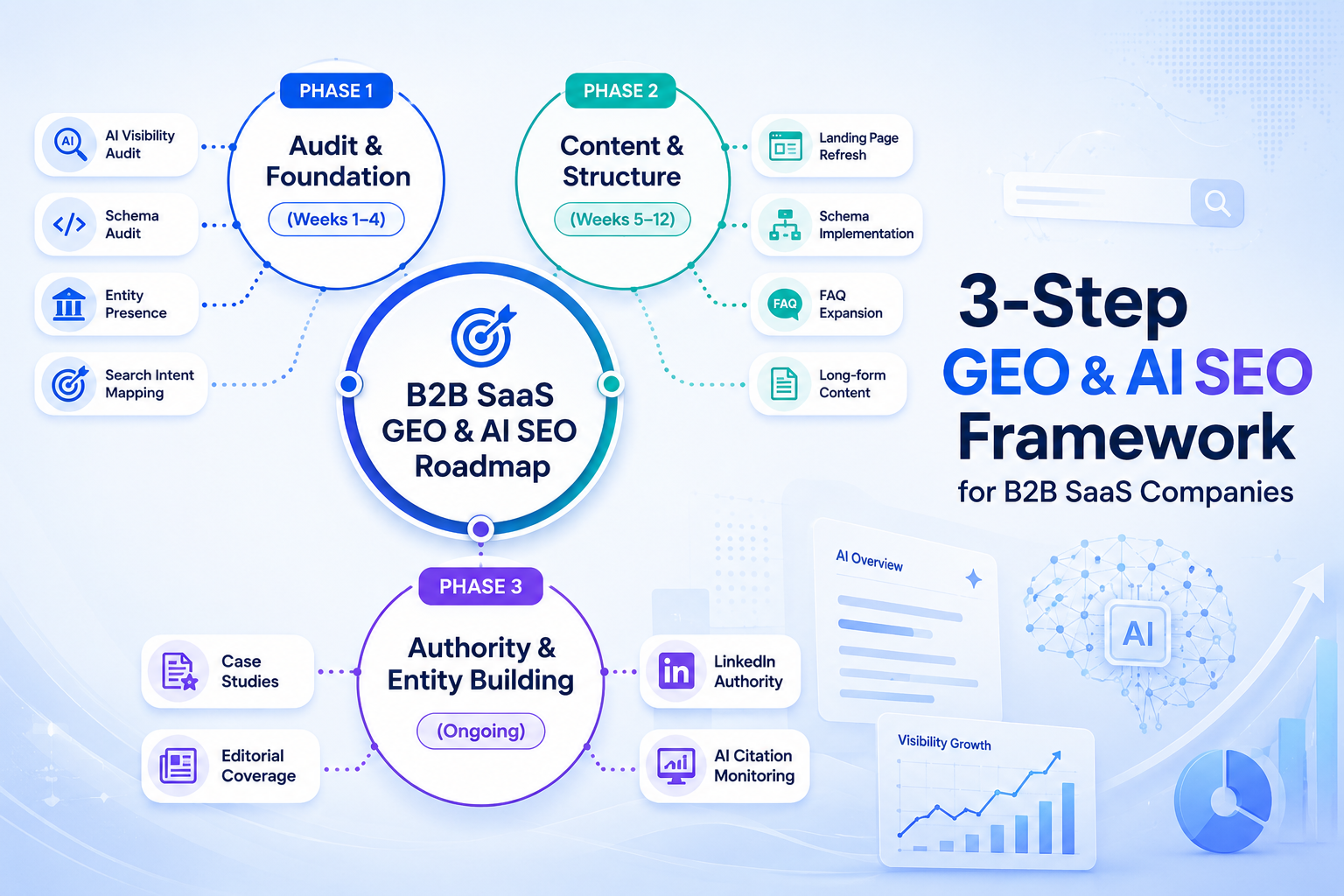
Many Indian B2B SaaS companies in sectors like HRtech, fintech infrastructure, and SaaS for SMBs discover at this stage that they rank page one on Google but appear nowhere in AI-generated answers. A structured SEO audit converts that vague concern into a specific action list, covering both traditional ranking gaps and AI visibility blind spots.
This restructuring alone can meaningfully increase AI citation frequency within 6–10 weeks, based on patterns observed across B2B SaaS clients. Pairing this with a consistent AI SEO content loop publishing, measuring, and refining based on citation data keeps the gains compounding over time.
A disciplined off-page SEO strategy focused on earning brand mentions and citations in relevant industry contexts, not just link volume is what turns on-site quality into AI-visible authority.
Indian SaaS companies face a distinctive challenge in GEO and AI SEO. Most are building category authority in international markets where they have limited brand recognition compared to established US or European competitors.
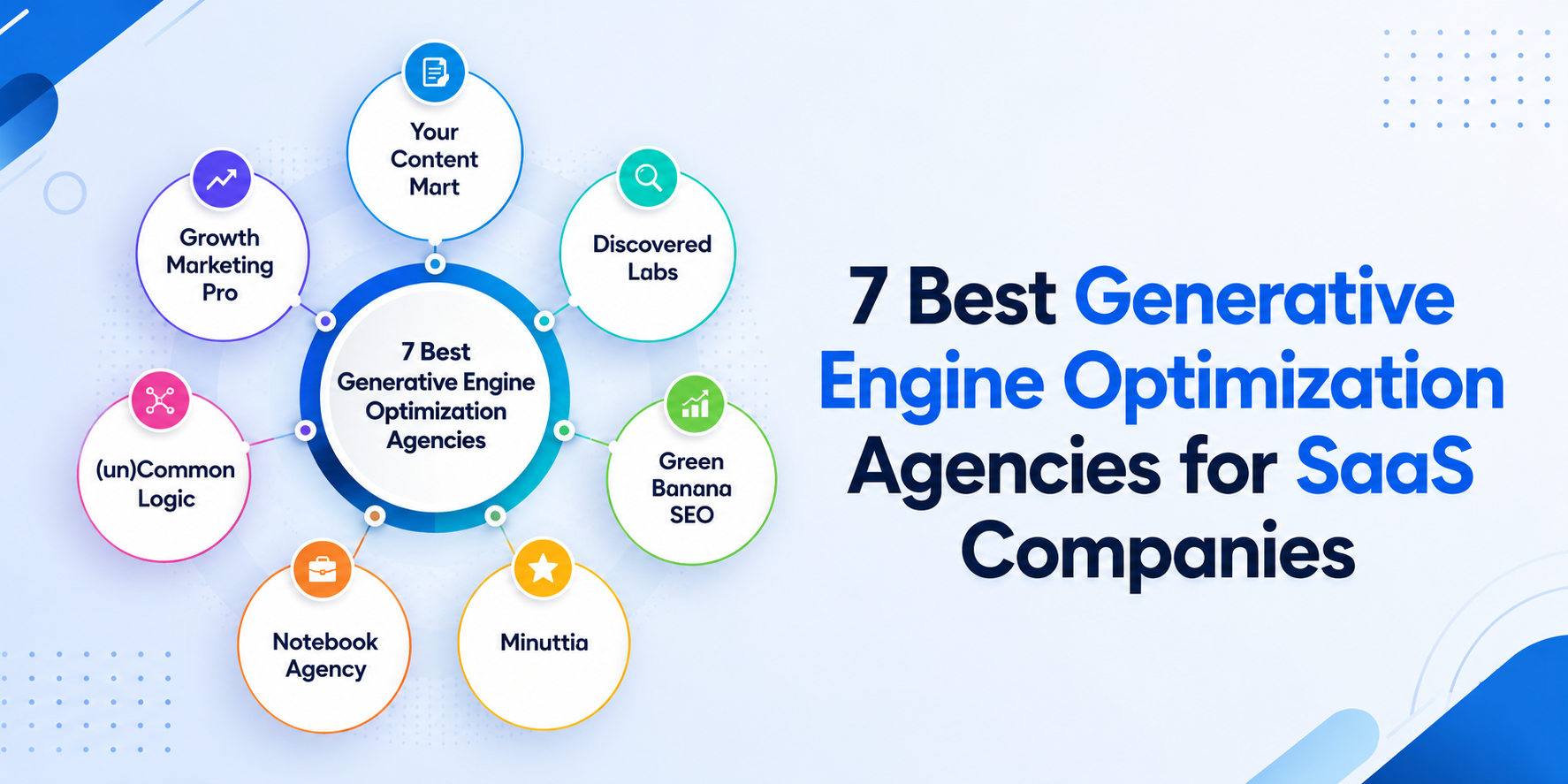
As competition grows, many organisations are turning to specialised partners and evaluating the best AI SEO agencies for B2B SaaS in India to accelerate AI visibility, improve citation frequency, and strengthen their presence in AI-driven search experiences across global markets.
The opportunity, however, is significant. Indian SaaS companies collectively serve a fast-growing share of mid-market and enterprise buyers globally, particularly in IT services, HR tech, fintech, and compliance software. Many of these categories are under-served by accurate, detailed AI-indexed content.
Practical priorities for Indian SaaS companies entering GEO and AI SEO:
Consider a SaaS platform offering Salesforce integration and managed services, targeting mid-market US businesses. Starting with minimal AI visibility (fewer than 10 brand mentions across AI engine responses), a structured GEO and AI SEO programme produced measurable results within six months:
The work behind these results was not technically complicated. It involved rebuilding core service pages with structured content, implementing comprehensive schema markup, adding FAQs targeted at real buyer questions, and building a systematic programme of case study publication and review acquisition.
What is the difference between GEO and AI SEO?
GEO (Generative Engine Optimisation) focuses on getting your brand cited in AI-generated answers, primarily through third-party authority building and brand entity presence. AI SEO focuses on optimising your website’s content and structure so that AI-driven search engines like Google AI Overviews can accurately extract and surface your content. Both work together. GEO without AI SEO leaves you cited but not well-represented; AI SEO without GEO improves on-site visibility but misses off-site AI discovery.
How long does it take for GEO efforts to show results?
For on-page AI SEO improvements, you can see movement in Google AI Overviews within four to eight weeks of implementing structural and schema changes. For broader GEO visibility across LLM search engines, a realistic timeline is three to six months of consistent execution before you see measurable increases in brand mentions and citation frequency. AI engine knowledge bases update at varying intervals, and some changes take longer to reflect than others.
Which AI engines should B2B SaaS companies prioritise for GEO?
Perplexity is currently the most commercially relevant for B2B research queries. It is widely used by professionals for comparative research and vendor shortlisting. ChatGPT Search has significant volume and is growing among business users. Google AI Overviews remain the highest-volume touchpoint because they appear directly in standard search results. Gemini rounds out the core four. For Indian SaaS companies targeting US and European markets, all four warrant attention, with Perplexity and Google AI Overviews offering the most immediate commercial impact.
Does GEO replace traditional SEO for B2B SaaS?
No. Traditional SEO including technical health, crawlability, page speed, backlink profile, and keyword targeting remains foundational. AI engines still crawl the web, and content that performs poorly in traditional SEO is unlikely to be well-represented in AI-generated answers either. GEO and AI SEO extend traditional SEO rather than replace it. Companies with weak traditional SEO foundations should address those before investing heavily in GEO-specific tactics.
What content types are most effective for AI citation in B2B SaaS?
Comparison pages and alternative-to pages perform exceptionally well because buyers frequently ask AI engines to compare options. Comprehensive use-case pages that answer specific application scenarios outperform generic feature lists. Original data or research, even from modest internal surveys, generates significantly higher citation rates than opinion content. Case studies with specific, named results are among the most-cited content types across AI engines. FAQ content structured with FAQPage schema has the highest direct correlation with Google AI Overview appearances.
How do I measure AI visibility for my SaaS company?
The simplest starting point is manual testing: define your 15 to 20 highest-value buyer queries and test them across ChatGPT, Perplexity, Gemini, and Google Search (for AI Overviews). Record where your brand appears, where competitors appear, and what content is being cited. Repeat this quarterly. More sophisticated approaches involve dedicated AI visibility tracking tools that automate query testing and track citation trends over time. Google Search Console remains the primary source for tracking AI Overview-driven traffic.
Search has not disappeared. It has evolved. The buyers your SaaS company needs to reach are still searching, but a growing share of them are searching through AI engines that synthesise answers rather than rank links. Getting visible in those answers is now a core commercial requirement. This shift is redefining marketing for IT and SaaS companies, requiring businesses to move beyond conventional SEO and invest in strategies that improve visibility across AI search platforms, answer engines and generative experiences.
GEO and AI SEO give you a structured path to that visibility: build extractable, authoritative content, implement comprehensive schema markup, establish your brand as a cited entity across the web, and track your progress against the actual queries that drive buying decisions in your category.
The companies that act on this now will hold a compounding advantage. AI citation has strong preferential reinforcement: brands that appear in AI answers get more traffic, more links, and more credibility, which feeds back into appearing in more AI answers.
White Bunnie works with B2B SaaS and IT services companies to build and execute GEO and AI SEO programmes that translate into measurable pipeline. If you are unclear where your brand currently stands in AI search or how to close the gap, that is a good place to start.

Neha founded White Bunnie in 2018. The agency specializes in SEO, AEO, and GEO for B2B IT services, SaaS, and ITES companies targeting global markets. Their work has helped brands move from zero visibility to consistent AI citations across various popular AI platforms like ChatGPT, Perplexity, and Gemini.
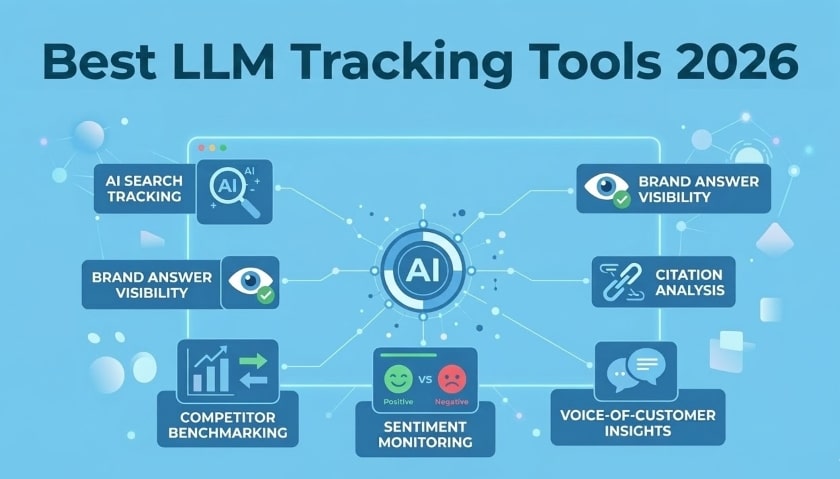
People used to find brands through Google. That’s changing. In 2026, a growing number of buyers start their research by […]
Read Post »
Growing your low domain authority eCommerce business with SEO is not just about increasing traffic but also about boosting revenue. […]
Read Post »
For years, Google Cache was a favorite resource for digital marketers, SEO experts, and everyday internet users. It provided quick […]
Read Post »
Copyright © 2026 White Bunnie -All Rights Reserved