

E-E-A-T in 2026: How to Build Real Experience Into Your Content
-
Author
Neha Garg -
Publish
May 12, 2025 12:00 pm -
Read Time
12 Min
 Lets talk











Fill in the Form below for a no-string attached free technical discussion.
Google has made one thing very clear between 2022 and 2026: generic content will not survive.
Core updates, the Helpful Content system becoming part of the core algorithm, multiple revisions to the Search Quality Rater Guidelines through 2025, and most recently the March 2026 Core Update (the most volatile in Google’s recorded history, with 79.5% movement in Top-3 results) all point in the same direction. Google wants helpful, trustworthy content backed by real-world experience, not articles that look like a basic content writing guide.
For Indian brands, this is both a risk and a big opportunity. If your content is based only on research and rewriting, you will keep losing visibility. If your content shows what you have actually done, clients you’ve helped, mistakes you’ve made, systems you use, you can stand out even in crowded niches.
In this guide, we’ll break down what E-E-A-T means in 2026 and how to bake real experience into every piece of content you publish.
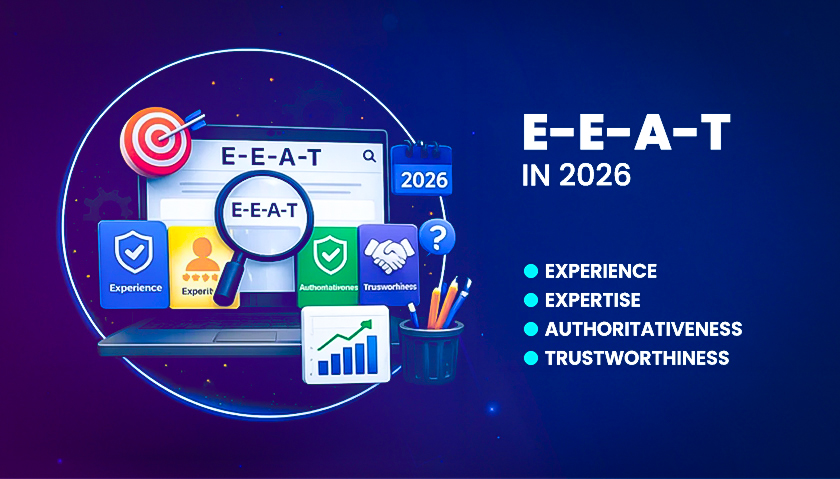
E-E-A-T stands for:
Experience – First-hand, real-world involvement with the topic.
Expertise – Depth of knowledge or skill in the subject.
Authoritativeness – How well-known and respected you or your brand are in that space.
Trust – Accuracy, honesty, safety, and reliability.
Google added the extra E for Experience in December 2022 to help raters judge whether content is written by someone who has actually done the thing, not just read about it.
By 2025–2026, the Search Quality Rater Guidelines (last revised September 11, 2025) keep stressing that Trust is central, and is earned through a mix of experience, expertise, and authority. The September 2025 revision was the most significant in years: it introduced an entirely new chapter on evaluating AI Overviews, expanded the YMYL category to explicitly include elections, government, and civic trust, and added fresh examples for rating AI-generated content.
No. E-E-A-T itself is not a “score” in the algorithm. It is a framework used in the Search Quality Rater Guidelines to evaluate how well Google’s systems are doing. But a 2025 correlation study analysing 10 million search results suggests E-E-A-T-related signals account for approximately 8% of ranking weight across all queries and that figure roughly triples to around 24% for YMYL topics. The direction is clear: the more YMYL your niche, the less optional E-E-A-T becomes.
In simple words: if you build strong E-E-A-T, your content is more likely to match what Google’s systems are trying to surface especially when supported by solid SEO and structured content clusters.
In simple words:
If you build strong E-E-A-T, your content is more likely to match what Google’s systems are trying to surface — especially when supported by solid SEO and structured content clusters.
A lot has happened since 2024:
At the same time, Google’s “Creating helpful, reliable, people-first content” documentation keeps repeating the same questions:
Do you show first-hand expertise?
Would someone trust this content with their money, health, or business?
Does the content leave users satisfied, or do they go back to search for another answer?
For Indian brands in YMYL categories, thin articles built without a proper content pillar strategy are at real risk.
To make E-E-A-T practical, it helps to see how each element works on a page. Google’s guidelines themselves distinguish “experience” from “expertise”.
| Type | What Google Wants To See (Simplified) |
|---|---|
| Experience | Evidence that the author has personally used the product, process, or service. |
| Expertise | Solid knowledge, credentials, or proven skill in the topic. |
| Authority | Signals that others in the industry trust you (mentions, links, citations). |
| Trust | Accuracy, transparency, safety, and honest intent across the whole site. |
In 2026, the edge comes from experience above all else. The March 2026 Core Update specifically re-weighted Experience signals relative to traditional authority indicators like link equity and topical coverage. Sites with high domain authority but thin experiential content lost ground to lower-authority sites that demonstrated genuine first-hand engagement.
The question is no longer, “Did you research this?” but “Have you lived this? And can we see that in the content?”
Examples of this in practice:
One of the most important clarifications from recent updates: Google does not penalize AI-assisted content categorically. What it penalizes is content produced at scale without meaningful human editorial oversight content that reads fluently but adds nothing unique.
Google’s own helpful content guidance (last updated December 2025) frames the question as “Who, How, and Why” who created the content, how it was produced, and why it was created. AI-generated content can satisfy E-E-A-T when it is:
AI content that fails these tests generic, unreviewed, keyword-stuffed is exactly what the December 2025 and March 2026 updates targeted. For Indian content teams using AI tools: AI should assist, not replace, the human expertise and original perspective. Every piece of AI-drafted content should have a real person bringing examples, editorial judgment, and lived experience to the table before it goes live.
In 2026, holding a ranking position and losing clicks are both possible at the same time. AI Overviews (formerly SGE) now appear in over 80% of B2B technology searches up from 36% in 2025. When an AI Overview is present, the #1 organic result sees roughly a 34.5% drop in click-through rate. However, brands cited within the AI Overview see a ~35% increase in brand clicks.
This is why Generative Engine Optimization (GEO) structuring content so AI systems extract and cite it is now a direct traffic lever alongside traditional SEO. The good news: the content that earns AI Overview citations is the same content that performs well in core updates. It is original, expert-attributed, topically authoritative, and built around genuine first-hand experience. For Indian brands, this means:
In short: if your content is good enough to rank in 2026, it is good enough to be cited in an AI Overview. The strategies are not separate.
This is where most sites struggle. They know E-E-A-T in theory but still publish safe, generic posts. Here’s how to fix that.
Instead of chasing every trending keyword, focus on:
Problems you solve every week
Example: An Indian performance agency writing about actual Google Ads recovery projects after a policy suspension.
Niches where you have proof
Case studies, dashboards, testimonials, email threads (sanitised).
Questions your sales and support teams hear daily
These are your best seeds for experience-led articles.
At White Bunnie, this often means prioritising topics where teams already have campaign data, screenshots, and before-after metrics. It becomes much easier to show experience, not just state it.
Google’s guidelines talk about checking the reputation of content creators, not just the brand and the March 2026 Core Update made author identity a direct page-level authority signal, not optional metadata. Sites that added structured author pages with verifiable credentials, industry affiliations, and consistent bylines saw measurable ranking improvements within weeks of the update rollout. Notably, 73% of top-ranking YMYL pages now show clear author credentials.
On your key pages, make sure you:
Add author names, not “Team” or “Admin”.
Include a short author bio that mentions:
Role and years of experience.
Industry focus (e.g., “10+ years in B2B SaaS SEO”).
Location (India helps when the content is India-specific).
Link to LinkedIn or professional profiles where possible.
This helps both users and quality raters feel more confident that a real, accountable person stands behind the advice.
Instead of a generic “10 steps” list, walk readers through what you actually did.
For example, imagine a page about migrating a website without losing rankings:
Show a before / after traffic graph (even if you blur numbers).
Add a short timeline of the migration: audit → staging → redirects → post-launch checks.
Include 1–2 screenshots (GSC, GA4, or your CMS) with key checks highlighted.
Mention 1–2 mistakes you avoided (for example, not redirecting image URLs, or forgetting hreflang).
This is the kind of detail that separates thin content from experience-rich content.
Google’s March 2026 Core Update specifically re-weighted Information Gain, a signal that measures how much genuinely new knowledge a piece of content adds relative to what already ranks for the same query. If your content disappeared from the internet tomorrow, would anyone lose access to information they couldn’t find somewhere else? For a large portion of the web, the answer is no. Data from the update confirms that sites using original, proprietary data saw up to a 22% increase in search visibility.
Easy ways to do this:
Pull small data samples from your own campaigns:
“Across 18 Indian D2C brands we manage, we saw a 27–32% drop in CPA after moving to server-side tracking.”
Run simple polls on LinkedIn and embed the result.
Use internal benchmarks:
Typical timeline for local SEO improvements in Tier-1 Indian cities.
Typical CTR lift after implementing proper review management on Google Business Profile.
Even small, honest numbers give your content a depth that generic guides will never have.
Short stories work very well, especially for Indian readers who want to see how things play out in “our” context.
Example structure:
“A Noida-based SaaS company came to us after a 45% traffic drop post-migration. Their content looked strong on paper, but every article was written by freelancers who had never seen their product. We rebuilt 12 core pages with input from the product team and added screen recordings and customer use cases. Within 4 months, organic sign-ups grew by 38% and support tickets related to ‘how it works’ dropped noticeably.”
You do not need dramatic numbers in every story. Even a small but clear improvement communicates experience.
The January 2025 QRG update added a formal definition of AI-generated content and directed raters to flag untrustworthy pages, spam, and misleading information particularly where AI content is used without proper checks. The September 2025 update reinforced this with concrete evaluation examples for AI Overviews. For YMYL content, the December 2025 revision added explicit guidance on how AI-generated content in these categories should be assessed.
You can build trust by:
Citing external sources with names and dates, not just “research shows…”.
Stating when something is your own observation vs a verified fact.
Adding a simple “How we wrote this” note on key YMYL pages, mentioning:
Who contributed.
What data was used.
When it was last updated.
This sort of transparency aligns very well with Google’s trust focus.
Let’s compare two articles on the same topic:
Version A – Thin Content
Lists generic tips: “optimize your profile, add photos, get reviews”.
Examples are global, not India-specific.
No mention of actual timelines, issues, or data.
No author name or background.
Version B – Experience-Led Content
Explains how a Kolkata-based clinic moved from position 9 to position 2 in the Local Pack in 60 days.
Shows:
Number of reviews before and after.
Change in click-to-call rate.
Exact steps followed (category choice, Q&A updates, photo refresh, review templates in Bengali/English).
Has author bio: “Local SEO Lead at White Bunnie, managing 40+ Indian Google Business Profiles.”
Includes 1–2 screenshots of the GBP dashboard and Insights.
Both pieces may target the same keyword. In a post-2024 world, the second one matches Google’s people-first, experience-first direction far better.
Before publishing any important article, run through this simple checklist:
Topic fit
Do we actually have hands-on experience with this topic?
Author signals
Is there a real author with a clear bio and role?
Experience proof
At least one story, case study, or example from our own work.
Screenshots, timelines, or process breakdowns where relevant.
Evidence and references
Data points backed by your own numbers or reliable external sources.
Trust elements
Clear contact details and about page.
Privacy, refund, or medical/legal disclaimers where needed.
User satisfaction
Does this answer the main question fully?
If you landed here from Google, would you need to go back and search again?
If you cannot tick most of these items, the content is probably not ready for 2026 search.
You don’t have to rebuild everything at once. Here is a simple three-month approach.
Identify:
Top 20–30 organic landing pages.
Any YMYL pages (finance, health, legal, immigration, career).
For each, ask:
Is there visible experience?
Is there a real author?
Are there outdated or generic sections?
Group pages into:
“High impact, low E-E-A-T” – fix first.
“High E-E-A-T already” – add small improvements.
Rewrite key pages by involving:
Sales teams, account managers, consultants, or founders.
Add:
Case studies in Indian context.
Screenshots of dashboards and tools.
Short quotes from customers (with consent).
Clean up anything that feels like it was written to “please the algorithm” instead of the reader.
Create an internal E-E-A-T writing guide for your team or freelancers.
Set rules like:
Minimum one real example per article.
Always include author bio and last-updated date.
Prefer “we actually did X” over “experts suggest X”.
Start applying this to new content, not just old pages.
Over time, this approach lines up with how Google’s core updates and helpful content signals are moving.
At White Bunnie, we treat E-E-A-T less like an “SEO trick” and more like good business hygiene:
If your team has real experience, we help you bring it to the surface.
If your past results are scattered across decks, dashboards, and WhatsApp chats, we turn them into structured, trustworthy stories.
If your current content feels generic, we work with your subject-matter experts to rebuild it around what you have actually done in India and beyond.
In 2026, the safest way to grow organic traffic is also the most honest one: publish content that only you could have written, based on experience only you have lived. The March 2026 Core Update, the expanded YMYL definitions, the new AI content evaluation criteria, and the rise of AI Overviews all reinforce the same truth original, expert-attributed, experience-backed content is the only durable strategy.
That is the real heart of E-E-A-T.

Neha founded White Bunnie in 2018. The agency specializes in SEO, AEO, and GEO for B2B IT services, SaaS, and ITES companies targeting global markets. Their work has helped brands move from zero visibility to consistent AI citations across various popular AI platforms like ChatGPT, Perplexity, and Gemini.

What Is AI Crawl Budget? AI crawl budget refers to the amount of attention and resources AI systems (especially large […]
Read Post »
In 2025, the way people find information online is changing fast. Instead of just typing short keywords into Google, users […]
Read Post »
Quick Summary Nearly 44% of citations AI models pull come from your first 30% of page content. Fresh pages updated […]
Read Post »
Copyright © 2026 White Bunnie -All Rights Reserved