


How to Create an AI SEO Content Loop (Optimization + Improvement)
-
Author
Saurabh Garg -
Publish
November 29, 2025 3:40 am -
Read Time
8 Min
 Lets talk











Fill in the Form below for a no-string attached free technical discussion.
Here’s something I hear from business owners all the time: “We publish content regularly, but nothing seems to stick.” The traffic doesn’t come. Rankings stay flat. Meanwhile, you watch competitors somehow stay visible despite doing what looks like the same thing you’re doing.
What’s missing isn’t more content. It’s a system that learns from what you publish. You need a loop where each piece of content teaches you something that makes the next one better. This is the foundation of modern AI SEO.
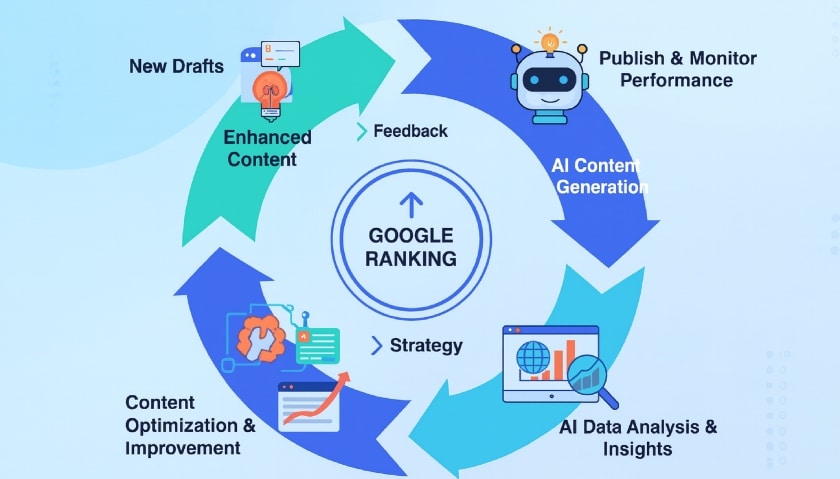
Imagine your content strategy as a circle instead of a straight line. Most people write something, hit publish, and move on to the next topic. That’s the straight line approach and it leaves a lot of value on the table.
A loop works differently. You write content, put it out there, see how people actually use it, then take what you learned to improve it. AI speeds up parts of this process, but the core idea is simple, let your content teach you what works especially as Content for AI Discovery becomes more influential.
Here’s how the circle looks:
The real power shows up when you complete the circle. What you discover in the monitoring phase shapes better research for your next round, especially when supported by a Content audit.

Search isn’t what it used to be. Google now shows AI-generated summaries at the top of results for about 13% of searches. That number keeps climbing. Even more striking people complete 60% of their searches without clicking any website. They get their answer right there on the search page.
This changes everything especially as businesses need to prepare for E-E-A-T in 2026 and new AI-driven ranking behaviors. You can’t just publish something good and expect it to keep working. The landscape shifts too fast.
For Indian businesses, there’s another layer of complexity. You’re dealing with 22 languages, different regional preferences, and markets that behave differently from city to city. Mumbai audiences respond to different things than Delhi audiences. What works in Bangalore might flop in Pune.
A content loop lets you test quickly and adjust based on what actually happens. Instead of guessing what might work across all these variables, you publish, measure, and improve based on real feedback.
Begin with what you already know. Open Google Search Console and look at which searches bring people to your site right now. Those queries tell you what your audience cares about.
Then expand from there. What questions do people ask your sales team? What issues come up repeatedly in support tickets? This stuff matters more than any keyword tool.
Yes, use AI to speed up competitor analysis and topic research. But balance that with real conversations. I’ve seen too many businesses chase keywords that look good in a tool but mean nothing to their actual customers.
Keep it organized. A simple spreadsheet works fine. Track:
This becomes your roadmap especially important as you plan Long-Form vs Short-Form Content depending on intent.
Now you write. Here’s where AI helps, but you need to stay in control.
Let AI handle the first draft, generate outlines, or suggest section headers. That’s fine. It saves time. But here’s what AI can’t do: it can’t add your specific experience. It doesn’t know about that client project where everything went wrong until you tried X approach. It hasn’t talked to your customers.
That’s your job. Take the AI draft and make it yours. Add real examples. Put in actual numbers from your business. Share something your competitors don’t know because they haven’t done what you’ve done.
Write like you talk. Keep sentences short around 15 to 20 words works well. If a paragraph runs more than four lines, break it up. Use bullet points when you’re listing things. This helps readers, and it helps AI systems understand your content better too. This is especially true when applying a RAG-Based Content Strategy for structured updates.
Your content needs to work in three different places now: regular Google results, those AI-generated summaries, and platforms like ChatGPT or Perplexity.
For regular Google, stick with what works:
AI summaries need a different approach. Answer the main question in the first 50 words of each section. Don’t make people hunt for the answer. Put FAQ sections with obvious questions and direct answers. Add schema markup if you can—it helps AI understand how your content is structured.
Think of it this way: you’re writing for both people who read your whole article and people who just need a quick answer.
Publish your content. Then watch what happens. Don’t just check once and forget about it.
Look at these numbers:
Check weekly for the first month. After that, monthly checks work fine. You’re looking for patterns, not obsessing over daily changes. If posts about topic A get way more engagement than topic B, that tells you something.
This is where most people stop and where the real value lives. After two months, sit down with all your data. Actually look at what happened.
Ask these questions:
Take those answers into your next planning session. If certain topics work, do more of them. If something isn’t working, figure out why or cut it loose.
This is the loop closing. What you learned from publishing becomes your research for what to create next.
A digital marketing agency in Delhi and they decided to try this loop approach with five blog posts about local SEO.
After 60 days, they noticed something odd. Their post about Google Business Profile optimization got decent traffic maybe 200 visitors a month. But nobody was booking calls from it. People read it and left.
Meanwhile, a different post about local citation management only got about 100 visitors monthly. Half the traffic. But it generated three times as many consultation requests.
So they made a choice. They took that citation post and expanded it into a full guide. Added specific examples for Mumbai, Bangalore, and Delhi businesses. Created videos showing exactly how to do each step. Basically, they bet on what was already working.
Three months later, that single piece of content brought in 40% of their new clients. Not the post they thought would win. The one the data showed was winning.
That’s why the loop matters. They would have kept pushing the Google Business Profile content if they hadn’t measured and adjusted.
Creating Too Much Content – I see this all the time. People think volume is the answer. It’s not. Five really good pieces beat fifty mediocre ones every single time.
Ignoring Performance Data – You set up analytics, then never look at them. Your data is trying to tell you what works. Listen.
Letting AI Write Everything – Content written entirely by AI sounds like everyone else’s AI content. Generic. Forgettable. Your experience and voice are what make it worth reading.
Forgetting Mobile Users – Most people in India are reading your content on their phones. If it looks terrible on mobile or loads slowly, you’ve already lost.
Skipping the Feedback Loop – This is the whole point. Publish, measure, improve. Not publish and move on.
You don’t need to go all-in on day one. Consistency beats intensity here. Maybe you commit to two pieces per month and spend two hours each week reviewing what’s working. That’s better than publishing ten posts in one week and then nothing for three months.
Get other people involved. Your sales team hears the same questions over and over—those are content ideas. Customer service knows what confuses people that’s more content. Product team knows what features people actually use you get the idea.
Every quarter, look at your whole content library. Update your top performers with fresh information. Delete or combine stuff that’s not pulling its weight anymore. Your library should get better over time, not just bigger.
Setting up a content loop takes some work upfront. But once it’s running, you’ll create less and get better results. You’ll actually understand what your audience cares about instead of guessing. Your decisions will come from data, not hunches.
Start small. Pick one topic. Build your loop around just that topic. Test it. Measure what happens. Adjust based on what you learn. Once you see it working, expand to more topics.
The businesses winning right now aren’t publishing more than everyone else. They’re publishing smarter. They watch what works, do more of that, and cut what doesn’t work.
Your loop can start with your very next piece of content. Make it good. See what happens. Make the next one better based on what you learned.
If you’d rather have someone else handle the technical setup while you focus on running your business, White Bunnie builds AI-powered SEO strategies that work for Indian businesses. We set up the systems, track the data, and help you focus on what’s actually driving results especially in this new era of AI SEO and evolving Content marketing.

Saurabh Garg, the visionary Chief Technology Officer at Whitebunnie, is the driving force behind our cutting-edge innovations. With his profound expertise and relentless pursuit of excellence, he propels our company into the future, setting new standards in the digital realm.
People used to find brands through Google. That’s changing. In 2026, a growing number of buyers start their research by […]
Read Post »
Landing a spot in Google’s AI-generated search results has become a real boost for businesses and creators alike. As Google’s […]
Read Post »
Understanding which search terms actually turn into sales or leads is key to a successful SEO strategy. Too often we […]
Read Post »
Copyright © 2026 White Bunnie -All Rights Reserved