

Entity SEO + AI: Why Entity Optimization is the Key to AI Overviews
-
Author
Saurabh Garg -
Publish
September 19, 2025 11:50 am -
Read Time
6 Min
 Lets talk











Fill in the Form below for a no-string attached free technical discussion.
AI Overviews (also called AI snapshots) are the new answer panels at the top of search results. These overviews are generated by AI SEO technology that scans and summarizes multiple sources to directly answer a query. In practice, this means many searches end without a click to any website. One analysis found over 50% of queries now end with no click. In this environment, just targeting keywords isn’t enough. Your content must be framed as clear, well-defined entities so AI systems can recognize and cite it. This is where strategies like Predictive AI SEO and entity-based optimization become essential.
AI Overviews are AI-generated summaries that appear above the usual list of blue links. For example, Google’s Search Generative Experience shows an “AI Overview” box at the top of the page. It pulls key facts from high-quality pages and displays them as one concise answer. This directly satisfies many searchers – so much so that organic traffic can suffer. Content creators now need visibility inside those AI answers, not just on page two of results. In short, if your content isn’t formatted and recognized by AI systems, it may be skipped over by these overviews.
AI Overviews tend to favor clear, factual content. They often cite bullet points, lists, and tables from pages that answer questions directly. That’s why traditional SEO measures (good content, fast pages, mobile-friendly design) are still vital. But beyond basics, pages should also give AI extra clues via structured data and entity-rich content (explained next). In other words, to get into an AI Overview, you must be an “authoritative entity” on your topic. This aligns with Google’s advice: focus on unique, satisfying content and a good page experience. In this evolving landscape, marketers are comparing AI SEO vs Traditional SEO approaches to understand what works best.
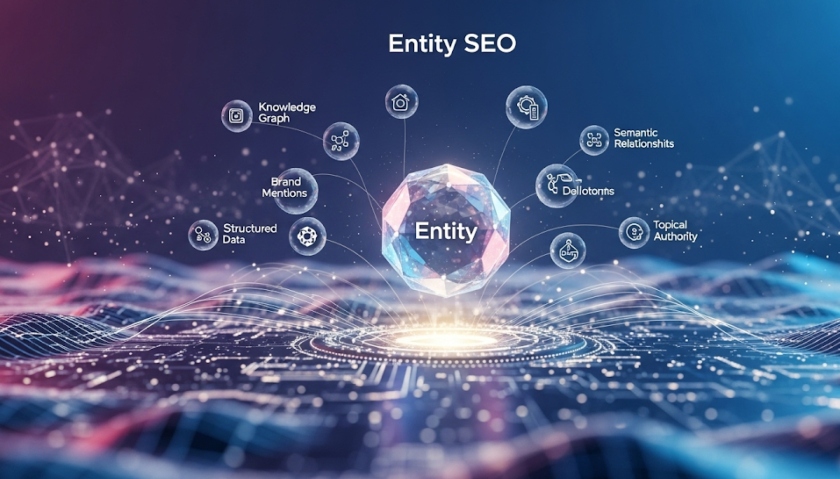
In SEO terms, an entity is any distinct concept or thing a search engine can recognize. It could be a person (Barack Obama), a place (Paris), a product (iPhone 15), or an idea (climate change). Think of entities as nodes in Google’s Knowledge Graph – each with attributes and relationships. For example, “Paris” isn’t just a keyword; it’s linked to entities like “France”, “Eiffel Tower”, and “Louvre Museum” in the graph.
Traditional SEO often optimized for exact keywords (e.g. “best pizza New York”). But with entity SEO, we optimize around a topic and its related concepts. This approach supports SXO (Search Experience Optimization), ensuring users and AI systems both find clear, connected answers.
Entity SEO is about helping search engines see the bigger picture. If a page mentions “cardinals” along with terms like “wildlife” and “conservation”, Google infers the bird. If it mentions “World Series” and “Stan Musial”, it infers the sports team. This contextual understanding makes your content more relevant. In short, entity SEO means building pages around real topics and linking them together, rather than relying on single keywords.

AI Overviews rely heavily on semantic understanding. They don’t just scan for keywords – they read for meaning. Google’s AI and similar models use semantic search, which focuses on the intent and context behind words. Entities play a huge role here. They allow the AI to disambiguate terms and gather facts. For instance, the word “apple” could mean the fruit or the tech company. Entity recognition tells the AI which one you’re talking about.
Because AI Overviews give direct answers, they favor content that clearly defines and relates entities. A recent guide notes that AI systems “think in terms of entities – people, places, things, and concepts.” Optimizing for entities “helps AI understand the relationships between different elements of your content”. In other words, if your page clearly explains an entity (for example, “Golden Gate Bridge” and related facts like location, year built, type), the AI can confidently include it in a generative answer.
Entities also tie into Google’s quality signals. When Google easily recognizes your business or topic as an entity, it boosts trust. One SEO guide explains that clearly identifying your brand or site as an entity “gives Google more confidence” in your content, helping build topical authority and even earning visibility in AI-generated summaries. This matches Google’s emphasis on E-E-A-T (Expertise/Experience, Authoritativeness, Trust). Being a well-known entity makes AI more likely to regard your content as authoritative when compiling overviews.
To get into AI Overviews, optimize your content around entities and structure. Here are key tactics:
Use Structured Data (Schema Markup). Adding schema tells AI exactly what your content is about. A recent guide points out that schema markup “provides explicit clues about your content’s meaning,” helping Google’s AI understand entities and relationships on your site. For example, marking up a page as a Local Business or using FAQ Page schema signals the business entity and Q&A content, which AI can use to build answers. Always test your schema to ensure it’s accurate.
Mention Relevant Entities Naturally. Identify the main entities related to your topic (tools like Google’s NLP API or InLinks can help find them). Include those terms and explain their connections. For example, a travel article about Paris should explicitly mention the city, country, landmarks (Eiffel Tower, Louvre), and nearby attractions. Use clear headings and bulleted lists for key facts. As one AI-overview study notes, content with bullet points and clear sections is more likely to be used. Avoid vague language – name the entity and related terms directly so AI doesn’t have to guess.
Build Topic Clusters and Internal Links. Create dedicated pages for important entities or subtopics, and link them together. For example, a fitness site might have a main “Strength Training” page and cluster pages on “protein intake,” “hypertrophy,” etc. Linking these shows the AI how entities relate. This also builds authority: an interconnected topic cluster signals comprehensive coverage to both Google and AI.
Be Answer-Focused and Readable. AI Overviews love direct answers. Begin sections with clear statements (e.g. an opening paragraph that answers a question). Use short paragraphs and simple language. Studies show AI tools perform better with plain, accessible text. (This also aligns with keeping a high Flesch reading ease.) For example, format FAQs on the page with schema so AI can easily extract question-and-answer pairs.
Maintain Consistent Business Information. If you have a local business, present a unified entity. Keep your Name, Address, Phone (NAP) identical on your site, Google Business Profile, and directory listings. AI Overviews prioritize “businesses with unambiguous identity and coverage (NAP, geo, services)”. Inconsistent info confuses the AI. So double-check hours, services, and categories match across all places.
Monitor and Refine. Finally, treat AI Overviews like a ranking feature. See which of your keywords trigger overviews and whether your pages are cited. Update content regularly, as AI often prefers fresh answers. Track knowledge panels or AI mentions – if Google starts showing an entity panel for your brand, you’re on the right path. If not, adjust by adding more entity context or schema.
To illustrate, consider a local restaurant optimizing for AI. The site includes pages like “Italian Restaurant in Delhi” with a bulleted list of signature dishes, hours, and address. It also has FAQ schema (e.g. “Do you offer outdoor seating?”). Because the restaurant page is clearly marked up as a Restaurant entity and mentions related cuisine entities, Google’s AI can pull facts directly. In one industry survey, restaurant content saw a 387% jump in AI Overviews when sites focused on local food terms and dining guidance. Similarly, travel sites that highlight destination entities saw overviews rise 381%. These real-world results show that tailoring content to entities and structured answers can dramatically increase AI visibility.
Entity-focused SEO is no hype – it’s simply how AI-powered search works today. By treating your topics as entities with clear details, you make it easy for generative AI to find and trust your content. In practice, this means using schema markup, writing about connected concepts, and giving straightforward answers. Google still values quality content and a good page experience, but it now ties that content into a web of entities.
For SEOs and content creators, the message is calm but clear: build content around topics, not just keywords. White Bunnie recommends starting with solid fundamentals (good content, mobile-friendly pages) and layering on entity signals. When your site is seen as a well-defined entity in its niche, AI Overviews will naturally look to you for answers. In the age of AI search, entity optimization is how you stay visible and authoritative – making sure your content appears right where searchers are getting their answers.

Saurabh Garg, the visionary Chief Technology Officer at Whitebunnie, is the driving force behind our cutting-edge innovations. With his profound expertise and relentless pursuit of excellence, he propels our company into the future, setting new standards in the digital realm.

VPNs (Virtual Private Networks) have become essential tools for ensuring online privacy, bypassing geographical restrictions, and securing data. While HideMyAss […]
Read Post »
Want your products to show up when someone asks ChatGPT what to buy? Here’s how to make that happen. TL;DR […]
Read Post »
Remember the days when finding a doctor meant asking your neighbors or flipping through the Yellow Pages? Well, times have […]
Read Post »
Copyright © 2026 White Bunnie -All Rights Reserved