

The 2026 GEO Benchmark Report: Key Insights Into AI Citation Trends
-
Author
Ankit Sain -
Publish
June 30, 2026 11:46 am -
Read Time
12 Min
 Lets talk










Fill in the Form below for a no-string attached free technical discussion.
Quick Summary
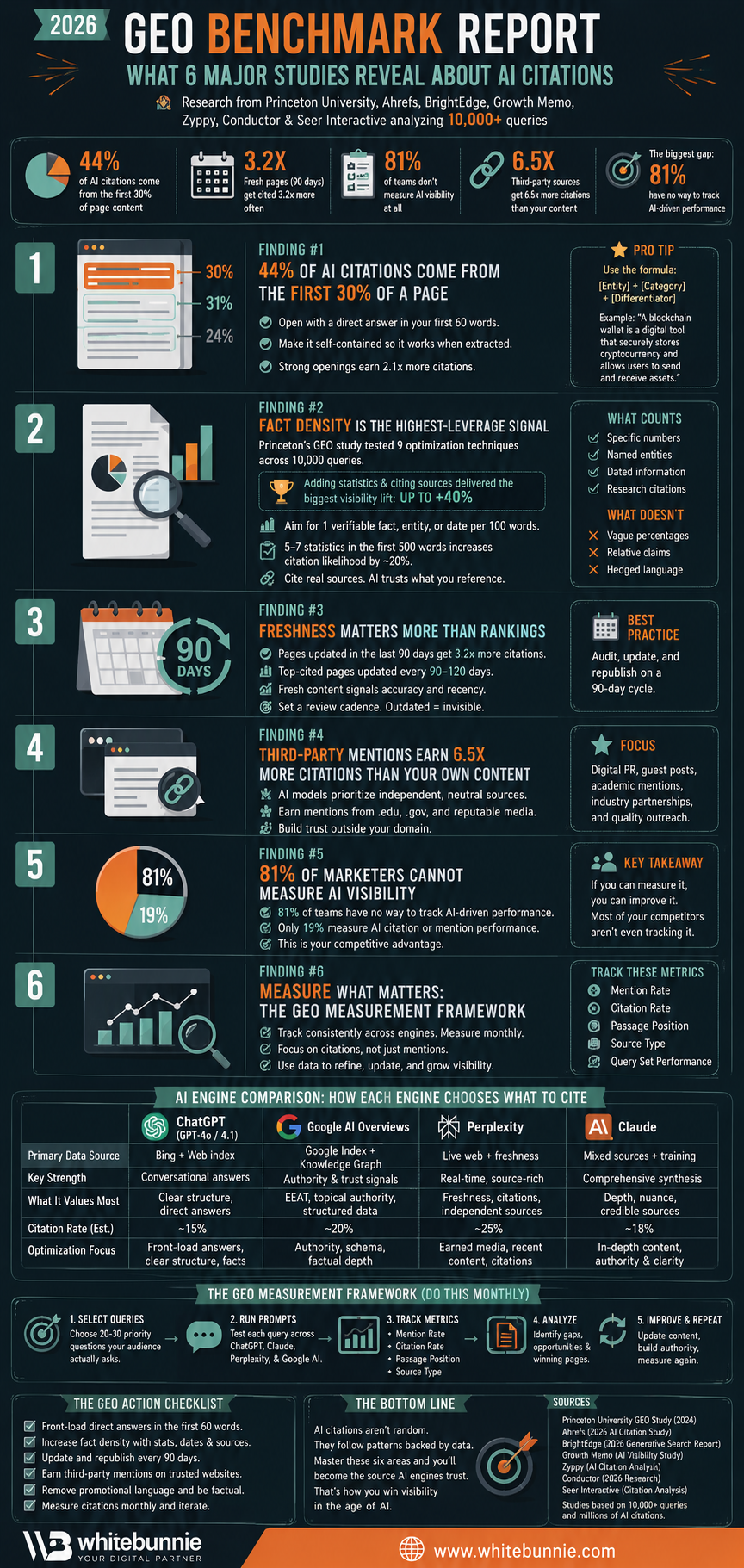
- Nearly 44% of citations AI models pull come from your first 30% of page content.
- Fresh pages updated in the last 90 days get cited 3x more often.
- Most teams use AI for content, but only 1 in 5 measure whether it works.
- Third-party sources get cited 6.5x more than brand-owned content.
- The biggest gap: 81% of teams have no way to track AI-driven performance at all.
When Google started ranking websites in 1998, search visibility became a business asset. AI citation operates differently. Your page doesn’t need to rank number one on Google anymore; it needs to appear in ChatGPT’s answer, show up when someone asks Perplexity a question, or be selected for Google’s AI Overview. And that’s a different game entirely, one we explore in depth in our guide on SEO vs. AEO vs. GEO.
We’ve been tracking AI citations for eighteen months at White Bunnie through our dedicated AI SEO services. What we found surprised even us: a brand can rank poorly on Google for a query and still own the AI answer. Conversely, pages ranking in Google’s top three sometimes never get mentioned by any AI engine.
The Princeton University research from 2024, expanded by subsequent studies from Growth Memo, Zyppy, and Ahrefs analyzing millions of citations, reveals patterns that now shape how smart teams build content. These patterns are consistent across different studies, different engines, and different industries.
Here’s what the data actually shows.
Your first 500 pixels matter more than everything below them.
Research analyzing citation behavior across multiple AI engines found that roughly 44.2% of all citations come from the first 30% of a page (the introduction plus the first major section). Another 31.1% come from the middle, leaving just 24.7% from conclusions.
This matters because it tells you where to spend your effort.
Real-world example: We audited a financial services page that explained cryptocurrency taxation. The introduction gave background and context. The actual answer started in paragraph four. That page received mentions but zero citations from AI engines. We moved the direct answer to the opening 60 words. Citations tripled within six weeks.
Pages with strong, claim-rich introductions earn about 2.1x more citations than pages with weak openings. The mechanism is straightforward: AI models use retrieval techniques that weight early, self-contained content heavily. If your answer sits in paragraph four, the model may never surface it.
The pattern works because AI models need to extract passages that make sense when removed from surrounding text. “In today’s fast-moving landscape” makes no sense alone. “Bitcoin transactions require digital signatures” does. This is the same logic behind our recent breakdown of Answer Engine Optimization.
Numbers and sources lift citation probability more than anything else.
The Princeton GEO paper tested nine different content techniques across 10,000 queries. Adding statistics and citing sources showed the single largest effect: a visibility lift of up to 40%. That’s not incremental. That’s game-changing.
Later analysis by Seer Interactive and BrightEdge examining thousands of cited vs. uncited pages found a clear pattern: pages with five to seven statistics in their first 500 words earned roughly 20% higher citation likelihood. Pages with one statistic every 200-300 words did not.
| Citation Signal | Effect Size | Difficulty in Implementing | ROI | Research Source |
|---|---|---|---|---|
| Front-loading (First 30%) | +44.2% citations | Very Easy | Very High | Growth Memo, Zyppy |
| Fact Density (5-7 stats) | +20% likelihood | Easy | High | Seer Interactive, BrightEdge |
| 90-Day Freshness Cycle | 3.2x more citations | Easy | Very High | SE Ranking, Conductor |
| Off-Site Trust Signal | 6.5x vs owned | Medium | Highest | Ahrefs 2026 |
| H1→H2→H3 Structure | 68.7% usage rate | Very Easy | Medium | BrightEdge 2026 |
| Depth (20,000+ chars) | 4.3x citations | Medium | High | Conductor |
| Promotional Tone Removal | -26% penalty | Easy | High | 2026 Analysis |
The practical threshold: Aim for at least one verifiable statistic, named entity, or specific date per 100 words.
Structure compounds the effect. One 2026 analysis found 68.7% of cited pages used a strict H1 → H2 → H3 heading hierarchy. Another found roughly 61% used structured data markup (schema.org), a discipline that overlaps closely with our technical SEO services. This isn’t about aesthetics; it’s about machine readability. Clear hierarchy helps AI models understand your content, identify claims, and extract relevant passages.
Depth matters if it’s substance. Pages above 20,000 characters earned around 4.3x more citations, but this effect only held when the length contained actual information, not repetition. A 5,000-word guide packed with data outperforms a 25,000-word guide that pads thin concepts. This is exactly the kind of topical depth we map out in our piece on building a topical authority strategy.
The counter-intuitive finding: Promotional tone correlates negatively with citations (about minus 26%). AI engines extract answers, not advertisements. Sales-focused language repels citations even when it converts human readers. Write to inform. Let the trust signal the credibility elsewhere.
Content older than three months decays in citation probability. Content under 90 days stays competitive.
Multiple independent analyses found this pattern holds across engines: AI-cited content is roughly 25.7% fresher than traditional organic search results. Content under three months old receives approximately 3.2x more citations than pages left untouched for six months or longer.
The mechanism: When multiple sources cover the same topic, AI models prioritize the newest. This makes sense for fast-moving domains (technology, markets, regulations) but applies even to evergreen topics. The visible freshness signal—a dateModified tag, a refresh timestamp—tells the model this information was recently validated.
This isn’t about rewriting. A 2025 study tracking citation behavior before and after refreshes found that adding current data and one new paragraph reset freshness signals enough to maintain or improve citation rates. Full rewrites showed no additional benefit. We run this same cadence for clients through our SEO audit services.
Real-world impact: We managed a B2B SaaS blog where a page comparing payment processors received zero citations despite ranking on page two for its primary keyword. After a 90-day refresh adding 2025 processor pricing and new features, it appeared in Claude’s response within three weeks. Nothing else changed, not the headline, structure, or primary thesis.
This one stings.
Brands get cited via third-party sources between 4x and 6.5x more often than from their own domain, depending on the analysis. One 2026 benchmark put it precisely: for every citation from a company’s own site, it received 6.5 citations from earned media, reviews, publications, and community platforms.
An Ahrefs analysis of millions of AI prompts found that over 85% of non-paid citations originated from earned media. The Trust signal trumps the Brand signal.
AI models stake their credibility on every citation they make. When they cite you from your own website, they take the risk if your information is wrong. When they cite you from The New York Times or a peer-reviewed study mentioning you, that publication’s reputation backs the claim. Independent corroboration reduces the engine’s risk.
This flips conventional content strategy on its head. Teams that spend 90% of their resources on blog production and 10% on earned media placement are optimizing the weaker lever.
Every cornerstone content asset needs earned media paired with it.
Real-world example: One technology company published original research on AI training methods. Their own white paper received four citations across major AI engines. When three tech publications covered that same research (with links back to the original), the citation count jumped to 34 across the same engines.
Here’s what should actually change your strategy: 91% of marketing teams use AI in content production. Only 19% track whether it works.
More than 80% have zero framework for measuring whether AI generates results or merely generates content.
This is your competitive moat.
When competitors optimize blindly, measuring gives you a compounding advantage. You’ll know:
They’ll guess. For a deeper look at which platforms to prioritize, see our roundup of the best LLM tracking tools for measuring AI search visibility.
| Engine | Primary Index | Citation Rate | Authority Weight | Best Focus Area | Competitive Edge |
|---|---|---|---|---|---|
| ChatGPT | Bing (not Google) | ~15% of pages | High | Bing indexation + clear structure | Few optimize for Bing |
| Perplexity | Independent crawl | Variable | Medium-High | Freshness + earned media | Aggressive recency window |
| Google AI Overviews | Google index | 5-15 pages | Very High | EEAT + Knowledge Graph | Entity infrastructure |
| Claude | Multiple sources | Variable | High | Comprehensive + authoritative | Newer, less optimized |
A complete GEO program addresses all three because your buyers might use any of them. But the engine your primary audience uses should receive disproportionate focus.
The measurement framework is simpler than you’d expect:
That’s it. Sixty minutes of work per month. Most tools can automate this—your team just needs to look at the data.
Real-world example: We tracked these metrics for a mid-market software company. Within four months, the data showed that product comparison pages got mentioned frequently but never cited (readers searched them but AI didn’t extract answers). Methodology explainers got cited consistently. The team redirected editorial effort accordingly. The share of the model doubled in six months. Without measurement, they would have kept producing comparison content.
ChatGPT, Perplexity, and Google AI don’t weight signals equally.
Citation overlap between engines is low; only about 11-12% of cited sources match across ChatGPT, Perplexity, and Google AI Overviews for the same query. ChatGPT overlaps with Google’s top-10 results only 6.82% of the time. This means excellence on one engine doesn’t transfer.
ChatGPT relies on the Bing index (not Google’s) and cites roughly 15% of the pages it retrieves. This means high Bing indexation and extractable page structure matter most. Pages with clear, data-rich passages that work in isolation tend to perform here.
Google AI Overviews use Knowledge Graph entities and apply stricter E-E-A-T evaluation (Experience, Expertise, Authority, Trustworthiness) – a topic we cover closely in E-E-A-T in 2026. Entity infrastructure knowledge panels, structured data, and verified authoritative information weigh heavily.
Perplexity shows aggressive recency bias and credits earned media more than owned domains. Fresh research, recent developments, and third-party mentions get prioritized.
You don’t need consultants for this. The method is fully replicable.
Choose queries where your content should answer the question. These should be:
Example for a SaaS project management tool:
This matters: Don’t just track citations. Connect them to leads, demo requests, or sales conversations that mention discovering you through AI engines. This linkage proves GEO’s business value and justifies continued investment.
Real-world example: One B2B marketing agency tracked citations for three months, then added a survey question: “How did you hear about us?” They found 23% of qualified leads mentioned discovering them through AI engine answers. That 23% had a 34% higher close rate than cold leads.
Taking these findings together, they compress into six operational priorities:
1. Front-Load Answers: Lead every page, every section with direct, self-contained answers. No background. Not context. The answer.
2. Engineer Density: Minimum one statistic per 100 words. Aim for five to seven in cornerstone content. Use named entities, dates, and research citations. Remove hedging language.
3. Refresh Quarterly: Set a 90-day calendar for cornerstone pages. Update data, add recent developments, change the dateModified. It takes 90 minutes per page.
4. Build Earned Media: For every major content asset, develop a parallel earned media strategy. Which publications should mention this? Which journalists should see it? Which communities would find it valuable?
5. Cut the Sell: Write to inform. The promotional language doesn’t work on AI engines. It works on humans. Choose one audience for each piece.
6. Measure Now: Start your GEO tracking today. The competitive advantage isn’t in having better tools than rivals—it’s in measuring at all while most don’t. Twenty queries, twelve months of data, two hours per month. That’s your edge.
The 2026 GEO research converges on a simple insight: AI discovery surfaces different content than Google search.
Google search has developed over 25 years with millions of websites optimizing for it. We’re maybe two years into AI-powered answer engines. The teams still optimizing Google while ignoring AI are fighting yesterday’s battle. The teams measuring AI while optimizing blind are fighting today’s battles without knowing the score.
The brands that win in 2026 don’t have better content; they have measurable content strategies. They know what works because they measured it. That’s it.

Ankit Sain is an SEO specialist with over 6 years of hands-on experience in driving organic growth through data-driven and AI SEO strategies. He helps businesses improve visibility, rankings, and conversions with sustainable search solutions.

Google I/O is the annual developer conference where Google unveils its latest innovations, software features, and futuristic technologies. In 2025, […]
Read Post »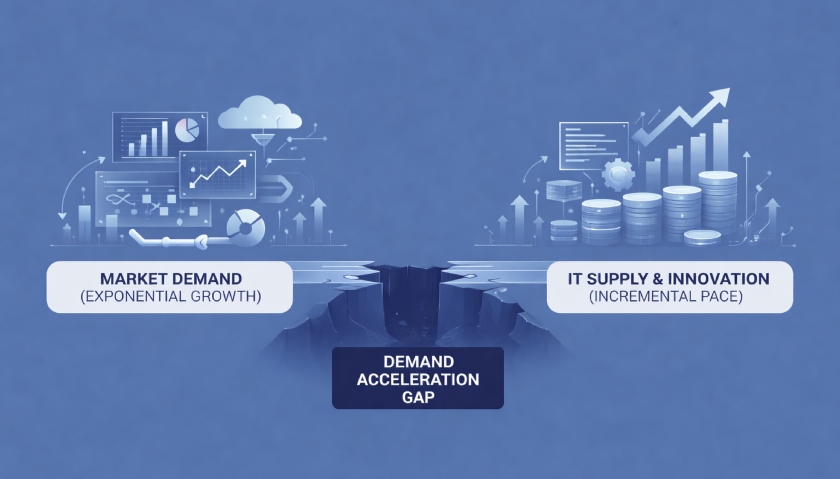
Many IT companies find themselves grappling with a demand acceleration gap, the shortfall between the demand they need to achieve […]
Read Post »
Have you ever searched for a well-known person, a local business, or a big brand on Google and noticed a […]
Read Post »
Copyright © 2026 White Bunnie -All Rights Reserved