

The Demand Acceleration Gap in IT Companies & How SEO Fills It

  • Author
    saurabh garg
  • Date
    January 8, 2026
  • Read Time
    10 Mins
blog-featured-image

TABLE OF CONTENTS

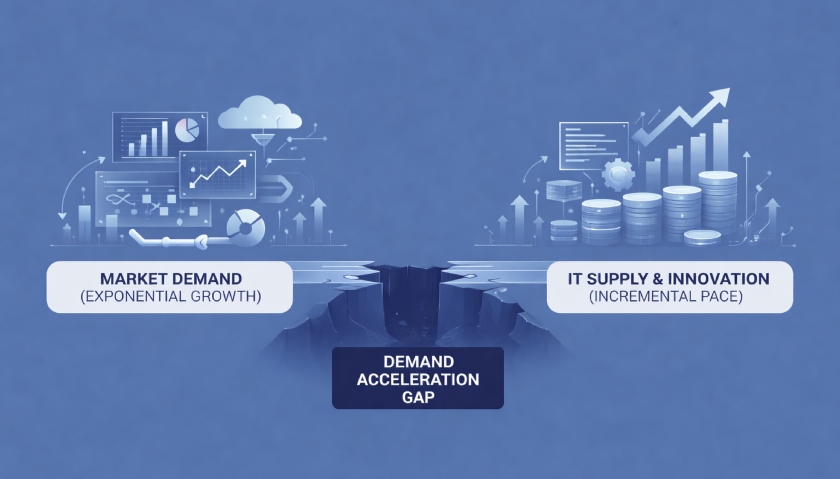
    Many IT companies find themselves grappling with a demand acceleration gap, the shortfall between the demand they need to achieve growth and the demand their current marketing generates. In simpler terms, it’s the gap between potential customers out there looking for solutions and the leads actually captured in your pipeline. This challenge is especially pronounced for B2B IT firms in India and globally, where long sales cycles and multiple decision-makers mean you can’t afford to let any interested buyer slip through. The good news is that SEO (Search Engine Optimization) can play a pivotal role in closing this gap. By making your company more visible and credible online, SEO helps fill your funnel with high-quality leads at a faster pace. This blog will explore why the demand acceleration gap exists in IT companies and how a smart SEO strategy can bridge it.

    Understanding the Demand Acceleration Gap in B2B IT

    In the B2B tech world, there’s often a mismatch between buyer interest and seller outreach. Marketing experts describe a demand gap as “the difference between the demand available in the market and the demand you actually see in your funnel”. Even if there are many companies looking for your IT solutions, you might only be engaging a fraction of them. For instance, a Deloitte study found that only 20% of B2B sellers feel prepared for the future leaving a vast gap between modern buyer expectations and what companies offer. This gap can result from several factors:

    • Traditional tactics losing effectiveness: Many Indian IT companies have long relied on cold calls, trade shows, and networks. But these methods alone can’t capture today’s digital-first buyers. If your outreach isn’t where buyers are looking, a demand gap grows.

    • Buyers doing independent research: Modern B2B buyers like to self-educate. Nearly 72% start their research online and review about 11 pieces of content on average before ever contacting a vendor. If your content isn’t part of that research journey, you’re missing out on their consideration.

    • Long, complex buying cycles: IT purchases often involve multiple stakeholders and months of deliberation. In fact, B2B tech purchases typically involve 6 to 10 stakeholders and 80% of buyers don’t reach out until they’ve completed ~70% of their buying journey. Without engaging content to nurture them during this process, interest can fade – creating a gap between initial demand and a closed deal.

    • Competitive market noise: India’s IT industry is highly competitive, from giants like TCS and Infosys to agile SaaS startups. Buyers have more choices and consider 62% more brands than they did a few years ago. Standing out requires being present and persuasive wherever buyers are looking. If your competitors are visible online and you’re not, the gap widens in their favor.

    In short, the demand acceleration gap boils down to lost opportunities interested prospects who never find you, or find you too late. Closing this gap means meeting buyers on their terms: providing the information and trust signals they need, when they need them. That’s where an SEO-driven approach to B2B marketing comes in.

    The B2B Marketing Challenge for IT Companies

    Before diving into SEO, it’s worth clarifying why B2B marketing (especially for IT companies) is a different beast. B2B buyers are professional problem-solvers searching for specific solutions, and their journey is research-heavy:

    • Multiple decision-makers: As noted, an IT purchase might go through half a dozen stakeholders or more from engineers to CFOs. Your marketing must win the confidence of all of them. This requires credible, in-depth content (technical specs, ROI cases, etc.) that speaks to varied concerns. It’s not easy to accelerate demand when you must convince a crowd, not just one person.

    • High stakes and scrutiny: Businesses investing in software or IT services take their time to avoid mistakes. Nearly 63% of leads take over 3 months to decide, and 20% take more than a year. Such drawn-out cycles mean you need a steady stream of nurturing content to keep your brand top-of-mind. Any lull, and a competitor’s content might swoop in to influence the decision.

    • Buyers trust content over sales pitches: Interestingly, 85% of B2B decision-makers trust organic search results more than paid ads. They actively seek out unbiased information in blog articles, whitepapers, case studies rather than rely on what a salesperson says at first. If your company hasn’t built up a library of trustworthy content online, you may not even make the shortlist. (On the other hand, ranking high on Google for relevant queries instantly lends your brand credibility.)

    • Digital shift in B2B: By the end of 2025, an estimated 80% of B2B sales will happen through digital channels. The share of revenue B2B companies generate online is projected to reach 56% in 2025 (up from just 32% in 2020). This trend is strong in major markets like India, where younger, tech-savvy procurement teams prefer to self-serve their buying journey. In fact, a majority of B2B buyers (including in India) now prefer a rep-free buying experience and only contact sales when absolutely necessary. For IT providers, this means your website is now your primary sales rep available 24/7 to inform and impress potential clients. If that rep (your site and content) isn’t up to par, you’ll feel the demand gap.

    All these factors create a perfect storm: IT companies must market smarter and provide value online or risk falling behind. The traditional sales-driven approach alone can leave a lot of latent demand untouched. This is why B2B SEO and content marketing have moved to the forefront as demand-generation engines. Let’s see how SEO specifically can turn the tide.

    How SEO Bridges the Gap and Accelerates Demand

    Search Engine Optimization is often thought of as a way to increase website traffic, but for B2B companies it’s really about capturing demand and driving pipeline. SEO ensures that when potential customers search for solutions, they find you and not just your competitors. Here are several ways SEO helps fill the demand acceleration gap for IT firms:

    • Capturing Active Search Demand: Every day, potential B2B buyers are searching for answers to their pain points “best cloud security provider in India”, “ERP solution for manufacturing”, and so on. Over two-thirds of B2B researchers begin with a Google search. If your site ranks for those queries, you tap into existing demand that might otherwise bypass you. SEO is about making sure your company shows up wherever relevant demand exists. As one marketing report put it, having a “good handle on the search terms that lead to solutions like yours is a perfect place to start” capturing outside demand. In practice, this means researching the keywords your prospects use and creating content that answers their questions. By doing so, you intercept interested buyers right at the moment they need help.

    • Building Credibility and Trust: Appearing in top organic search results not only drives traffic, it builds trust. Buyers know that ranking on the first page of Google is earned, not bought, so it carries authority. And as noted, decision-makers trust organic results far more than ads. By investing in SEO, you essentially earn endorsements from search engines that your content is relevant and valuable. High-quality content (blogs, guides, case studies) optimized for SEO serves a dual purpose: it educates your audience and signals that your company is a knowledgeable player in the field. This credibility is crucial in B2B marketing, where a single deal can be worth millions and no one wants to make the wrong choice.

    • Aligning with the Buyer’s Journey: SEO-driven content allows you to map to every stage of the B2B buyer journey, closing gaps along the way. Early in the cycle, a CTO might search for “advantages of AI in supply chain” your informative blog or white paper on that topic can introduce your brand and capture the lead. Later, her team might compare specific solutions, your SEO-optimized product pages or case studies can influence that evaluation. By the time the buyer is ready to talk, they may have seen your brand repeatedly in search results, read your insights, and come to trust your expertise. Remember, 80% of buyers reach out only after two-thirds of their journey is done. SEO ensures you’re present during that silent research phase, guiding prospects toward your solution. This accelerates demand by shortening the leap from initial interest to serious consideration, the buyer is already educated and warmed up by your content.

    • Generating Higher-Quality Leads at Lower Cost: One powerful aspect of SEO is that it pulls in people actively looking for what you offer. These leads often have higher intent and convert better than those procured via cold outreach. And while SEO requires investment, it tends to have a compounding ROI. Recent industry data shows that B2B SaaS companies average a 702% ROI on SEO, with a breakeven in just ~7 months. In other words, every dollar put into quality content and optimization can return sevenfold in the form of organic leads and sales. Moreover, a survey in 2024 found 91% of marketing leaders reporting that SEO positively impacted their marketing goals. These aren’t short-term vanity metrics; they’re talking about pipeline and revenue. By consistently publishing optimized content, you build an always-on lead engine. Unlike paid ads that stop when the budget is paused, SEO content keeps attracting visitors month after month. This sustainable influx helps close the demand gap because you’re not constantly starting from scratch to find new leads; they’re finding you organically.

    • Accelerating Pipeline Velocity: The goal isn’t just more leads, but faster movement from interest to decision. Here, too, SEO has an edge. Studies indicate that focusing on SEO can drive 37% faster growth in marketing-qualified leads (MQLs) compared to relying on ads alone. Why? Organic leads often self-qualify by consuming your content, and they come in with a base level of knowledge. Sales teams can engage these leads in more informed, productive conversations, speeding up the sales cycle. Think of SEO as greasing the wheels of your funnel prospects slide through smoother because they’ve been nurtured by the content they found via search.

    • Leveling the Playing Field (Global and Local Reach): For Indian IT companies aiming to win business internationally, SEO is a great equalizer. A smaller firm in Bengaluru can outrank a global giant on a specific solution keyword if they execute a smart SEO strategy. This opens doors to markets and clients that cold calling or local sales reps would struggle to reach. For example, a niche SaaS provider from India might rank #1 for “cloud project management for fintech,” landing inquiries from fintech companies worldwide. That’s net new demand captured purely through online visibility. Conversely, if your strategy is more local (say, targeting Indian enterprises), local SEO techniques ensure you show up in location-based searches. An IT services company in Mumbai could optimize for “ERP implementation Mumbai” and dominate that local search niche, capturing demand in its own backyard. In both cases, SEO broadens your accessible market and fills your pipeline beyond the limits of your direct sales network.

    Real-World Example: From Chasing to Attracting Leads

    To illustrate the impact, consider a real-world example. White Bunnie recently worked with a mid-sized tech provider that had a classic demand acceleration gap. They were heavily reliant on cold emails and referrals and struggled to hit their lead targets. We helped pivot their strategy to make SEO and content the cornerstone of their marketing. The results were transformative. One case study from a similar initiative showed a 700% jump in inbound leads after committing to consistent SEO-driven content. The company went from chasing prospects to having prospects flow in steadily. “Cold emails and unanswered calls became a thing of the past. Instead, we had leads pouring in through our website,” the team noted, once they climbed to the top of search results in their niche. This kind of growth isn’t an anomaly; it’s what happens when pent-up demand in the market finally finds an easy path to your door.

    Crucially, these were high-intent leads coming via Google searches, which meant they converted at a higher rate than any leads from earlier campaigns. The sales team could spend time closing deals rather than prospecting, accelerating the company’s overall growth. This example underscores a broader point: when you align SEO with B2B demand generation, you essentially unlock a floodgate of opportunities that were previously passing you by.

    Closing the Gap with Calm Confidence

    Bridging the demand acceleration gap isn’t about overnight tricks or overly aggressive marketing – it’s about a steady, strategic approach that meets buyers where they are. SEO is a natural fit for this philosophy. It doesn’t scream for attention like an ad; instead, it quietly ensures your expertise is visible when someone seeks it. By using clear, direct language and genuinely helpful content (exactly what Google rewards), you not only please the search algorithms but also earn the trust of potential clients.

    For IT companies in India and beyond, the path forward is clear. The B2B landscape is only becoming more digital and self-driven. In 2024 and 2025, organic search accounted for roughly one-third of all website traffic on average and that share will likely grow as more buyers prefer to do their own research. Companies that invest in SEO are positioning themselves to capture this organic demand. Those that don’t will keep feeling the strain of that demand gap the sluggish pipeline, the missed deals that went to a savvier competitor who showed up in search results.

    At White Bunnie, we have seen first-hand how a solid SEO and content strategy can transform B2B marketing outcomes. It takes patience and quality execution, but the payoff is a consistent pipeline and accelerated growth. The demand acceleration gap is very real in many IT companies, but it’s also a gap that can be filled. By leveraging SEO to its fullest from technical website optimizations to publishing valuable content regularly you ensure that when the market is looking for solutions, your company is front and center. In the end, filling this gap isn’t about hype or buzzwords; it’s about being present, being credible, and being helpful. Do that, and demand generation shifts from a constant uphill push to a more natural pull with qualified leads coming to you. That is the calm, confident way to accelerate growth in the digital age.

    Key Takeaways

    • Demand acceleration gap: the shortfall between market demand and your captured leads. It’s common in B2B IT due to changing buyer behavior.

    • B2B buyers go digital: Around 71–72% of B2B buyers start with online research, often via Google. If you’re not visible online with useful content, you’ll miss out on many potential deals.

    • SEO builds pipeline: Over 76% of B2B marketers rank SEO as their top traffic strategy, and for good reason. It delivers trust (85% prefer organic results) and high ROI (hundreds of percent in many cases).

    • Indian IT firms benefit: SEO lets Indian companies reach global clients searching for solutions, leveling the field. It also helps capture local demand by dominating relevant niche keywords.

    • Focus on content and intent: By aligning content to what your buyers seek at each stage, SEO helps move prospects along faster. Companies using SEO report faster lead growth and positive impacts on revenue.

    • Not an overnight fix, but a lasting one: AI SEO is a long-term play. It requires consistency and quality. But once momentum builds, it creates a sustainable inbound engine that accelerates demand generation calmly and steadily.

    By understanding and addressing the demand acceleration gap with an SEO-driven mindset, IT companies can ensure they are not just keeping up with the market, but leading the charge in the domains where their customers are actively looking. In today’s environment, that makes all the difference.


    RELATED ARTICLES

    Change The Way You Engage With Your Audience

    Get In Touch With Our Highly Skilled Digital Boost Your Website Rankings.

    get-touch

    Get In Touch

    Use the form below and we’ll get back to you ASAP


      Building Digital Success Stories Since 2018

      Powered by Creativity. Connected With Cities Worldwide.

      Ask AI about White Bunnie
      Scroll to Top