
SEO vs. AEO vs. GEO: A Complete Comparison Guide for B2B IT Companies (2026)
-
Author
Neha Garg -
Publish
April 22, 2026 1:03 pm -
Read Time
7 Min

 Lets talk










Fill in the Form below for a no-string attached free technical discussion.
TL; DR
- SEO vs. AEO vs. GEO are not competing strategies. Rather, they are three layers of modern digital visibility.
- SEO helps your website to rank on Google and other search engines.
- AEO (Answer Engine Optimization) ensures that your content is picked as a direct answer by the AI systems.
- GEO (Generative Engine Optimization) ensures that your brand is cited and recommended by AI platforms like Perplexity, ChatGPT, and Gemini.
- SEO still remains the foundation. Without it, AEO and GEO cannot perform effectively.
- The real opportunity lies in integrating all the three into a single cohesive strategy.
If you have been working in the area of B2B marketing – even briefly – you have probably noticed how frequently these three terms come up: SEO, AEO, and GEO. They are often used interchangeably, sometimes positioned as replacements, and almost always surrounded by more confusion than clarity.
So let us simplify this.
For B2B IT companies targeting international markets like the UK, US, or Canada, this distinction is no longer theoretical. It directly impacts how the buyers find, evaluate, and shortlist vendors.
Before we dive deeper into each of the concepts, it is really important to understand why SEO vs. AEO vs. GEO has become such a critical discussion now in 2026.
B2B buyer behavior has changed fundamentally.
Earlier, a typical journey looked like this:
Today, the journey is far more compressed and fairly AI-driven:
In several cases, buyers are forming opinions before they even land on your website.
That means:
You need to be optimally visible, extractable, and trustworthy across multiple layers.
That is exactly where SEO, AEO, and GEO come in.
To understand the full picture, it helps to start with the basics. What is SEO and how does it actually work?
Search Engine Optimization (SEO) is the process of improving the visibility of your website in traditional search engine results.
Despite the rise of AI, SEO remains the foundation of digital presence.
When someone searches for:
SEO determines if your website appears at the top – or happens to get lost in the noise.
SEO works exceptionally well – for traditional search.
But here is the catch: If a buyer asks ChatGPT:
“Which IT companies in India are best for Fintech app development?”
Your Google ranking does not guarantee visibility there. In fact, with AI Overviews now dominating the top of search results, even well-ranking pages are seeing fewer clicks than before.
This is the gap where AEO and GEO step in.
Answer Engine Optimization (AEO) is the natural evolution of SEO in an AI-first world of today’s time.
Instead of focusing purely on the rankings, AEO focuses on answerability.
This shift may appear to be small – but it completely changes how content is being created.
For AEO for B2B IT companies, this is critical because buyers now ask fairly complex, intent-driven questions like as:
With AEO, your content does not just rank – it also gets used.
And in an AI-driven environment, being used matters more than being seen.
Generative Engine Optimization (GEO) is the newest and most strategic layer in this ecosystem.
While AEO focuses on content structure, GEO focuses on brand authority and trust.
SEO helps your website rank.
GEO helps your brand get recommended.
When AI engines generate responses, they do not just rely on your website. They pull from a vast network of signals across the internet.
In B2B, decisions are high-value and at the same time, high-risk. AI engines tend to recommend brands that appear consistently credible across multiple sources.
That means even if your content is excellent (AEO), you may still not get recommended without GEO.
One of the biggest prevailing misconceptions in digital marketing today is treating these as separate strategies.
They are not.
They are actually the layers of the same system:
In fact, a significant portion of AI-generated answers still relies on top-ranking pages – proving that SEO and AEO are deeply interconnected.
Not every company needs to tackle all the three layers at once. The right starting point depends on your current visibility.
Start with SEO:
Without this foundation, AEO and GEO have nothing to build on.
This is a common scenario now in 2026.
You have done SEO right – but AI Overviews are reducing the clicks significantly.
The solution to this is to add AEO.
This is where most established companies are today.
The solution is to focus on GEO.
We are no longer living in a world where ranking on Google guarantees visibility.
The buyers of today’s time:
This means your strategy must necessarily evolve.
You do not just need traffic.
You need presence across the entire decision-making journey.
By aligning SEO, AEO, and GEO into a unified approach, you are not just improving rankings – you are building trust, authority, and influence.
And in a competitive B2B IT landscape, that is what truly drives growth.
Not at all. SEO is still the foundation. However, it now works alongside AEO and GEO to cover the full buyer journey.
AEO focuses on content structure for the purpose of AI extraction. GEO focuses on brand authority for AI recommendations.
Which is more important – AEO or GEO?
Both are considered to be highly essential. AEO ensures your content is usable, while GEO ensures that your brand is trusted.
The simplest way is to run an AI visibility audit and search for your services on ChatGPT, Google, and Perplexity.
White Bunnie offers a free AI Visibility Audit for B2B IT companies, helping you to understand your current position across SEO, AEO, and GEO, and what to prioritize next.

Neha founded White Bunnie in 2018. The agency specializes in SEO, AEO, and GEO for B2B IT services, SaaS, and ITES companies targeting global markets. Their work has helped brands move from zero visibility to consistent AI citations across various popular AI platforms like ChatGPT, Perplexity, and Gemini.
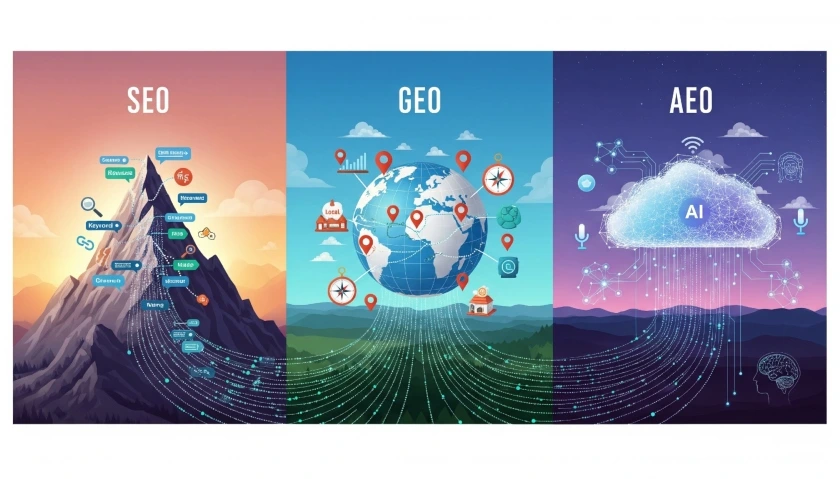
In 2025, being seen online is about more than Google rankings. Brands like White Bunnie now need to consider SEO, […]
Read Post »
A strong SEO strategy is important for the success of an ecommerce website. Whether you’re just starting out and planning […]
Read Post »
When an AI model gives you an answer, that answer didn’t come from nowhere. Behind every response is a web […]
Read Post »
Powered by Creativity. Connected With Cities Worldwide.
Copyright © 2026 White Bunnie -All Rights Reserved