
SEO vs GEO vs AEO — Which Matters Most in 2025?
-
Author
Saurabh Garg -
Publish
September 11, 2025 6:09 am -
Read Time
8 Min
 Lets talk









Fill in the Form below for a no-string attached free technical discussion.
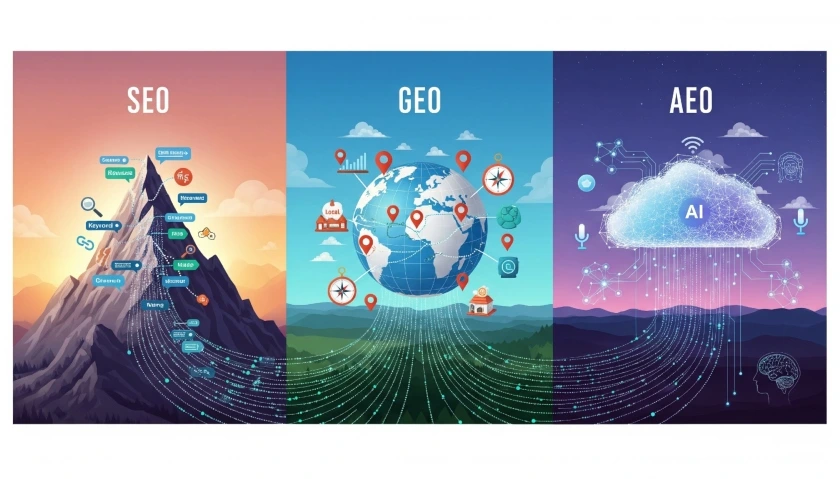
In 2025, being seen online is about more than Google rankings. Brands like White Bunnie now need to consider SEO, AEO and GEO. Each helps users find answers in a different way. SEO means ranking pages on search engines. AEO means appearing in Google’s answer boxes (featured snippets). GEO means writing answers that AI assistants (like ChatGPT) will quote.
These methods overlap but work differently. SEO brings visitors by ranking pages. AEO shows answers on Google’s page (often boosting clicks). GEO can get your content quoted by an AI assistant.
SEO: Make your site rank higher on Google. Use keywords, links, and a clear structure.
AEO: Win Google’s answer boxes. Write short answers with lists or FAQs so Google can feature them.
GEO: Get AI to cite you. Write clear answers so chatbots like ChatGPT will quote your content.
They all aim to help users find your content. But success looks different. For SEO, success means high traffic and top rankings. For AEO, it means grabbing answer boxes. For GEO, it means being cited in AI answers.
Search habits have changed. People now often ask AI assistants full questions instead of short keywords. On average, AI queries are about 23 words long, versus ~4 words for traditional Google searches. Google is responding: its new AI Overviews panels reach ~1.5 billion people per month (26.6% of internet users), and these panels cut site clicks by ~34%.
Tech companies are adding AI everywhere. Apple plans to include Perplexity and Claude in its Safari browser. Microsoft and Google have their own AI chat modes. In practice, someone might ask Siri or ChatGPT for an answer instead of Googling.
AI “crawler” bots are also growing. One study found AI bots did about 25% of web crawling requests by mid-2025. Models like GPT-4 and Claude are actively reading websites now. This means your content needs to be understandable by both human visitors and AI.
Key trends: Analysts expect big changes. For example, Gartner predicts traditional search traffic could drop ~25% by 2026 as people switch to AI chatbots. Even so, classic SEO is still huge. Google Trends shows “SEO” gets ~250k U.S. searches/month, while “AEO” or “GEO” are almost zero. In short, companies are preparing for AI search but still rely heavily on traditional search.
Google vs AI traffic: Google organic sends ~345× more traffic to sites than chatbots do. SEO still drives most visits.
AI referrals: ChatGPT now sends ~80% of all AI-powered web traffic, up 85% in a year.
Source overlap: ~80% of sites cited by AI assistants aren’t in Google’s top 10. Only ~7% of ChatGPT’s links match Google’s top 10.
AI Overviews: Google’s AI answer panels reach ~1.5B people (26.6%) and cut site clicks by ~34%.
Brand citations: The top 50 brands get ~29% of AI citations, while ~26% of brands have zero AI mentions.
Content freshness: AI favors new info: cited pages are ~26% newer on average.
Crawler bots: AI bots now handle ~25% of web crawling, up from far less before.
Featured snippets now appear in ~19.2% of Google searches. When Google shows a snippet, it often lifts clicks (snippets can boost CTR by ~8%). However, about 58% of searches end with no click, since the answer is shown on the page. The image above highlights these featured-snippet stats for 2025.
| Feature | SEO (Search Engine Optimization) | AEO (Answer Engine Optimization) |
GEO (Generative Engine Optimization)
|
| Primary Goal | Rank web pages higher in traditional search results. | Become the direct, featured answer for a specific question. |
Be cited as a trusted source within AI-generated summaries.
|
| Core Tactic | Keyword optimization, backlink building, technical health. | Structured data (schema), Q&A formatting, conversational language. |
Building topical authority, E-E-A-T signals, earning brand mentions.
|
| Focus | Visibility and clicks to a website. | Precision and winning “position zero” or voice search replies. |
Authority and being synthesized into a new AI response.
|
| Content Format | Long-form articles, blog posts, landing pages. | Concise paragraphs, bulleted lists, tables, FAQ pages. |
In-depth topic clusters, comprehensive guides with citations.
|
| Key Metric | Organic rankings, click-through rate (CTR), organic traffic. | Featured snippet ownership, voice search mentions. |
Citation frequency, share of voice in AI answers, brand mentions.
|
| Where You Appear | Traditional “blue link” search results. | Featured snippets, “People Also Ask” boxes, voice assistant replies. |
Google AI Overviews, ChatGPT responses, Perplexity summaries.
|
Each method is about visibility. With SEO, someone clicks to your site. With AEO, Google shows your answer directly. With GEO, an AI assistant reads your answer and names your site.
Featured Snippet: A travel blog answers “Best time to visit Paris” with a short list. Google highlights it as a featured snippet, and clicks to the blog jump by ~8%.
AI Answer: White Bunnie publishes a product guide. A user asks ChatGPT, “What are the features of X?” The chatbot quotes White Bunnie’s text. White Bunnie gets brand exposure. (In fact, one tech CEO saw ~10% of new sign-ups come from ChatGPT referrals.)
Combined Approach: A local bakery optimizes its site for “best bakery near me.” It adds a Q&A on “how to bake bread” (AEO) and clear recipe answers (GEO). This covers both Google searchers and AI users.
Brand Awareness: Retailer Canada Goose tested AI answers to see if chatbots mention “Canada Goose” when describing jackets. Even getting the brand name cited was seen as a win. They used an AI tool to track this AI visibility.
Voice Search: Many people use voice assistants. If your content is snippet-friendly, it might be read by Alexa or Google Assistant. If it’s clearly written, a chatbot might pull it, too.
SEO Tools: Continue using Semrush, Ahrefs, etc., for keywords and links. Many now track AI mentions. For example, Ahrefs Brand Radar shows if your site appears in Google’s AI Overviews.
Schema & Formatting: Use FAQ or HowTo schema. Structure content with headings, bullet lists, and short paragraphs. This helps Google and AI parse your answers.
Write Clear Q&As: Write each answer fully under a question. Well-written answers can be lifted by chatbots exactly.
Keep Content Fresh: Update articles regularly. Fresh information helps AI visibility.
Monitor AI Traffic: Check analytics for AI referrals (often labeled “OpenAI” or “BingChat”). Watch how often your site is cited.
Maintain Quality: Most top content now includes human editing. Make sure your content is accurate and trustworthy (Google still values expertise).
Balance Focus: Write for readers first. Use SEO/AEO/GEO tactics to make your answers easy to find, but always answer the question clearly.
By late 2025, no single strategy rules. SEO still drives most traffic. But AEO and GEO add new ways to be seen. SEO is the foundation (hundreds of times more traffic than AI referrals). AEO gets your content onto the search page. GEO puts your content into AI-driven answers.
At White Bunnie, we plan for all three. We use AI SEO best practices, add snippet-friendly answers, and write clear Q&As. This way, whether someone Googles us, asks Alexa, or chats with an AI, White Bunnie’s answers can show up.
Bottom line: Focus on providing clear, helpful answers. Use SEO to rank, format for answer boxes, and write AI-friendly answers. A balanced approach ensures visibility in 2025, no matter how people search.

Saurabh Garg, the visionary Chief Technology Officer at Whitebunnie, is the driving force behind our cutting-edge innovations. With his profound expertise and relentless pursuit of excellence, he propels our company into the future, setting new standards in the digital realm.

To get your SaaS brand cited on ChatGPT and Perplexity, you need to do five things: build deep topical authority […]
Read Post »
Imagine you’ve built an innovative fintech platform that could revolutionize the industry. But there’s a problem – your website is […]
Read Post »
SEO is not just a buzzword anymore but more of a tool that helps businesses with visibility. However, on this […]
Read Post »
Copyright © 2026 White Bunnie -All Rights Reserved