
How to Detect Pages at High Risk of Being Cannibalized by AI
-
Author
Saurabh Garg -
Publish
October 7, 2025 4:39 am -
Read Time
8 Min

 Lets talk










Fill in the Form below for a no-string attached free technical discussion.
If you’ve seen organic traffic or CTR drop despite steady rankings, generative AI might be the reason. AI cannibalization occurs when AI-powered search results (like Google’s Search Generative Experience or SGE) answer user queries directly on the SERP—leaving users with no need to click your page. Nearly 60% of Google searches now end without a click, and when AI summaries appear, clicks on organic results drop almost by half.
To protect your traffic, you need to identify which pages are most at risk and adapt your SEO strategy accordingly.
AI cannibalization is the next level of zero-click search. Google’s SGE uses large language models to generate direct answers from multiple sources. If your page used to rank for a question like “how to prepare for an exam,” SGE might now summarize that answer, diverting your traffic.
In essence, AI cannibalization = AI stealing your clicks.
To protect your traffic, you need to identify which pages are most at risk and adapt your AI SEO strategy accordingly.
AI overviews are most likely triggered by long, natural language searches. Short keywords rarely get AI answers, but over half of searches with 10+ words now do.
Action: Review your long-tail keywords (especially those phrased as full questions). Pages optimized for very specific queries like “how to optimize social media marketing for small businesses” or “how to prepare for NEET in 3 months” are high-risk. Flag these for monitoring.
AI cannibalization hits informational queries the hardest—searches that start with “how,” “what,” “why”—because users just want a quick answer. Transactional or navigational searches (like “buy iPhone 14” or “Facebook login”) are largely safe.
Studies show AI summaries mostly replace non-branded, informational searches, with nearly 99% overlap between AI results and these query types.
Action: Categorize your keywords by intent. Closely monitor pages answering general questions or definitions. Branded and transactional queries can largely be excluded from this risk assessment.
If your target keyword already shows Featured Snippets, People Also Ask, or FAQs, it’s a clear signal that Google can answer it without a click—making it ripe for AI summaries.
Action: Manually check your top keywords. If they already trigger these features (e.g., “benefits of yoga for mental health”), treat those pages as high-risk and track their CTR closely.
The good news: branded searches are rarely cannibalized. Only around 5% of branded queries trigger AI overviews, and when they do, they often increase clicks due to brand visibility.
Action: Exclude brand-related keywords when analyzing at-risk pages. Focus instead on generic, non-branded topics where AI competes for user attention.
AI doesn’t affect all industries equally. According to BrightEdge (2025), sectors like healthcare, education, finance, and B2B tech see the highest AI overview coverage—up to 90% of queries in some niches. These fields rely heavily on factual, question-based content, which AI can easily summarize.
Conversely, e-commerce and transactional queries face minimal impact—for now.
Action: If you’re in an information-heavy industry, assume higher risk and monitor your content closely. Local services or product-focused businesses can stay watchful but may not yet face major AI interference.
Google Search Console (GSC) is your best detection tool.
Steps:
Go to Performance → Search Results in GSC.
Compare post-AI rollout data (last 3–6 months) with pre-May 2024 performance.
Watch for stable impressions but falling clicks or CTR—a telltale sign AI is answering the query.
Use filters for question phrases (“how,” “what,” “why,” “benefits of”) to isolate likely affected queries.
Example: If your article “What is UPI and how does it work?” maintains impressions but sees a CTR drop after June 2024, AI overviews are likely capturing the clicks.
Finding at-risk pages is only the first step. Next, you need to adapt your SEO strategy to thrive in the AI era.
If AI is summarizing your content, make sure it uses your content and cites your brand. This is known as Answer Engine Optimization (AEO).
Key AEO steps:
Match user intent: Write content that directly answers the core question clearly and contextually.
Use conversational keywords: Integrate question-style headings and FAQs using natural language.
Start with a concise summary: Provide a one-paragraph answer at the top, followed by details. This boosts your chance of being cited in AI summaries.
When structured clearly, your content can become a trusted source for AI to draw from—keeping your brand visible even if users don’t immediately click.
AI summaries can’t replace interactive, experiential, or proprietary content. Offer something that gives users a reason to visit your site.
Ideas:
Interactive tools: Calculators, quizzes, simulators.
Downloadables: Templates, PDFs, or study guides.
Case studies: Real-life stories and examples.
Exclusive data: Original research or surveys.
Expert insights: Opinions from credible professionals.
Example: A healthcare site that includes a “self-assessment quiz” or a “doctor checklist” offers something AI can’t. Users will click for the added value.
In AI-driven SERPs, your brand is your moat. When AI overviews list sources, recognizable brands get clicks—unknown ones don’t.
Build brand recall by:
Maintaining consistent visibility through guest posts, PR, and directories.
Publishing branded content that showcases expertise and success stories.
Engaging your community on LinkedIn, YouTube, or X (Twitter).
When users trust your name, they’ll click your link even after reading AI’s answer—or search directly for your brand later.
AI mainly affects top-of-funnel (TOFU) content like “what is” or “how to” guides. Middle- (MOFU) and bottom-funnel (BOFU) pages—product comparisons, case studies, and pricing—remain relatively untouched.
Example:
A blog titled “What is digital marketing?” might lose clicks, but “SEO vs PPC: Which gives better ROI?” or “Our Digital Marketing Packages” will still attract serious buyers.
Action: Strengthen MOFU/BOFU content to secure leads and conversions from users who move beyond AI answers.
Don’t rely solely on organic search. AI’s rise proves the need for a multi-channel approach.
Build alternative traffic pipelines:
Email marketing: Drive repeat visits via newsletters.
Social media: Promote content on LinkedIn, YouTube, and Instagram.
Referrals & partnerships: Collaborate with influencers or publications.
Paid ads: Use strategic ads to reclaim traffic for key pages.
A strong mix of SEO, social, and email ensures steady visibility—even if Google’s AI evolves further.
The shift toward AI-powered search is real—but not the end of SEO. By spotting high-risk pages early and evolving your strategy, you can protect visibility, recover clicks, and strengthen brand authority.
Focus on:
Tracking long-tail and informational queries.
Using GSC to spot CTR drops.
Adapting your content for AI inclusion.
Offering unique, human-centered value.
Investing in brand and diversified channels.
In 2025, SEO isn’t just about Search Engine Optimization—it’s about Answer Engine Optimization (AEO) and Generative Experience Optimization (GEO).
The future belongs to brands that stay adaptable, authentic, and audience-first—because no AI can fully replace the human insight behind great content.

Saurabh Garg, the visionary Chief Technology Officer at Whitebunnie, is the driving force behind our cutting-edge innovations. With his profound expertise and relentless pursuit of excellence, he propels our company into the future, setting new standards in the digital realm.
Google has made one thing very clear between 2022 and 2026: generic content will not survive. Core updates, the Helpful […]
Read Post »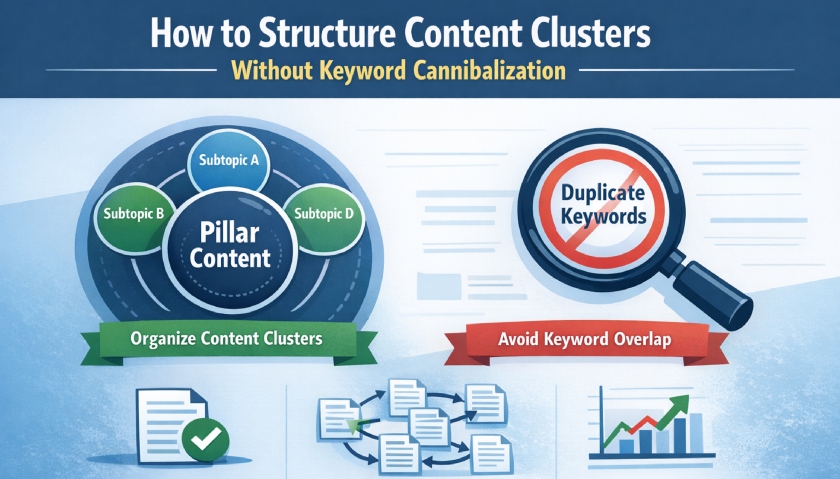
Content clusters are one of the simplest ways to make your SEO content easier to understand for both people and […]
Read Post »
A healthy website maintains steady search traffic and rankings. When organic traffic or keyword positions suddenly fall, it’s time to […]
Read Post »
Copyright © 2026 White Bunnie -All Rights Reserved