


How to Structure Content Clusters Without Keyword Cannibalization
-
Author
Saurabh Garg -
Publish
December 17, 2025 6:22 am -
Read Time
8 Min
 Lets talk











Fill in the Form below for a no-string attached free technical discussion.
Content clusters are one of the simplest ways to make your SEO content easier to understand for both people and search engines. The idea is straightforward, you build one strong pillar page around a main topic, then support it with smaller pages that go deeper into related subtopics.
When clusters are planned well, search engines can see that your site covers a topic in full, which helps build topical authority. But when clusters are built without a plan, they often create keyword cannibalization multiple pages fighting for the same query. That usually leads to weaker rankings across the board.
In this guide, we’ll cover a planning framework that assigns a clear job to every page, connects them with internal links, and reduces overlap. We’ll also touch on Answer Engine Optimization (AEO), since clusters can help your content show up in AI-driven answers too.
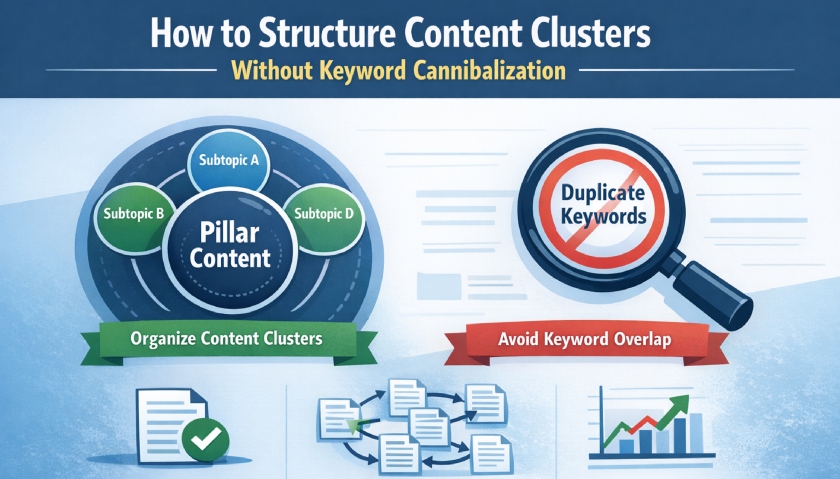
A content cluster starts with a pillar page that covers a broad theme. Around it, you publish cluster pages that each tackle one specific angle. The pages link together, especially back to the pillar, so the entire group works like a connected hub.
For example, a software company could create a pillar page on “Cloud Security Best Practices,” then publish cluster pages on topics like encrypting data at rest, access control, compliance requirements, and incident response. Readers can move from the overview into the details without getting lost.
This structure also helps search engines understand how your pages relate to one another. When every page has a clear focus and the links are intentional, the cluster reads like a complete topic map instead of a random pile of blog posts.
A strong hub-and-spoke setup also reduces confusion. The pillar introduces the subtopics and links out. Cluster pages do the deep work and link back. Done right, this lets multiple pages rank for related queries while still supporting the same “topic authority” goal.
Keyword cannibalization happens when two (or more) pages on your site target the same keyword or very similar queries. It’s not always obvious until you look at rankings and see your own pages competing with each other.
When this happens, search engines may struggle to choose which page is “the” best answer. That usually leads to weaker performance for both pages compared to a single strong page.
The most common downsides look like this:
This is common on large sites where multiple writers publish similar articles over time. The fix isn’t “write less”—it’s “plan better.” Clusters work when each page owns a distinct intent and keyword theme.
To build clusters without cannibalization, you need a planning method that forces clarity. Here’s the CIRC framework: Core topic, Intent, Role, Connections.
Start by picking the main topic that matters to your audience and ties into your business goals. This becomes your pillar theme. Choose something broad enough to support multiple subtopics, but not so broad that it turns into a vague “everything page.”
For every subtopic, define what the person is really trying to do. Are they learning? Comparing options? Ready to act?
Example intents for the same theme can look very different:
When intent is mapped early, you’re less likely to write two pages that answer the same question in slightly different words.
Decide whether a page is a pillar or a cluster page. Pillars cover the full topic at a high level. Cluster pages go deep on one slice.
A pillar might target broader terms (“cloud security checklist”), while a cluster page targets a more specific query (“encrypting AWS S3 data”). That separation keeps pages from stepping on each other.
Plan links before you publish. The pillar should link to each cluster page. Every cluster page should link back to the pillar. Add cluster-to-cluster links only when it truly helps the reader.
Use anchor text that describes what the linked page is actually about. Skip vague anchors like “click here.” Clear linking reduces confusion and reinforces which page owns which topic.
Before creating new cluster content, audit your existing library to catch any cannibalization or gaps. Use Google’s site search (site:yourdomain.com “keyword”) or analytics to surface all pages ranking for a query.
If you find two pages covering the same topic, decide what to do now not later. Often, the best move is to merge them into one stronger page, then redirect the weaker URL.
Next, do keyword and question research. Use tools like Ahrefs/Semrush, “People Also Ask,” and internal sources like sales or support teams. Real customer questions are often the best cluster page ideas.
For each topic, capture:
The key rule: one primary keyword theme → one page. If two keywords are basically the same query, treat them as one page unless there’s a clear difference in audience or intent.
Once the map is clear, writing becomes easier. Start with the pillar page. It should be comprehensive, but not bloated. Cover the topic fully at a high level and introduce subtopics naturally so it makes sense to link out.
Then write the cluster pages. Each one should answer its own question deeply without drifting into another cluster page’s territory.
A practical way to avoid overlap: When you mention a related topic, acknowledge it briefly and link to the page that owns it. That keeps the page focused and improves navigation.
Keep paragraphs short and specific. Use headings that match what readers are scanning for. Add examples, checklists, visuals, or decision criteria so each page provides unique value.
If two pages are too close, either:
Internal links are what turn “related posts” into an actual cluster.
Your baseline structure should be:
Anchor text matters. It should describe the destination page in plain language (“cloud data encryption methods”), not filler text.
Strong internal linking helps search engines crawl and understand the topic network. It also helps newer cluster pages rank faster when the pillar already has authority.
AI-driven search changes what “visibility” looks like. You’re not only trying to rank you’re also trying to be the source that answer engines reference.
Clusters help here because they signal completeness. When your site covers a topic from multiple angles (and those angles are clearly connected), it’s easier for systems to identify your site as a reliable source.
For AEO, keep content machine-friendly:
Internal linking also helps AI systems see that your content is part of a coherent topic set, not isolated pages.
On bigger sites, cannibalization can creep back in over time. Schedule audits every few months.
When you spot overlap:
Treat your cluster like a system. If pages support each other, rankings stabilize. If they compete, performance gets messy.
Content clusters work best when every page has a job. Audit what exists, map the cluster using CIRC, assign intent clearly, and build pages that don’t overlap. Then connect everything with purposeful internal linking.
Finally, make clusters easy to parse for both search engines and answer engines. When your content is structured, distinct, and connected, you get stronger rankings and better visibility in AI-driven search too.

Saurabh Garg, the visionary Chief Technology Officer at Whitebunnie, is the driving force behind our cutting-edge innovations. With his profound expertise and relentless pursuit of excellence, he propels our company into the future, setting new standards in the digital realm.
Have you ever searched for a well-known person, a local business, or a big brand on Google and noticed a […]
Read Post »
Google Search Console is expanding beyond websites and into social media. In December 2025, Google announced an experimental update that […]
Read Post »
You worked hard on your website’s SEO. You found the right keywords. You built some links. But your visitors still […]
Read Post »
Copyright © 2026 White Bunnie -All Rights Reserved