
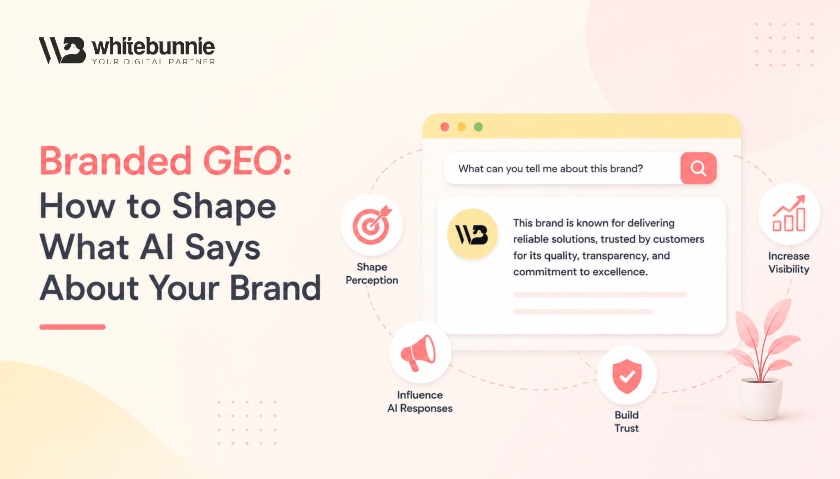
Branded GEO: How to Shape What AI Says About Your Brand
-
Author
Ankit Sain -
Publish
August 19, 2026 3:41 am -
Read Time
14 Min
 Lets talk










Fill in the Form below for a no-string attached free technical discussion.
Quick Summary
- Branded GEO is the work of shaping the sources AI systems read when someone asks about your company by name.
- You cannot edit an AI answer directly. You can change what the model finds and verifies, which changes the answer over time.
- India is now central to this. ChatGPT passed 100 million weekly users in India by February 2026, and Google AI Mode runs in English, Hindi and seven more Indian languages.
- Google published its first official guide to generative AI search in May 2026. It says GEO and AEO are still SEO for Google Search, and it names tactics you can safely skip.
- Five moves work: audit branded prompts, fix your entity layer, build third-party corroboration, win comparison prompts, and correct errors at the source.
- Track share of voice, sentiment, cited sources and AI referral traffic. Rankings alone will not show you the problem.
Ask ChatGPT what your company does. Then ask Gemini. Then ask Perplexity. If you have never run this test, the answers usually surprise people. One model describes a service you stopped selling two years ago. Another names a competitor as the safer choice. A third invents a founding year with total confidence.
This is not malice. It is arithmetic. These systems assemble a picture of your business from whatever they can find and cross-check, and most of that material sits outside your website. Review sites, directories, old press coverage, forum threads.
Branded GEO is how you fix the inputs.
Branded GEO is the practice of shaping how generative AI systems describe your business when someone searches for your brand by name. It works on the sources those systems read, not on the answer itself. The aim is an accurate, current and fair representation across ChatGPT, Gemini, Google AI Overviews, AI Mode, Perplexity, Microsoft Copilot and Claude.
General GEO goes after category prompts. Things like “best NetSuite implementation partner in India” or “top B2B SEO agencies”. Branded GEO handles a different set of questions:
Different prompts pull different sources. Category prompts pull listicles and comparison pages. Branded prompts pull your own site, your LinkedIn page, review platforms, news mentions and business databases. That is why the two need separate work.

The three overlap heavily. Google confirmed that overlap in May 2026.
India is no longer a secondary market for AI adoption. It is one of the primary ones.
OpenAI CEO Sam Altman said in February 2026 that India has 100 million weekly active ChatGPT users, making it the second-largest market after the United States.
Sensor Tower data reported by TechCrunch shows India became the world’s largest market for generative AI app downloads in 2025, with installs up 207 percent year over year, and roughly 19 percent of the global user base of leading AI assistant apps against 10 percent for the United States.
Google moved the same way. AI Mode launched in India in June 2025, added Hindi in September, then Bengali, Kannada, Malayalam, Marathi, Tamil, Telugu and Urdu the following month. India was also the first country outside the United States to get Search Live inside AI Mode.
The audience is there. Accuracy is the problem.
The European Broadcasting Union and the BBC ran the largest study of its kind in October 2025, covering more than 3,000 responses from ChatGPT, Copilot, Gemini and Perplexity across 18 countries and 14 languages. It found that 45 percent of answers had at least one significant issue, 31 percent had serious sourcing problems such as missing or incorrect attribution, and 20 percent contained major accuracy errors. Those failures were consistent across languages and territories, so an Indian brand is no safer than a European one.
B2B research published by O’Dwyer’s in May 2026 found 31 percent of the links ChatGPT cited for senior-level B2B queries were misattributed or fabricated. The same research put earned editorial coverage at 17 percent of total citations, the smallest slice by volume but the one AI leaned on most when forming a view about a brand.
The pattern holds. Where credible, current sources exist, models use them. Where they do not, models fill the gap with whatever is nearest.
BrightEdge data from early 2026 put AI Overviews on roughly 48 percent of tracked queries, up from about 31 percent a year earlier. B2B technology queries reached 82 percent. Prevalence figures vary widely between studies because each tracker uses a different keyword set, so treat any single number as directional and measure your own.
On 15 May 2026, Google published its first official documentation on this topic, titled “Optimizing your website for generative AI features on Google Search” (Google Search Central). It closed a two-year industry argument in a few lines.
Three points matter for branded GEO:
This does not make branded GEO pointless. It narrows it. Your technical foundation is the same one you already built for search. What changes is the questions you optimise against, the sources you influence off-site, and how you measure?
It is also worth remembering that Google speaks only for Google. ChatGPT, Perplexity and Claude retrieve differently and cite differently. Our breakdown of how to get a SaaS brand cited on ChatGPT and Perplexity covers those differences in detail.
You cannot fix what you have not measured. Pick 15 to 20 branded prompts and run each across at least four platforms: ChatGPT, Gemini, Perplexity and Google AI Overviews. Add Copilot if you sell into enterprise IT.

Image source: ChatGPT
Run each prompt two or three times. AI answers are probabilistic, so a single run tells you little. A prompt that returns three different answers is itself a signal. It usually means the model has thin or conflicting evidence about you.
Manual auditing works for the first pass. It does not scale to weekly monitoring. These platforms consistently rank for AI visibility searches in 2026 and hold up in practice:
Two buying rules. First, insist on seeing the underlying AI responses, not just a visibility score. A number you cannot audit is a number you cannot act on. Second, check the sampling frequency, because any tool reporting from single runs is reporting noise. Our longer comparison of AEO tracking tools goes deeper into feature and pricing trade-offs.
An entity is how machines identify your company as a distinct thing, separate from every similarly named business. Weak entity signals are the most common reason models describe a brand vaguely or confuse it with someone else.
The technical side is covered in our technical AEO checklist, including schema, crawlability for AI agents and semantic HTML. If your foundations are shaky, start there before anything else, or with a technical SEO audit.
Conflicting facts are worse than missing facts. When LinkedIn says one thing and your website says another, the model has no reason to trust either. Align these, in order:
Check the boring details. Company description, founding year, employee range, city, service names. Use one spelling of your brand name everywhere. “White Bunnie” and “Whitebunnie” fragment entity recognition.
Corroboration means several independent, credible sources say the same thing about you. It turns a claim into a fact from a model’s point of view. If your site says you launched in 2018, and a trade publication and your Crunchbase profile agree, the model treats it as settled. If only your site says it, the model hedges or guesses.
For Indian B2B brands, the sources that carry weight include:
One caution on reviews. Volume without recency does not help. Twenty reviews from 2022 tell a model what you were, not what you are.
Comparison prompts are where deals are quietly lost. When someone asks an AI, “Should I go with Brand A or Brand B?” the model builds its answer from whatever comparison material exists. If your competitor published a detailed comparison page and you did not, their framing becomes the default. What to do:
Comparison content that admits limitations outperforms content claiming to win every category. It reads as credible to a human and gives a model something specific to attribute.
When a model states something false about your company, arguing with the model achieves nothing. Work backwards to the source instead.
Expect this to take time. Recovery after a widely repeated error typically runs three to six months, because models need the new version reflected across enough trusted sources before it displaces the old one.
Rankings will not tell you whether AI describes you correctly. Track these instead:

Image source: ChatGPT
Set a baseline, then re-measure monthly. Quarterly is too slow for a channel moving this fast.
Can I control what ChatGPT says about my brand?
Not directly. There is no dashboard for editing an AI answer. You control the inputs instead: website content, structured data, listings, reviews and earned media. When those sources agree and stay current, AI descriptions become more accurate over time. Treat it as influence, not control.
How long does branded GEO take to show results?
Entity and schema fixes can register within weeks, since Google’s generative features draw from the live Search index. Corrections to information models learned from older sources take longer, usually three to six months.
What is the difference between branded GEO and general GEO?
Branded GEO targets prompts that already name your company and focuses on accuracy and fair framing. General GEO targets category prompts where you compete to be mentioned at all. They pull from different sources, so they need different work.
Do I need a separate AI SEO strategy, or is SEO enough?
For Google, its May 2026 documentation states that optimising for generative AI features is still SEO. For ChatGPT, Perplexity and Claude, retrieval and citation behaviour differ, and off-site corroboration carries more weight. The practical answer is one programme with a wider question set and deliberate off-site work.
How often should I audit what AI says about my brand?
Run a full manual audit quarterly and automated monitoring monthly. Audit immediately after any rebrand, pricing change, leadership change or funding announcement, because those are the facts models get wrong when old sources outrank new ones.
Open ChatGPT and ask what your company does. Do the same in Gemini and Perplexity. Write down what is wrong.
That list is your project plan. Most of it traces back to sources you can update this week: a stale About page, a directory listing nobody has touched since 2021, a LinkedIn description written by someone who has left.
The brands described accurately in 2027 are the ones giving models accurate material in 2026. Unglamorous work. It compounds.
At White Bunnie, branded GEO sits inside our wider AI SEO practice, where we run prompt audits, entity cleanup and citation building for B2B brands across India, the US, the UK and the UAE. If you want to know what AI currently says about your company before a competitor does, that audit is the place to begin.

Ankit Sain is an SEO specialist with over 6 years of hands-on experience in driving organic growth through data-driven and AI SEO strategies. He helps businesses improve visibility, rankings, and conversions with sustainable search solutions.

Predictive AI in SEO is transforming how we discover and use keywords. Instead of chasing high-volume keywords after they’re already […]
Read Post »
The rise of AI-driven search means “getting to #1” no longer guarantees visibility. AI Overviews (Google’s conversational answers), ChatGPT, Perplexity […]
Read Post »
You’re craving your favorite dish. Instead of opening a food delivery app, you tell an AI assistant, “Find me a […]
Read Post »
Copyright © 2026 White Bunnie -All Rights Reserved