
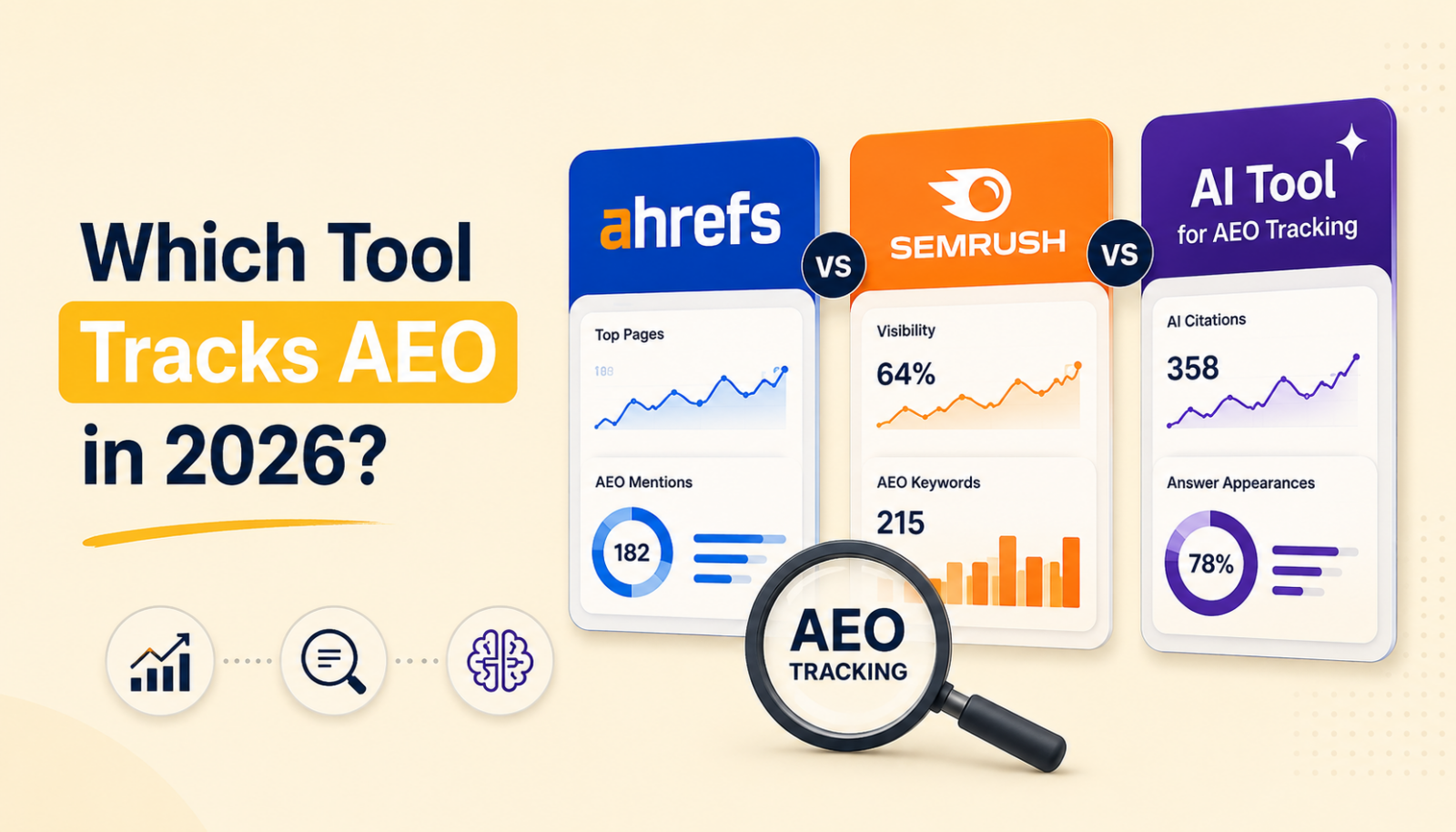
Ahrefs vs Semrush vs AI Tool for AEO Tracking in 2026: What Actually Works
-
Author
Saurabh Garg -
Publish
July 15, 2026 6:49 am -
Read Time
13 Min
 Lets talk








Fill in the Form below for a no-string attached free technical discussion.
Quick Summary
All three can track how your brand shows up in AI answers, but they suit different buyers:
- Semrush AI Visibility Toolkit: Cheapest way in (~$99/month per domain), good if you already run SEO in Semrush.
- Ahrefs Brand Radar: Biggest prompt database and the best history, but the bill climbs fast once you add all platforms.
- A dedicated AI tool (Profound leads, with Peec AI and AthenaHQ close behind): Deepest, prompt-level tracking across the most engines, including Claude and Grok. Worth it when AI search is a real channel, not a side note.
Search changed, and your reporting probably hasn’t kept up. A few years ago, a keyword rank told you almost everything. Today, a huge share of people never scroll to the blue links at all. They read the AI answer at the top and move on.
That shift has a name: Answer Engine Optimization, or AEO. And to do that, you first need to see where your brand appears when someone asks ChatGPT, Gemini, Perplexity, or Google’s AI Overviews about your category. That’s what AEO tracking tools do.
Three options dominate the conversation in 2026: Ahrefs (through its Brand Radar add-on), Semrush (through its AI Visibility Toolkit), and a wave of purpose-built AI tools led by Profound. This guide compares all three with current 2026 pricing and features, then helps you pick based on your team, your budget, and how much AI search matters to your business.
AEO tracking measures how visible your brand is inside AI-generated answers. Instead of counting keyword positions, it counts things like mentions, citations, sentiment, and “share of voice” across engines such as ChatGPT, Gemini, Perplexity, and Google AI Overviews.
Traditional rank tracking answers one question: where does my page sit for this keyword? AEO tracking answers a different one: when a real person asks an AI a question in my category, does my brand get named and is it described well?
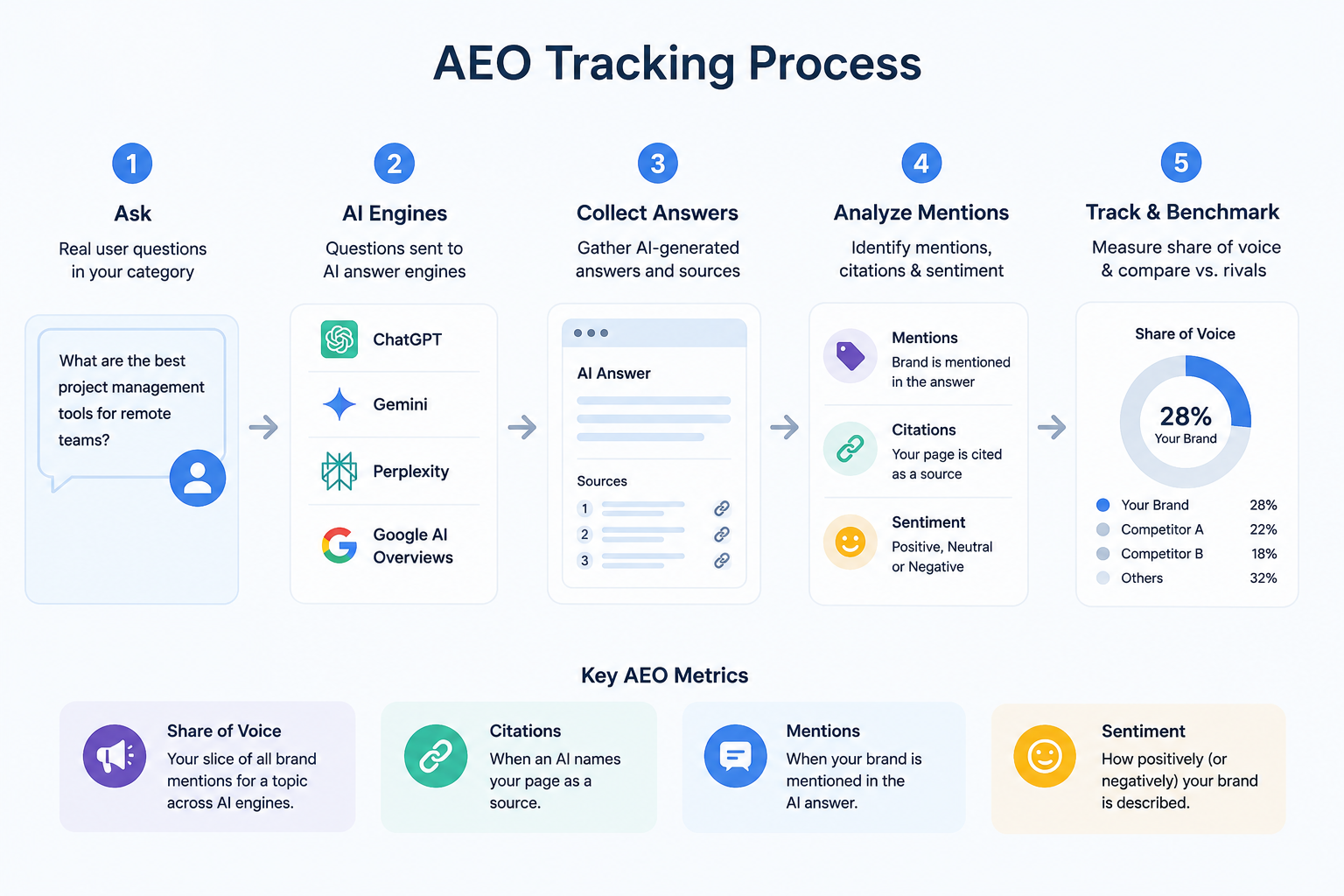
The two disciplines overlap but aren’t the same. A few terms you’ll run into:
If you want the fundamentals first, start with our guide to Answer Engine Optimization before you shop for a tool.
The numbers make the case better than any pitch. Here’s the current picture, drawn from independent 2026 research:
This matters more in high-growth markets. Per OpenAI’s Signals India report from February 2026, India is its second-largest market, with 100M+ weekly users and a higher share of work-related use than the global average. In other words, buyers there are already asking AI which vendors to shortlist and you want to be in that answer.
At White Bunnie, we help brands turn AI search from a blind spot into a channel through our AI SEO services, choosing the right tracking stack, then doing the content and earned-media work that gets you cited.
You can read the wider dataset in Superlines’ 2026 AI search statistics roundup and Instant Press’s AEO/GEO stats page, both of which cite named sources for every figure.
Ahrefs built its AEO tracking straight into the tool many SEOs already open every day. It’s called Brand Radar, and its selling point is scale.
Brand Radar checks your brand against a database of 370M+ “search-backed” prompts, questions modeled on real keywords and People Also Ask queries, not made-up ones. It now covers seven AI surfaces: Google AI Overviews, Google AI Mode, ChatGPT, Perplexity, Gemini, Microsoft Copilot, and Grok. It also tracks brand mentions on YouTube, Reddit, and TikTok because those channels feed AI answers.
Your core metrics are Mentions, Citations, Impressions (weighted by search volume), and AI Share of Voice. A real edge: Brand Radar keeps historical data going back to 2025, which most dedicated AI tools can’t offer. If you need to show your boss a six-month trend, that matters.

Image source: Ahrefs brand radar
This is where you need to read carefully, because the headline price hides the real one. You still need an active Ahrefs base plan (Lite starts at $129/month). On top of that, Brand Radar costs $699/month for all platforms, or from $398/month if you track only a subset. The all-platforms tier includes 2,500 custom-prompt checks a month, plus YouTube, TikTok, and Reddit tracking (free while in beta).
Independent reviews from EWR Digital and others put a realistic full setup between $828 and $1,148 a month, once the base plan is included, about 2.5x the category average. The sticker price understates the real bill.
One consolation: basic AI Overview detection inside Ahrefs’ Rank Tracker is included in base plans, so lighter users get some AI visibility signal without the full add-on.
Semrush took a friendlier entry route. Its AI Visibility Toolkit is an add-on that drops AI tracking into the SEO suite millions already use.
You track your own high-value prompts day by day across ChatGPT, Google AI Mode and AI Overviews, Perplexity, and Gemini, with Claude added more recently. Beyond raw visibility, it reports Brand Performance and sentiment (how AI describes you), runs Competitor and Prompt Research, and audits your site for issues that block AI crawlers. Larger teams can step up to Enterprise AIO for product-, region-, and persona-level tracking.

The toolkit is $99/month per domain and includes 25 tracked prompts. The costs stack as you grow: an extra 50 prompts is +$60/month, each extra domain is +$99/month, and AI access for another user is +$99/month. If you also want classic SEO, the Semrush One bundle starts at $199/month, versus roughly $239 buying the SEO ($139.95) and AI ($99) toolkits separately. Semrush offers a demo, and trial terms vary by plan, so check the current options before you buy.
Both Ahrefs and Semrush bolted AI tracking onto SEO platforms. A newer group built for AEO from scratch. Ranked by search visibility and market presence in 2026, the standout is Profound, with Peec AI, AthenaHQ, Otterly.ai, and Scrunch AI forming the rest of the top tier.
Profound is the most-funded name in the space. It raised a $96M Series C in February 2026 at a $1 billion valuation, and it holds G2 Winter 2026 Leader status. Customers include Ramp, MongoDB, Figma, Zapier, DocuSign, and Walmart. Ramp’s 7x jump in AI visibility is the most-cited case study in the category.
What sets it apart:
The catch is price and fit. The $99/month Starter plan covers ChatGPT only with 50 prompts. Real functionality starts on the $399/month Growth plan (ChatGPT, Perplexity, and Google AI Overviews), and full engine coverage Claude, Gemini, Grok, and the rest sits in custom-priced Enterprise, where real deployments run $2,000/month and up. It’s also a lot of platform for a lean team, and it leans toward measurement, so you still need people to act on the data.
You don’t have to start at the top. For teams watching budget, these names come up often (prices verified July 2026):
Here’s the quick-scan comparison. Prices are as of July 2026 and shift often, so confirm current numbers before you buy.
| What matters | Ahrefs Brand Radar | Semrush AI Toolkit | Profound (AI-native) |
|---|---|---|---|
| Entry price | $129 base + $398–$699 add-on | $99/mo per domain | $99 (ChatGPT only); $399 for 3 engines |
| AI engines tracked | 7 (adds Grok; no Claude) | 5+ (incl. Claude) | Up to 10 (widest coverage) |
| Tracking method | Snapshot, keyword-first, huge database | Simulated prompts you choose | Prompt-level + real crawler logs |
| Historical data | Best in class (from 2025) | Day-by-day going forward | Limited to lower tiers |
| Content help | No | Basic recommendations | Yes (Agents) |
| Best for | Research teams inside Ahrefs | SMBs already on Semrush | AI search as a core channel |
Skip the “it depends” non-answer. Here’s a straight recommendation by situation:
Whatever you pick, pair the tool with a plan to act on it. Tracking tells you where you’re invisible; it doesn’t fix it. That part needs content and earned mentions; see how to rank in Google AI Overviews.
Say you run marketing for a mid-sized B2B SaaS company selling to finance teams. You set up prompt tracking for the questions your buyers actually ask an AI: “best expense management software for startups,” “GST-ready accounting tools,” and so on.
Week one, the data stings. ChatGPT names three competitors and skips you. Perplexity cites a comparison article you’re not even in. But now you can see the sources feeding those answers, often a G2 listing, a Reddit thread, or a “best of” roundup. That’s your roadmap. You earn a mention in the roundup, answer the exact questions on your own site with clear, structured content, and re-check in a month. The tool proves whether it worked.
This is the loop that matters: see the gap, close it with content and citations, measure again. Every tool in this guide can run the first and third steps. The middle step is where brands win or lose.
A few habits separate teams that improve from teams that just watch a dashboard:
Is Ahrefs or Semrush better for AEO tracking in 2026?
Semrush is the cheaper, simpler start at about $99/month per domain and tracks your exact prompts. Ahrefs Brand Radar has a much larger prompt database and better history but costs more once the add-ons stack up. Small teams usually prefer Semrush; research-heavy teams already on Ahrefs prefer Brand Radar.
Do I need a dedicated AI tool if I already pay for Ahrefs or Semrush?
Not if AI search is a side metric, the built-in add-ons will do. If AI visibility is a core channel or something you report to clients, a dedicated tool like Profound, Peec AI, or AthenaHQ gives deeper, prompt-level tracking across more engines, including Claude and Grok.
Which AI engines matter most for Indian brands?
ChatGPT carries the largest share of AI referral traffic and has huge usage in India, one of OpenAI’s biggest markets. Google AI Overviews and AI Mode also reach a large Indian audience. Perplexity is worth tracking for research and B2B queries because it sends more clicks to cited sources than most engines.
How accurate are these tools?
Treat all of them as directional, not exact. Ahrefs and Semrush model presence rather than checking every live session, and independent tests have found gaps. Dedicated tools that use real prompt-level checks and crawler logs tend to be more precise, at a higher price. Verify high-stakes findings by prompting the AI yourself.
What does AEO tracking cost to get started?
You can start from roughly ₹2,500 a month (about $29) with a budget tracker like Otterly, or around ₹8,400 a month ($99) for Semrush’s toolkit or Profound’s Starter plan. Full multi-platform coverage in Ahrefs, or an enterprise tool like Profound, runs much higher, often ₹70,000 a month and up. Match the spend to how much AI search actually drives your pipeline.
There’s no single winner here, and any guide that names one is selling something. Semrush is the easiest and cheapest on-ramp. Ahrefs gives you scale and history if you can absorb the cost. Dedicated tools like Profound go deepest when AI search is a channel you’re serious about.
The bigger point: measuring AI visibility is no longer optional. With more buyers starting their research inside an AI and only a small fraction of marketers tracking it, the brands that set up measurement now build a lead that’s hard to catch later. Pick the tool that fits your budget, then spend your energy on the part that moves the needle, earning mentions and answering real questions clearly.
At White Bunnie, we help brands turn AI search from a blind spot into a channel by choosing the right tracking stack, then doing the content and earned-media work that gets you cited.

Saurabh Garg, the visionary Chief Technology Officer at Whitebunnie, is the driving force behind our cutting-edge innovations. With his profound expertise and relentless pursuit of excellence, he propels our company into the future, setting new standards in the digital realm.

If you work in SEO or content marketing, you know the ground can shift fast. But when Google rolled out […]
Read Post »
If you run stores, clinics, salons or branches in more than one Indian city, the way people find you has […]
Read Post »
Most B2B websites have a content problem that looks different from what they expect. The problem is not too little […]
Read Post »
Copyright © 2026 White Bunnie -All Rights Reserved