












Key Takeaways
- Google released its first official guide to optimising for AI Search (AI Overviews and AI Mode) on 15 May, explicitly retiring AEO and GEO as separate disciplines and pulling everything back to foundational SEO.
- Google permanently removed FAQ rich results from Search as of 7 May 2026. FAQ schema no longer generates SERP features and sites will see impression drops in Search Console for any pages that previously earned FAQ appearances.
- Google Search Console’s 50-week impression logging bug, affecting data from May 2025 to April 2026, was confirmed fixed. Historical data will not be corrected. Any impression baseline you built over the past year needs reassessment.
- Semrush Sensor remained below 4 throughout, except on May 15, where it touched 6 for a brief period on Mobile devices. The April 2026 core update continues to settle across verticals.
Google publishes its first official AI Search Optimisation Guide
Source: Optimising your website for generative AI features on Google Search, 15 May 2026
On 15 May 2026, Google published a formal guide titled ‘Optimising your website for generative AI features on Google Search’, covering both AI Overviews and AI Mode. The guide is published on Google Search Central and represents the first time Google has spoken directly about what site owners need to do; and what they can stop worrying about to appear in AI-generated results.
What this guide means for B2B, ITES, and SaaS
The guide’s most significant move is the explicit retirement of AEO and GEO as separate optimisation disciplines. If you’ve been treating these as distinct programmes, our breakdown of SEO vs AEO vs GEO is worth revisiting in light of this update. Optimizing for AI Search is SEO done well, and the same foundational work that earns traditional rankings is what earns AI citations. For B2B SaaS companies that have invested in parallel AEO or GEO programmes, this is a consolidation signal, not an instruction to stop what works, but a clear statement that fragmented acronym strategies will not outperform a well-executed content cluster with strong E-E-A-T.
Here is the what Google Said:
What about “AEO” and “GEO”? “AEO” stands for “answer engine optimization” and “GEO” for “generative engine optimization”. These are both terms you may see used to describe work specifically focused on improving visibility in AI search experiences. From Google Search’s perspective, optimizing for generative AI search is optimizing for the search experience, and thus still SEO.
The guide also confirms that Google’s AI uses a query fan-out technique, meaning a single well-scoped paragraph on a specific subtopic can earn a citation even when the page does not rank in the top ten organic results for the broader query. For B2B companies with deep informational content across narrow intent clusters, this is a genuine opportunity, and one that favours original research and specific observations over summarized industry content.
Separately, Google confirmed that llms.txt files receive no special treatment. If any team has invested time in building or maintaining these files to influence AI crawling, that effort can stop.
Google core ranking systems focus on high-quality content while other systems block spam; and generative AI features depend on both.
Action Required following this Guide:
Audit your highest-traffic informational pages for paragraph-level specificity. A page that ranks fifth for a broad query but contains one authoritative, well-structured paragraph on a specific subtopic now has a genuine path to AI citation independent of its overall ranking position. Keep improving your website health and content structure, nomenclature of the activities is not of much importance.
Google permanently removes FAQ rich results from Search, effective 7 May 2026
Source: Google Search Central documentation update, confirmed via Google Developers changelog, May 2026.
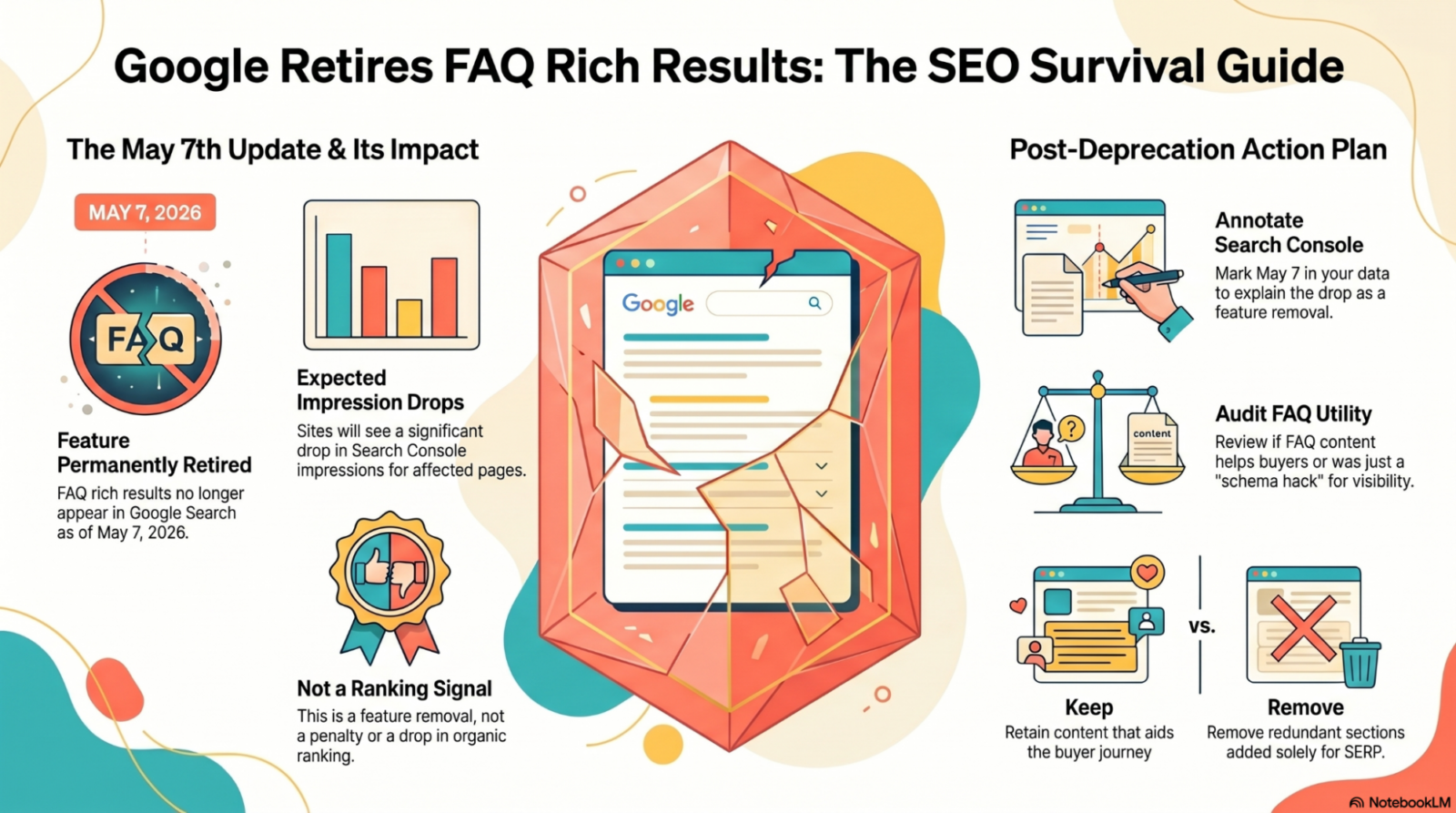
As of 7 May 2026, FAQ rich results no longer appear in Google Search. Google added a deprecation notice to the FAQ rich result documentation on Google Search Central, confirming the feature has been discontinued across all query types and languages. Sites that previously generated FAQ-style SERP features from FAQ schema markup will no longer earn those appearances. Search Console impression counts for affected pages will fall as a direct consequence.
What this means for B2B, ITES, and SaaS
B2B and SaaS sites that used FAQ schema on product pages, pricing pages, or service pages to earn expanded SERP results need to act on two fronts.
First, the impression drop in Search Console is real and expected. It reflects the removal of a SERP feature, not a ranking or traffic loss. Do not treat it as an algorithm signal or a content quality issue.
Second, the underlying FAQ content itself may still have value as a content asset, but the schema markup that powered the rich result is now redundant. For B2B companies that added FAQ sections to web pages specifically to earn rich results, a highly regarded tactic (since the AI boom) over the past three years.
Action needed following Google Update
Pull your Search Console performance data filtered to FAQ rich result appearance type and annotate the impression drop from 7 May as a known feature removal, not a ranking event.
Those pages / sections recorded impressions drop, should be reviewed on their own merits, do they help the reader, or were they added purely for the SERP feature? Pages where FAQ content is genuinely useful to a buyer evaluating a product or service should keep it. Pages where it was added as a schema hack can have it removed without consequence.
On Our Radar for Next Week
Two developments to watch next week:
Google I/O, 2026: Google’s annual product announcement event is scheduled for 19 and 20 May. Based on everything that has happened in the last two weeks, expect announcements about how AI search is expanding, how more content types will be pulled into AI answers, and how Google plans to handle the question of giving websites more credit for the traffic they are losing.
Perplexity Computer integration with premium data sources:Perplexity added access to CB Insights, PitchBook, and Statista data directly within its Computer product in March. If B2B buyers begin using this for vendor research, the content that earns citations in those queries will need to be grounded in comparable data depth. To stay ahead of which AI platforms are gaining traction in research workflows, it’s worth following developments using the right LLM tracking tools watch for any pattern shift in which sources Perplexity cites on market sizing or competitive landscape queries.
Adobe-Semrush integration effects on SEO tooling: The Adobe acquisition of Semrush, completed in April 2026, has not yet produced visible product changes. Watch for any announcements in the coming weeks about how Semrush data will integrate into Adobe Experience Cloud reporting flows, relevant for any B2B or ITES company that uses both platforms.
White Bunnie Observations
In our client accounts this week, we are seeing a consistent pattern across B2B SaaS sites with established content clusters; the pages that are earning AI Overview citations are not always the pages that rank highest for the seed keyword. In several accounts, a page sitting in positions six through nine for a broad informational query is being cited in AI Overviews for a specific subtopic within that query. Each chunk of the content has its own importance, and has its own ranking.
Here is the screenshot showcasing how each and every section of one of the blog is having different impressions, clicks and rankings.
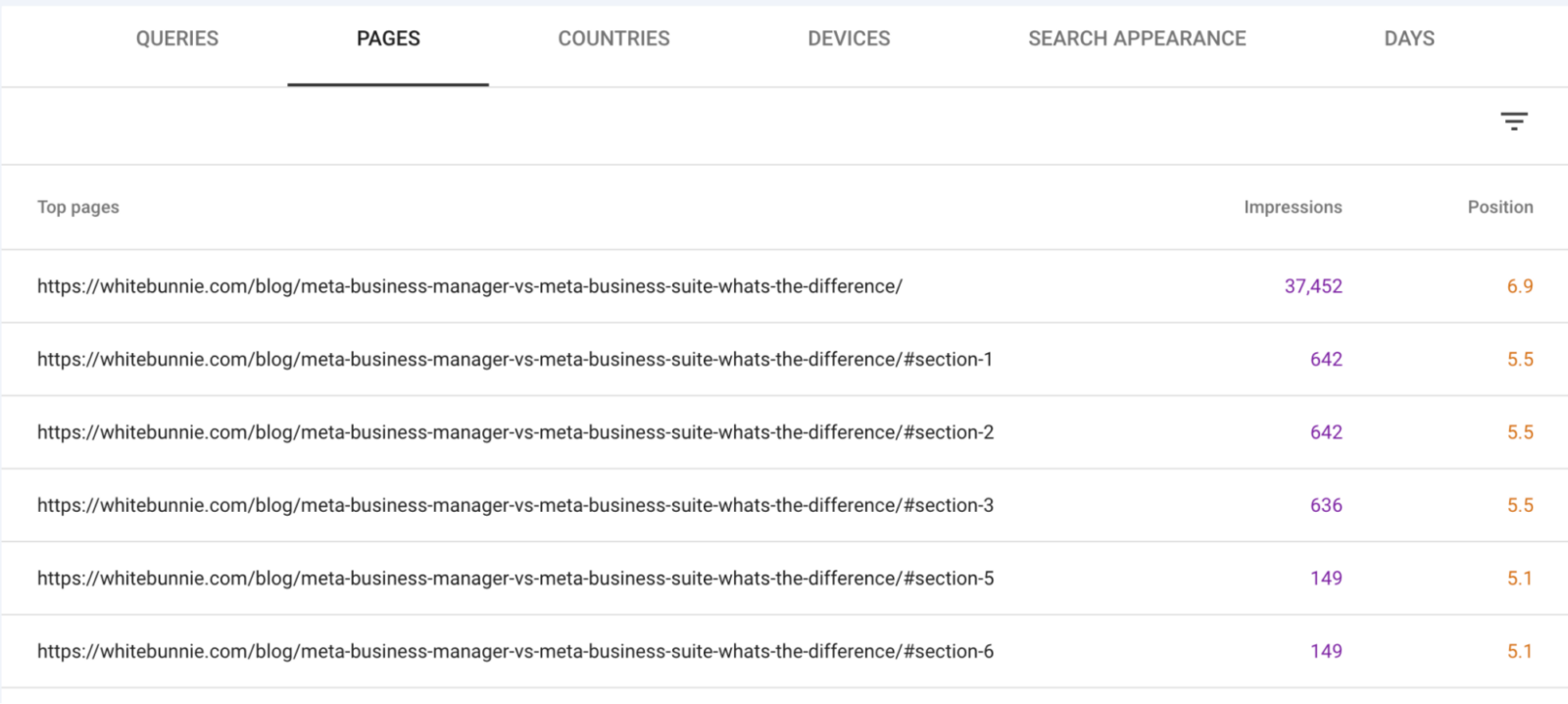
This aligns directly with what Google confirmed in its AI Search guide this week. The query fan-out technique means AI answers pull passages from across multiple sources based on subtopic relevance, not overall page ranking. The practical implication is that content depth at the paragraph level now matters independently of ranking position. A mid-ranking page with one highly specific, well-evidenced section on a narrow aspect of the topic has a genuine path to citation that a broader, shallower page ranked above it does not.
We are watching this pattern across accounts before drawing a firm conclusion on frequency or vertical specificity. But it is consistent enough across different client categories; ITES service pages, SaaS feature documentation, and B2B how-to content. Our broader AI SEO work across these accounts shows this shift in signal is more visible across informative content (blogs and white papers). We are treating it as a signal worth structuring content around, not just observing.