


What Is Query Fan-Out? How It Affects AI Visibility and Search Performance
-
Author
Saurabh Garg -
Publish
July 9, 2026 8:00 am -
Read Time
12 Min
 Lets talk











Fill in the Form below for a no-string attached free technical discussion.
TL;DR: Query fan-out is the process by which an AI search engine turns one question into many smaller searches. It runs those searches simultaneously, grabs the best passage from each, and builds a single answer. This is why you can rank first on Google and still get skipped by ChatGPT, Perplexity, or Google AI Mode. To show up in AI answers, your content has to cover the full set of questions behind a topic, not just one keyword.
Quick facts:
At White Bunnie, we track how brands lose and win space in AI answers. The pattern repeats. A page holds a strong Google position for months. Then a client checks ChatGPT or Google AI Mode and finds a competitor cited instead. Rankings look fine. AI visibility does not.
Query fan-out explains the gap. Once you understand how it works, the fix stops feeling like guesswork. This guide breaks down what query fan-out is, how each AI platform runs it, and the exact steps we use to earn more citations for our clients.
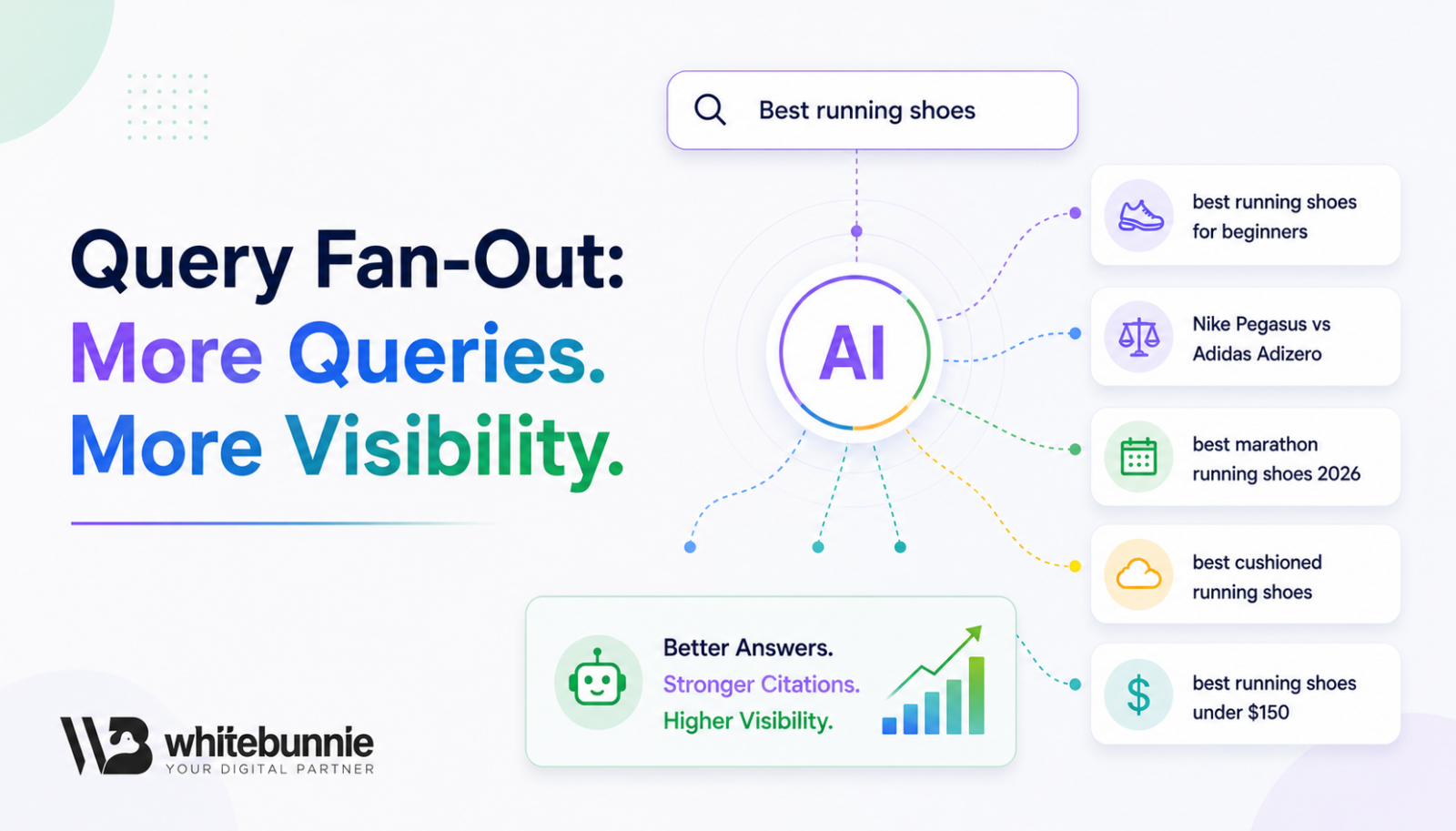
Query fan-out is a retrieval method. An AI search system takes one user prompt and splits it into several related sub-queries. It runs them in parallel, pulls results for each, and merges the strongest passages into one answer.
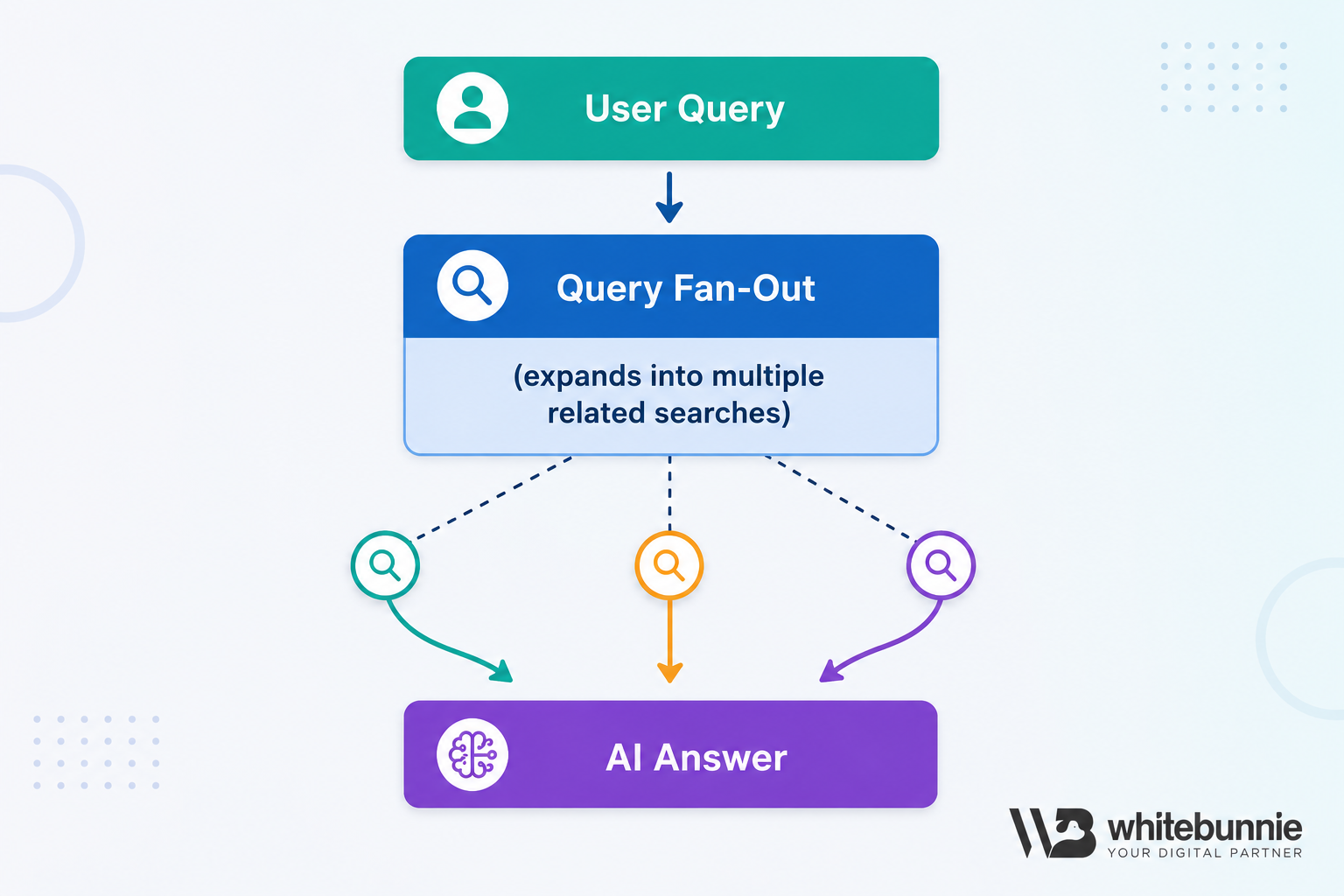
Google’s Head of Search, Elizabeth Reid, described the mechanism at Google I/O 2025. She said Search breaks a question into subtopics and issues a set of queries at the same time, on the user’s behalf, using a custom version of Gemini. Google names this the query fan-out technique.
The term is not official across every platform. Engineers use other names for the same idea:
“Query fan-out” became the shorthand SEO teams settled on. Google’s own version sits inside a patent called Thematic Search, where the sub-queries get labeled as “themes” (iPullRank).
Say a user types “best running shoes for flat feet.” A classic search matches that phrase. An AI system fans it out into threads like these:
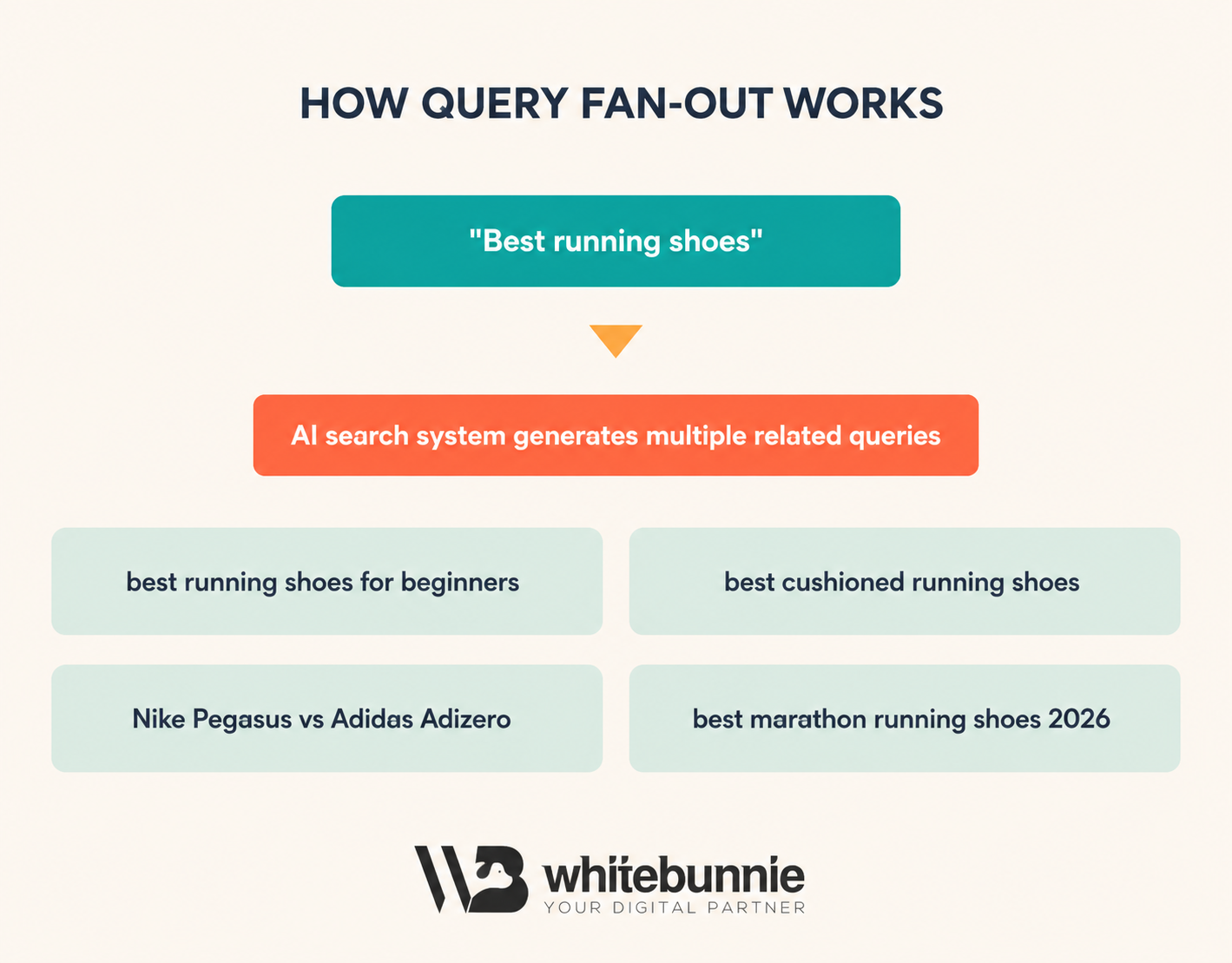
The AI answers each thread, then stitches the parts into one reply. Your page might get cited for the “arch support vs motion control” thread, even if it never ranked for the main phrase. That is the shift. You compete across a whole topic, not one keyword.
AI models fan out for four reasons:
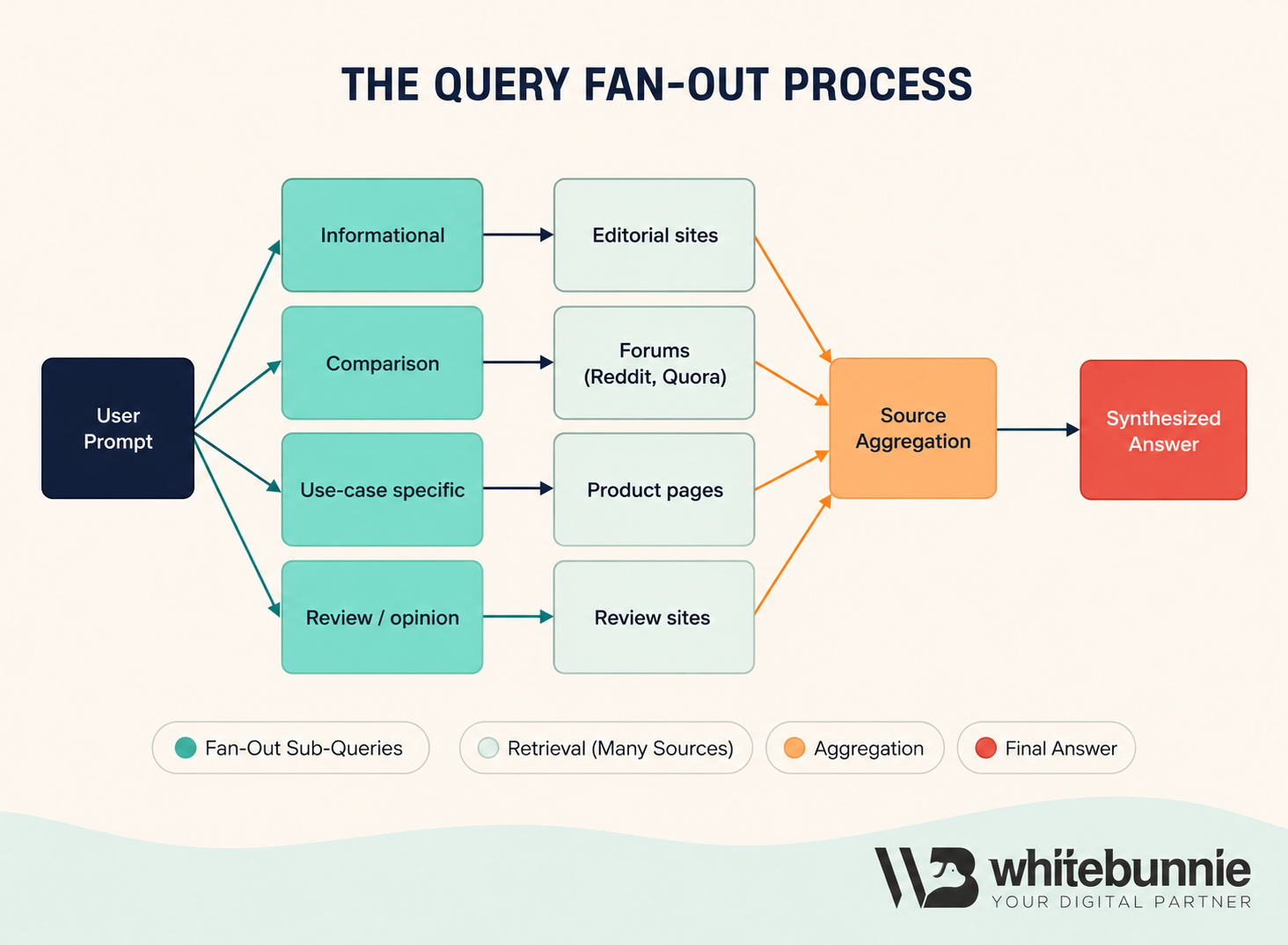
This is the part that changes your content strategy. Four shifts matter most.
Ranking first used to mean you owned the answer. Not anymore.
Ahrefs studied 863,000 keyword SERPs and 4 million AI Overview URLs. In July 2025, 76% of AI Overview citations came from top-10 organic pages. By March 2026, that figure fell to 38% (reported by Search Engine Journal). The rest split between positions 11 to 100 and pages ranked past 100.
Mike King of iPullRank puts the overlap between Google rankings and AI citations at just 25% to 39%. A top spot helps. It no longer wins the citation on its own.
An AI system does not hand the user your full page. It scans your content and lifts the one passage that answers a sub-query. Google anchors these extracts at the passage level using scroll-to-text fragments, sometimes called “fraggles.”
The takeaway for content teams: each section has to stand on its own. If a reader (or a model) needs the paragraph above to make sense of the one below, the passage is harder to extract. Wellows found the sweet spot for AI Overview extraction sits around 134 to 167 words per passage. The same answer-first habit that wins featured snippets and rank zero also wins AI extractions.
Fan-out rewards depth over single-keyword pages. A page that covers many angles of a topic gets pulled into more sub-queries. This is why topic clusters and thorough pages earn more citations than thin, one-keyword posts. It rewards a real content marketing plan over a scattered one-off post.
Surfer SEO found that pages that rank for fan-out queries are 161% more likely to get cited than pages that rank only for the main query.
Here is the trap. Keyword tools show you the visible query. They miss the hidden ones. Research from 85sixty found that about 95% of fan-out phrases carry zero monthly search volume. Average fan-out query length runs 5.5 words on ChatGPT and 9.1 words on Gemini, against roughly 3.4 words for a classic Google search.
Source: 85sixty
If you plan content only from volume data, you skip the exact phrases AI searches for. Profound also found that answer engines add modifiers on their own, like “best,” “top,” “reviews,” and the current year. Your page needs that language on it.
Each platform fans out in its own way. That affects how many sub-queries run and which sources win.
| Platform | How Fan-Out Behaves |
|---|---|
| Google AI Mode | Breaks complex prompts into many parallel sub-queries across Google’s index. Runs deep on multi-part questions. |
| Google AI Overviews | Synthesizes Google’s index into a summary. Runs on Gemini 3 globally since January 27, 2026, which shifted citation patterns. |
| ChatGPT | Answers simple facts from training data. Runs live searches when a query needs fresh data, comparisons, or current prices. Often pulls from Reddit and review sites. |
| Perplexity | Runs two layers at once: it scans your prior chat for context, then searches the live web. Pair your page with user context you cannot predict. |
| Claude | Asks clarifying questions first, then runs fewer, tighter searches based on your answers. Rewards specific, well-defined pages. |
One note of caution. Some of this comes from how each system describes its own reasoning. Models are not reliable narrators of their own process. Treat platform behavior as a guide, not gospel, and test it yourself.

This is the workflow we run for clients at White Bunnie. It repeats for every topic that matters to your business.
Start with the questions your buyers ask an AI tool, not the keywords they type into Google. We pull these from:
Write down the high-intent prompts. “Noise-canceling headphones” is a keyword. “What noise-canceling headphones last more than two years for daily commuting?” is a buyer prompt. The second one drives the sale.
You need to see the hidden sub-queries. Two options work:
Each sub-query needs a matching content format. Sort them:
A comparison query needs a comparison table. A general guide will not get cited for it.
Search site:yourdomain.com [sub-query topic] On Google to see what you already cover. Then grade each page:
If mapping this by hand feels heavy, a structured SEO audit does the same work across your whole site.
Also, run your prompts through AI tools to see which competitors show up. If a rival appears and you do not, that is a gap to close before they own it.
Creating the content is half the job. The other half is making passages easy to lift:
Clean technical SEO and tight on-page SEO make these passages easier for a model to reach and lift.
Freshness carries weight too. Ahrefs found AI tools cite pages that run about 25.7% fresher than the pages classic search surfaces. Revisit and update your key pages on a schedule.
Track your money prompts across AI platforms. For each one, check three things:
Tools like Profound and Semrush’s AI visibility tracker automate this once you move past a handful of prompts. Our roundup of LLM tracking tools covers the current options. Fan-out queries shift with each run, so treat tracking as ongoing work, not a one-time check. Run a full AI visibility audit each quarter to catch new gaps.
After running this process across many accounts, the same errors keep costing brands citations:
We do not chase every possible query. We map the ones tied to real revenue, build content that answers each intent on its own, and structure every passage so a model can lift it clean. Then we watch the AI answers and adjust. It is steady, repeatable work, and it compounds.
You do not need a full site rebuild to start. Restructuring a few high-priority pages around their fan-out gaps often moves the needle on its own.
Is query fan-out the same as keyword research?
No. Keyword research is something you do to find search terms. Query fan-out is something the AI does on its own, behind the scenes, every time someone asks a question.
Which AI platforms use query fan-out?
All the major ones: Google AI Mode, Google AI Overviews, ChatGPT, Perplexity, and Claude. Each runs it in its own way.
How many sub-queries does fan-out create?
It varies by prompt and platform. Research shows a single question often triggers 8 to 12 sub-queries. Deep research modes can run far more.
Can I see the fan-out queries a model runs?
In part. Tools like Qforia, Profound, and the Keyword Surfer extension surface them. Google hides its exact fan-outs, so you work from patterns, not a perfect list.
Does ranking first on Google still matter?
Yes, but less than it did. A strong rank helps, yet it no longer guarantees an AI citation. In 2025, the top 10 pages made up 76% of AI Overview citations. By March 2026, that dropped to 38% (Ahrefs).
How is query fan-out different from query expansion?
They overlap. Query expansion rephrases one query to catch more results. Fan-out goes further and splits one query into many distinct sub-queries that run in parallel.
AI search runs on query fan-out, so your content strategy should too. High rankings alone will not earn AI mentions. The brands that show up cover the full set of questions their buyers ask and make each answer easy for a model to pull. That work sits at the core of generative engine optimization.
Start with one money prompt. Map its sub-queries. Audit where your content stands. Then close the gaps, one topic at a time.

Saurabh Garg, the visionary Chief Technology Officer at Whitebunnie, is the driving force behind our cutting-edge innovations. With his profound expertise and relentless pursuit of excellence, he propels our company into the future, setting new standards in the digital realm.

In the dynamic world of digital marketing and SEO, the LLMS.txt file has emerged as a noteworthy innovation. As businesses […]
Read Post »
In today’s competitive digital landscape, small businesses are constantly seeking effective strategies to stand out and attract the right customers. […]
Read Post »
In 2025, getting noticed online takes more than just showing up on search engines. The rise of large language models […]
Read Post »
Copyright © 2026 White Bunnie -All Rights Reserved