


Difference Between Citations in AI Overviews and AI Mode
-
Author
Saurabh Garg -
Publish
December 26, 2025 5:48 am -
Read Time
8 Min
 Lets talk











Fill in the Form below for a no-string attached free technical discussion.
Google Search no longer shows information in a single, uniform way. Over the last two years, Google has introduced multiple AI-driven answer formats that change how content is selected, summarized, and cited. Two of the most important of these formats are AI Overviews and AI Mode.
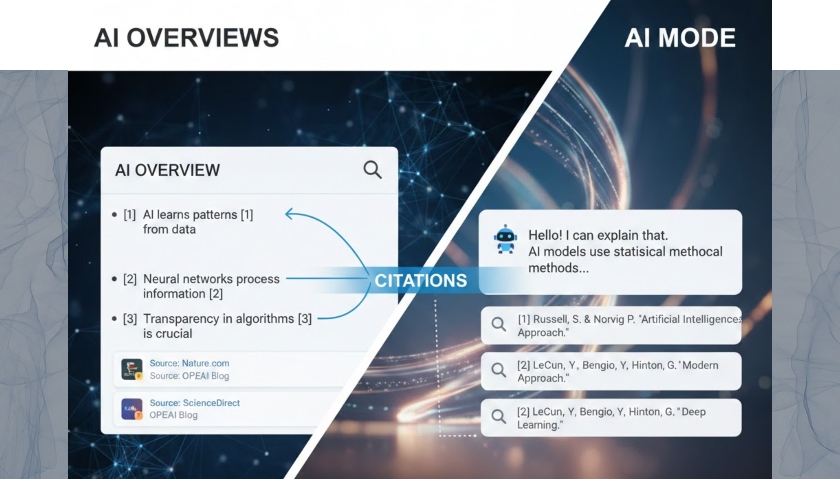
Although both surfaces rely on the same underlying Gemini models, they behave very differently when it comes to citations. Treating them as interchangeable leads to incorrect assumptions about visibility, authority, Brand Mentions in Generative AI Search Results, and overall performance in AI-driven search.
This article explains how citations work in AI Overviews versus AI Mode, why overlap is limited, and how content creators should adapt their approach.
In traditional search results, success is measured by rankings and clicks. In AI-driven search, success is measured by whether your content is selected as a supporting source for a generated answer or Featured in Google AI Overviews.
A citation in an AI answer serves a different purpose than a blue-link ranking. It exists to support claims, provide verification, and offer users a way to explore deeper if needed. The AI answer remains primary; the citation is secondary but still powerful.
Citations can appear as visible link cards, grouped source references, or contextual links attached to specific statements. Their presence signals trust and relevance rather than popularity alone.
AI Overviews are short, AI-generated summaries that appear directly within the standard Google Search results page. They are often compared in discussions such as Google AI Overviews vs. AI Chatbots, because although both provide answers, their behavior and citation logic differ significantly.
They typically appear for informational queries and are designed to provide a fast, high-level explanation before users decide whether to click further.
Citations in AI Overviews are selective by design. Google limits the number of sources shown to avoid overwhelming the user and to preserve the summary-first experience.
In most cases, only a small group of sources is displayed at the top of the overview. Additional sources may appear when the user expands the result, but even then, the total number remains limited. This creates a competitive environment where only a few pages earn visibility.
Because of this constraint, AI Overviews tend to favor pages that explain a concept clearly and quickly. Definitions, authoritative guides, strong entity pages, and even resources listed on Free Citation Sites often perform well because they help the AI extract reliable information without ambiguity.
AI Mode is a conversational search experience designed for deeper exploration. It resembles guided research and aligns closely with emerging Predictive AI SEO strategies, where content anticipates user follow-up questions.
This format resembles guided research more than traditional search. The AI response grows as the conversation progresses, and the supporting sources evolve with it.
Citations in AI Mode are broader and more flexible. Because answers are longer and unfold over multiple turns, the AI can reference a wider range of sources without crowding the interface.
As users ask follow-up questions, new citations may appear that were not relevant to the original prompt. This makes AI Mode more dynamic and less predictable than AI Overviews.
AI Mode often pulls from pages that support depth rather than speed. Detailed explanations, step-by-step guides, comparison articles, and practical examples are more likely to appear as the conversation advances.
The key distinction between the two experiences lies in how much context the AI needs to satisfy the user.
AI Overviews aim to answer a question quickly within a standard results page. This forces the system to choose a small number of high-confidence sources that can stand in for the broader web.
AI Mode, by contrast, assumes the user wants to explore. The AI is free to draw from a larger pool of sources over time, adjusting citations as intent becomes clearer.
This difference alone explains why citation overlap between the two surfaces is often limited. Even when the topic is identical, the support requirements are not.
Several structural factors cause citation divergence between AI Overviews and AI Mode.
First, the two experiences respond to different intent signals. AI Overviews trigger most often for broad, explanatory queries. AI Mode attracts users who want comparisons, clarification, or applied guidance.
Second, answer length matters. A short overview can only justify a few sources. A long, conversational response can justify many.
Third, AI Mode reacts to user input in real time. Each follow-up question reshapes the retrieval process, introducing new angles that require different supporting material.
Finally, trust requirements vary. Overviews often rely on well-established sources to anchor the summary. AI Mode can afford to include niche, specialized, or situational sources as long as they address the specific follow-up.
One of the most common mistakes teams make is tracking citations in only one surface. Visibility in AI Overviews does not predict visibility in AI Mode, and vice versa. Separate measurement is essential when building an effective AI SEO strategy.
Each surface needs its own monitoring, its own benchmarks, and its own success criteria. Without this separation, performance data becomes misleading.
Both surfaces reward pages that make information easy to extract and verify. This means clear headings, focused intent, and plain language.
Pages that try to cover too many angles at once often fail to earn citations because the AI cannot confidently isolate the right information.
AI Overviews favor pages that define or explain a topic cleanly. These pages usually open with a direct answer, followed by a short expansion that covers key points without distraction.
The goal is not depth but certainty. The AI needs to trust that the page represents the topic accurately and without bias.
AI Mode rewards pages that support exploration. Comparison articles, implementation guides, troubleshooting resources, and decision frameworks perform well because they map naturally to follow-up questions.
These pages do not need to be short. They need to be structured so that different sections can be cited independently as the conversation evolves.
Consider a B2B query such as “best CRM for mortgage loan officers.”
In AI Overviews, Google may present a brief summary explaining what features matter most, supported by a small number of high-level comparison or guide pages.
In AI Mode, the same query can branch into follow-ups about geography, integrations, pricing models, or migration from spreadsheets. Each follow-up introduces new citation opportunities, often favoring different pages than those shown in the overview.
The topic stays the same, but the citation logic changes because the user’s needs change.
Strong citation performance starts with disciplined structure. Each page should serve a single, clear purpose and answer a specific type of question. Pages designed intentionally as Content for AI Discovery perform especially well.
Trust signals matter as well. Named authors, genuine update dates, and transparent sourcing help the AI assess reliability.
From a technical perspective, pages must load cleanly, render properly, and avoid unnecessary duplication. Even the best content cannot earn citations if the AI struggles to interpret it.
Effective reporting separates AI Overviews and AI Mode into distinct views.
For AI Overviews, track whether an overview appears, whether your site is cited, and which competitors appear alongside you.
For AI Mode, track citation presence across multiple turns in the same query path. Many wins happen after the first follow-up, not at the initial prompt.
This approach prevents false confidence and reveals where real visibility gaps exist.
AI Overviews and AI Mode may share the same underlying technology, but they reward different behaviors and different content structures. Citations are shaped by intent, answer length, and interaction depth—not by a single ranking system.
At White Bunnie, we treat these surfaces as distinct layers of visibility within Google Search. When content strategy respects that difference, citation opportunities become clearer and more predictable.

Saurabh Garg, the visionary Chief Technology Officer at Whitebunnie, is the driving force behind our cutting-edge innovations. With his profound expertise and relentless pursuit of excellence, he propels our company into the future, setting new standards in the digital realm.

Search Engine Optimization (SEO) often looks simple from the outside: install a plugin, tweak titles, add keywords, and optimize meta […]
Read Post »
Search engine optimization (SEO) is not just about optimizing on-site elements; off-page SEO plays a crucial role in determining your […]
Read Post »
If you’ve seen organic traffic or CTR drop despite steady rankings, generative AI might be the reason. AI cannibalization occurs […]
Read Post »
Copyright © 2026 White Bunnie -All Rights Reserved