

Brand Keyword Bidding in Google Ads: What Indian Advertisers Should Review After Hindware
-
Author
Saurabh Garg -
Publish
July 7, 2026 10:05 am -
Read Time
10 Min
 Lets talk











Fill in the Form below for a no-string attached free technical discussion.
Your brand name is probably one of your cheapest, highest-intent keywords. So what happens when a competitor’s sponsored ad sits above your organic result for that exact name?
That question has come back into focus for Indian advertisers after the Hindware-Google keyword advertising dispute. Instead of treating it only as a legal headline, marketing teams should treat it as a practical reminder; review how brand, competitor, and trademarked terms are being used inside your Google Ads account.
For PPC teams, the useful takeaway is simple. Brand keyword bidding is no longer only a CPC, conversion, and impression-share discussion. It now sits at the intersection of paid search, user trust, brand protection, and account-level controls.
Someone typing your exact brand name has often already heard about you, compared you, or decided to contact you. That is why branded clicks are usually cheaper, cleaner, and more likely to convert, a big part of why Quality Score and CPC efficiency matter so much on these terms specifically.
It can push your own CPC up as you defend a term you should naturally own. It can also pull away users who were already looking for you. In some cases, the user may not even realize they clicked a competitor’s ad until they land on the wrong website.
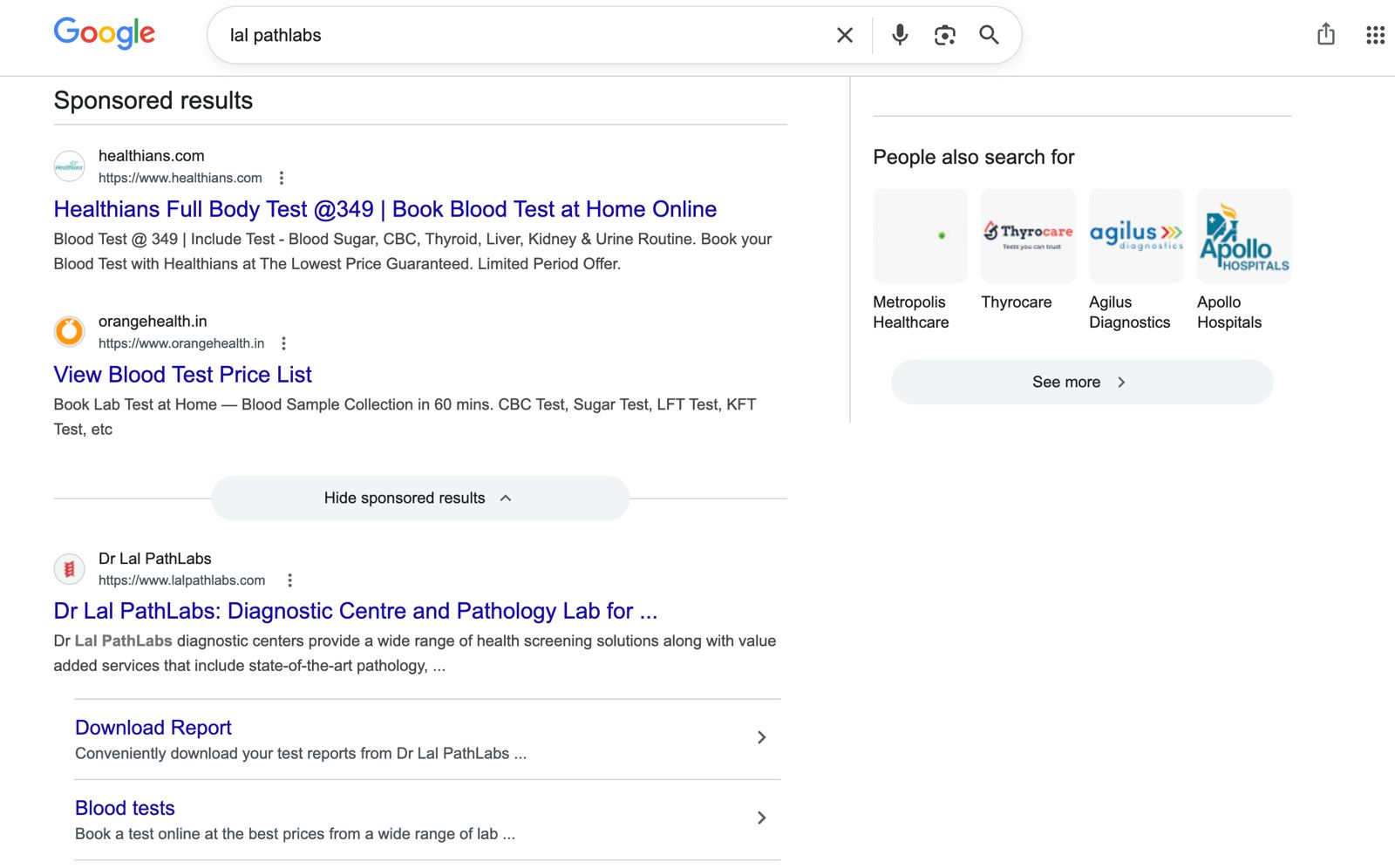
Source: Google search, 7 Jul 2026, Noida. Healthians and Orange Health’s Ads are visible while Searching for Lal Pathlabs brand.
A competitor’s sponsored ad appearing above a brand’s own organic result, the exact scenario at the centre of the Hindware dispute.
A user searches for your brand, clicks a sponsored result, lands on another company’s page, and fills out a form thinking the company is connected to you. Sales then works a lead that was never truly aligned. On paper, the campaign may still show conversions. In reality, lead quality suffers.
Agencies and in-house teams often take over Google Ads accounts that already contain competitor keywords, broad match campaigns, old experiments, or auto-suggested keyword themes. The campaign keeps spending, reporting looks normal, and no one revisits whether those keywords were ever reviewed or approved. That is where risk usually hides: not in a bold strategy, but in neglected campaign structure.
The Delhi High Court’s Hindware judgment brought the issue back into the spotlight. Hindware sells sanitaryware under the well-known “HINDWARE” mark and objected to competitor ads appearing for searches related to its brand name and product terms. The case drew attention because it was not only about rival advertisers. It also raised questions about how brand terms are suggested, auctioned, and used inside paid search systems.
The important point for marketers is not to overstate the ruling. It does not mean every competitor keyword campaign is automatically wrong. It also does not mean every brand-bidding strategy should be switched off immediately.
What it does mean is that Indian advertisers should review how such campaigns are set up, how ad copy is written, how landing pages identify the advertiser, and whether there is any chance of user confusion.
The ruling should be read as a signal about risk and governance, not as a reason for panic.
In simple terms, Google generally does not restrict trademarks used only as keywords. However, it may restrict trademark use inside ad text when the ad is from a direct competitor or when the ad is confusing, deceptive, or misleading about the source of the product or service.
A keyword is what triggers an ad. Ad copy is what the user sees. The landing page is where the user decides whether the advertiser is relevant, official, comparable, or connected to the brand they searched for.
Platform policy tells you what may be technically allowed inside Google Ads. It does not remove the need to assess market-specific risk, brand sensitivity, user confusion, client approval, and campaign intent. That is where PPC governance comes in.
In most competitor keyword campaigns, the biggest risk is not the bid itself. The bigger risk is the experience that follows the bid.
An ad headline may include a competitor’s brand name directly. A comparison landing page may discuss a rival but fail to clearly identify who the advertiser is. Dynamic keyword insertion may automatically place a competitor’s brand term into the ad headline, a risk that has grown alongside recent Performance Max asset control and DKI changes. A broad match campaign may start capturing competitor and dealer searches without anyone noticing.
Reseller, dealer, aggregator, and marketplace campaigns need even more care. If the ad or landing page gives the impression of an official relationship that does not exist, users may misunderstand who they are dealing with the same trust-and-verification gap that programs like Google Guaranteed Ads were designed to close for local service categories.
That is why this issue belongs inside a PPC audit, not only inside a legal discussion. For advertisers, the better question is “Could a reasonable user understand clearly who is advertising, what relationship exists, and where they are being sent?”. If the answer is unclear, the campaign needs review.
Run this as a review, not a fire drill. Most of these checks can be completed inside your Google Ads account within a day.
Check your brand name, product names, service names, and common misspellings in an incognito window.
Look at who appears above your organic result. Note competitor ads, reseller ads, aggregator ads, marketplace ads, and any ad that could confuse a user searching specifically for you. Do this for your most important locations as well, because ad results can vary by city and region.
Your search-term report is where unplanned exposure usually appears. Look for competitor names, dealer names, product trademarks, old brand names, abbreviations, and confusing queries that are triggering your ads.
This step is especially important if your account uses broad match, Performance Max, dynamic search ads, or automated keyword expansion.
If you are intentionally targeting competitor names, keep those campaigns separate from regular non-brand campaigns.
This makes them easier to review, pause, budget, and explain. It also helps you prevent competitor terms from being buried inside broad non-brand campaigns where they may go unnoticed.
Be careful with using another brand’s name in headlines, descriptions, paths, sitelinks, callouts, and structured snippets.
Even where a comparison is valid, the ad should not mislead the user into thinking the advertiser is the searched brand, an official partner, or an authorized representative unless that is actually true.
Dynamic Keyword Insertion (DKI) can be useful, but it needs guardrails. If a campaign can trigger on competitor or trademarked queries, DKI may accidentally insert sensitive brand terms into live ad copy. Review DKI settings and add negative keywords wherever needed.
The landing page should identify the advertiser clearly and immediately. This is especially important for comparison pages, reseller pages, “alternative to” pages, and category pages that mention multiple brands. A user should not need to scroll, investigate, or guess who they are dealing with.
No competitor keyword campaign should run without written approval. For agencies, this approval should come from the client. For in-house teams, it should come from the relevant marketing, brand, or leadership stakeholder.
The approval does not need to be complicated. It should simply record the strategy, keyword category, ad-copy approach, landing page, and review owner.
Review branded search results weekly for your priority terms. This is useful even if you do not run competitor campaigns yourself. It helps you spot new advertisers, unauthorized resellers, confusing claims, and sudden CPC pressure on branded terms.
Brand SERP monitoring should be part of paid-search hygiene, just like conversion tracking and budget checks.
Build the review into the process instead of relying on judgement per campaign. A few changes cover most of the exposure.
Add a competitor-keyword approval step before any such campaign goes live, with the decision recorded. Separate competitor campaigns from your regular non-brand campaigns so they are easy to find, pause, and review in isolation. Keep ad copy clean of rival trademarks, and treat comparison pages as high-care assets that state the advertiser plainly.
Do not let ad copy or a landing page imply partnership, dealership, or official status unless it is true and documented. Keep the strategy note and the approval screenshots together, so the reasoning behind a campaign survives a team change.
For agencies, this is also a client-trust issue. A client should never discover later that their account was bidding on competitor names without their knowledge.
Balance matters here, so be precise about what the ruling does not say.
It does mean PPC teams should be more deliberate about intent, ad copy, landing page clarity, and documentation, especially in India, and especially around coined or well-known marks.
Brand keywords are not only a performance lever. They sit where paid search, user trust, brand protection, and campaign governance overlap, and the Hindware discussion is a reminder of exactly that.
The next step for most advertisers is straightforward. Audit how your brand terms and competitor terms are running in Google Ads, check that the ad experience is clear to a real user, and document the strategy before you scale any campaign that touches a competitor’s name.
They sit where paid search, user trust, brand protection, and campaign governance overlap. The Hindware discussion is a useful reminder for advertisers to review that overlap before scaling competitor or trademark-sensitive campaigns.
Audit how your brand terms and competitor terms are appearing in Google Ads. Check whether the ad experience is clear to a real user. Review whether competitor activity was approved. Make sure dynamic keyword insertion is not creating unwanted ad copy. And document the strategy before scaling anything that touches another brand’s name.
Brand bidding should not be treated as a hidden PPC tactic. It should be treated as a visible, reviewed, and documented part of search governance.

Saurabh Garg, the visionary Chief Technology Officer at Whitebunnie, is the driving force behind our cutting-edge innovations. With his profound expertise and relentless pursuit of excellence, he propels our company into the future, setting new standards in the digital realm.

For years, Google Cache was a favorite resource for digital marketers, SEO experts, and everyday internet users. It provided quick […]
Read Post »
If you are into B2B marketing and want to generate a consistent flow of high-quality leads then Accounts Based Marketing […]
Read Post »
Content clusters are one of the simplest ways to make your SEO content easier to understand for both people and […]
Read Post »
Copyright © 2026 White Bunnie -All Rights Reserved