


IndexNow vs Sitemap: Which One Should You Use in 2026?
-
Author
Saurabh Garg -
Publish
November 19, 2025 4:34 am -
Read Time
8 Min
 Lets talk











Fill in the Form below for a no-string attached free technical discussion.
Website owners care about one thing when they publish new content how quickly it gets indexed. In 2026, this leads to a common question:
Should you stick to the traditional XML sitemap or start using the newer IndexNow protocol?
At White Bunnie, many Indian businesses ask this while planning their SEO setup. Since Google controls 97–98% of India’s search market, its indexing preferences matter the most. But Bing and other global engines still contribute meaningful traffic, and they support IndexNow.
This guide explains both methods in simple language and shows why using both together gives the strongest results.
An XML sitemap is a file that lists your important webpages. Search engines use it to understand your site structure and discover URLs. They fetch this file at intervals and decide when to crawl each page. This makes it part of a pull-based system, you wait for search engines to come and check your sitemap.
Website owners usually submit their sitemap to Google Search Console and Bing Webmaster Tools.
A good sitemap:
Lists all your important URLs
Shows when each page was last updated (using <lastmod>)
Helps search engines understand your site
Acts as a safety net in case some pages are hard to reach through internal links
Even if some pages have weak linking, the sitemap ensures they still get discovered.
IndexNow is a newer protocol introduced by Microsoft Bing and Yandex in 2021. It works differently from a sitemap. Instead of waiting for bots, IndexNow lets your site push updates instantly.
Whenever you:
Publish a new page
Update an existing page
Delete an outdated page
Your site sends a ping to a specific IndexNow API link. This ping tells participating search engines that the page needs a quick crawl.
A major advantage is that one ping reaches all search engines that support IndexNow, such as Bing, Yandex, Seznam, and Naver. You don’t need to submit each URL separately.
Adoption has grown quickly:
Over 60 million websites were using IndexNow by late 2023
About 1.4 billion URLs were submitted per day
By early 2024, IndexNow powered 17% of new URL discoveries on Bing
Many CMSs and CDNs now have IndexNow built in, making setup simple.
No. Google tested the protocol but does not use it as of 2025–2026. So IndexNow will not speed up Google’s indexing. Google still depends on:
XML sitemaps
Good internal linking
RSS feeds
Its own limited Indexing API (jobs and live streams only)
This makes IndexNow a complement, not a replacement. Google still relies heavily on systems built around Mobile-First Indexing, so strong technical SEO remains important.
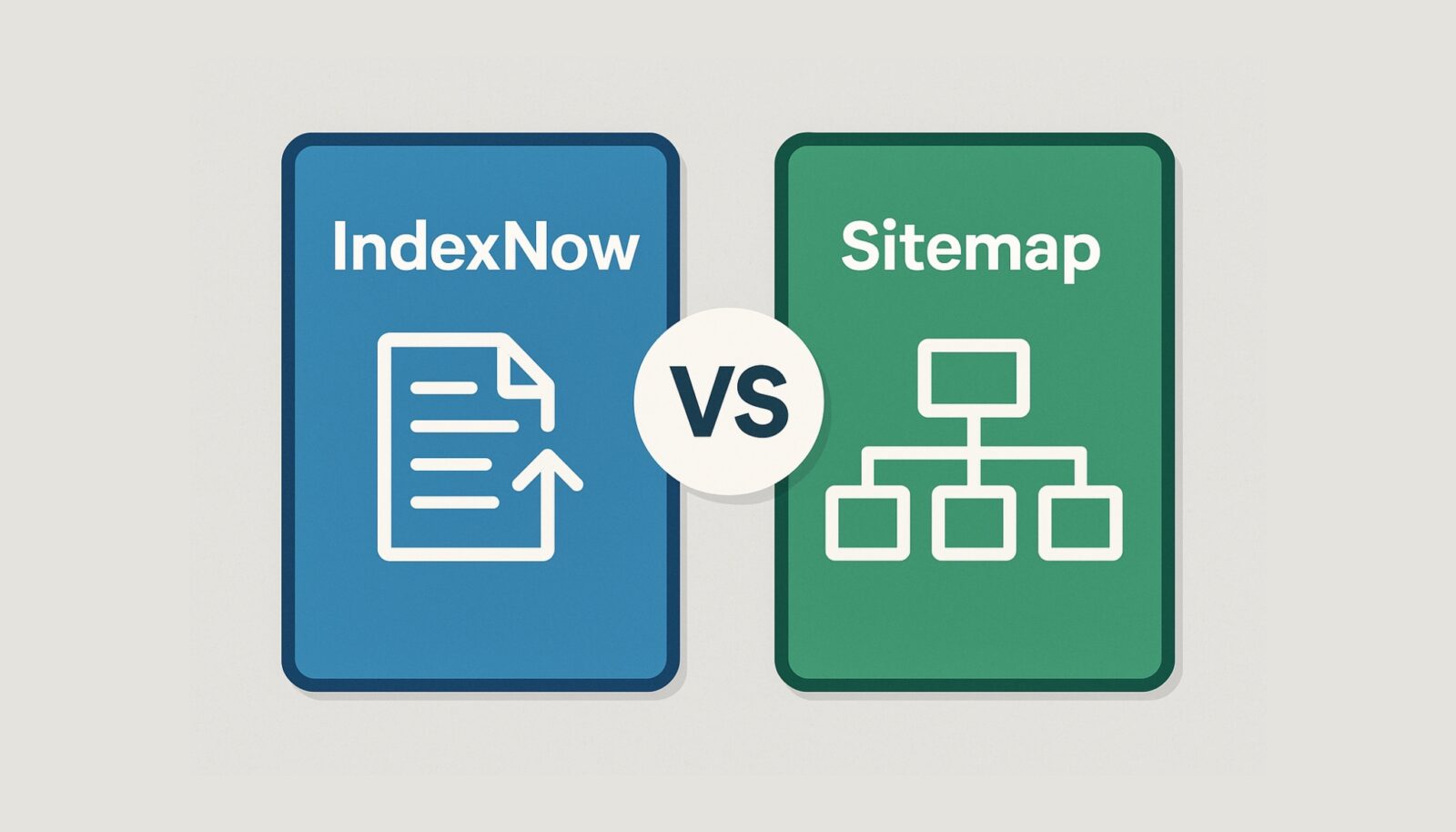
XML sitemap → Search engines come to you.
IndexNow → You send changes to them instantly.
IndexNow reduces waiting time because the signal is delivered in real time.
IndexNow often gives faster indexing on search engines that support it.
Tests show:
A news article indexed in 2 hours with IndexNow
The same article indexed in 15 hours through sitemap-only crawling
Websites in fast-moving niches—news, product updates, time-sensitive blogs—benefit the most. Faster indexing means more timely visibility.
Sitemap: Lists every URL on the site.
IndexNow: Sends alerts only when pages change.
IndexNow is not meant to list every page. It only notifies updates.
That’s why IndexNow’s official note says:
“Use IndexNow for updates and sitemaps for full coverage.”
Support differs:
| Feature | Sitemap | IndexNow |
|---|---|---|
| Supported by Google | ✔️ | ❌ |
| Supported by Bing | ✔️ | ✔️ |
| Supported by Yandex, Seznam, Naver | ✔️ | ✔️ |
| Supported globally | ✔️ | Limited |
If you want Google traffic—which is essential in India—you cannot skip sitemaps.
Both tools are simple to implement:
Most CMS platforms auto-create sitemaps
Submitting the sitemap is a one-time step
Many CMS plugins (like Rank Math) and CDNs (like Cloudflare) now support IndexNow
IndexNow setup usually needs only:
Generating an API key
Uploading a text file or enabling a plugin
After that, your system handles pings automatically.
A tech news website struggled with slow indexing. New articles sometimes took up to 48 hours to appear on Bing. After enabling IndexNow, most articles were indexed within 30 minutes.
This gave the publisher a major advantage—stories ranked while they were still trending. Google remained slower, but IndexNow still delivered extra traffic from Bing and other supporting engines.
For any business posting time-sensitive updates—news, offers, product changes, or fresh blogs—IndexNow can reduce the delay between publishing and appearing in search results.
The most effective approach is not to choose between them. Use both.
Google depends on them
They give complete URL coverage
They act as a safety net
Given Google’s dominance in India, a sitemap remains non-negotiable.
IndexNow gives near-instant alerts that help Bing and other engines pick up updates quickly. It improves indexing speed with little effort and no negative trade-offs.
Even if Google never supports IndexNow, the benefits on other engines are still worth it.
Bing itself has said that using both methods gives content “the best chance to be discovered, crawled, and indexed efficiently.”
Using XML sitemaps + IndexNow gives you:
Full coverage for every page
Fast crawling for new and updated pages
Better performance across all search engines
More consistent indexing for websites with frequent updates
Extra visibility in markets outside India
This makes your site more resilient in a mixed search ecosystem.
Search engines are moving toward faster, more responsive indexing systems. Google has shown interest in real-time signals, even if it hasn’t adopted IndexNow yet. If Google ever shifts toward a similar system, having IndexNow enabled now prepares you for that future.
Even if they don’t, your sitemap already covers Google, and IndexNow covers others—so nothing is lost. Understanding Crawlability vs. Indexability helps ensure search engines can access your pages and actually add them to the index.
At White Bunnie, we recommend using both XML sitemaps and IndexNow for every website we manage.
Here’s the simple setup:
Keep your XML sitemap updated
Make sure it has accurate <lastmod> entries
Submit it in Search Console and Bing Webmaster Tools
Enable IndexNow on your site or server
Maintain clear internal linking
Update your content regularly
This combination gives you broad and fast indexing across all major search engines. It’s reliable, easy to maintain, and future-ready.
By using both systems, you ensure your site appears in search results as quickly as possible—whether the update is new content, a revised page, or a product change.

Saurabh Garg, the visionary Chief Technology Officer at Whitebunnie, is the driving force behind our cutting-edge innovations. With his profound expertise and relentless pursuit of excellence, he propels our company into the future, setting new standards in the digital realm.

If you’re in the real estate business in India, there’s one goal every agent and brokerage shares — getting your […]
Read Post »
If you’re new to SEO and digital marketing, understanding content pruning can feel a bit overwhelming. However, once you grasp […]
Read Post »
Understanding crawlability and indexability is essential to mastering SEO. These two technical aspects ensure that your website not only gets […]
Read Post »
Copyright © 2026 White Bunnie -All Rights Reserved