

Google Spam Algorithm Updates: What Each One Targeted and Who It Hit (2021–2026)
-
Author
Saurabh Garg -
Publish
May 16, 2024 10:35 am
Last updated: July 2, 2026 5:03 am -
Read Time
8 Min

 Lets talk











Fill in the Form below for a no-string attached free technical discussion.
Key Takeaways
- A spam update is a change to SpamBrain, Google’s AI spam system. It is different from a core update, which re-evaluates overall content quality.
- Most spam updates demote sites algorithmically. Link spam updates neutralize manipulative links instead of penalizing, and that credit cannot be earned back.
- The March 2024 spam update was the heaviest in years. It added three new spam policies and led to named publishers like Forbes Advisor and CNN Underscored losing entire sections from Search.
- Site reputation abuse (parasite SEO) enforcement removed third-party affiliate sections from major news brands, in some cases, days before Black Friday 2024.
- Recovery from a spam update can take many months, and only after Google’s systems re-learn that your site complies.
A Google spam update is an improvement to SpamBrain, Google’s AI spam-detection system, that demotes or removes sites breaking Google’s published spam policies. It is different from a core update. A core update re-evaluates which pages best answer a query, while a spam update enforces specific rules: scaled content abuse, site reputation abuse, link spam, and expired domain abuse. A site hit by a spam update stays demoted until Google’s systems confirm, over a period of months, that it complies again.
That distinction matters the moment your traffic drops. If organic visits fall sharply, Search Console shows no manual action, and nobody changes the site, a spam update is the first thing to check. This guide walks through every documented Google spam update since 2021, names the real sites each type of enforcement has hit, and links to both the original reporting and Google’s own reference for each one. Read it once, and you will be able to tell a spam update apart from a core update the next time your rankings move.
A spam update is a notable improvement to Google’s spam-detection systems, not a change to how Google ranks quality content in general. Google fights spam continuously with an AI system called SpamBrain. A spam update is the moment Google ships a meaningful upgrade to that system and logs it publicly.
The scale of what SpamBrain handles is the reason these updates move rankings so sharply. In its 2021 webspam report, Google said SpamBrain caught roughly six times more spam in 2021 than in 2020. When a system operating at that scale gets a step-change improvement, sites that were ranking on borrowed time tend to drop all at once.
A core update is a different event. It re-evaluates which pages best satisfy a query across the whole index. A spam update asks a narrower question; is this site breaking a specific spam policy? You can be hit by one and untouched by the other, which is exactly why diagnosing the right one matters before you change anything.
Google’s spam enforcement exists because manipulating rankings used to work spectacularly well, and big brands did it. The clearest case is JC Penney in February 2011. A New York Times investigation found thousands of unrelated sites pointing keyword-rich links at JCPenney.com.
The retailer had been ranking number one for many search terms it had no natural claim to, including “Samsonite carry-on luggage,” “dresses,” and “area rugs”. After Google’s webspam lead Matt Cutts confirmed the links violated guidelines, those rankings collapsed to page five and beyond within hours. The penalty lasted roughly 90 days while JC Penney unwound the scheme.
The same era produced more cautionary cases. Interflora vanished from Google’s results in 2013 over paid advertorial links, then recovered in about 11 days once it cleaned up. Every modern spam update is a descendant of this fight. If you have inherited a messy backlink profile, our guide on how to find and remove toxic backlinks covers the cleanup.
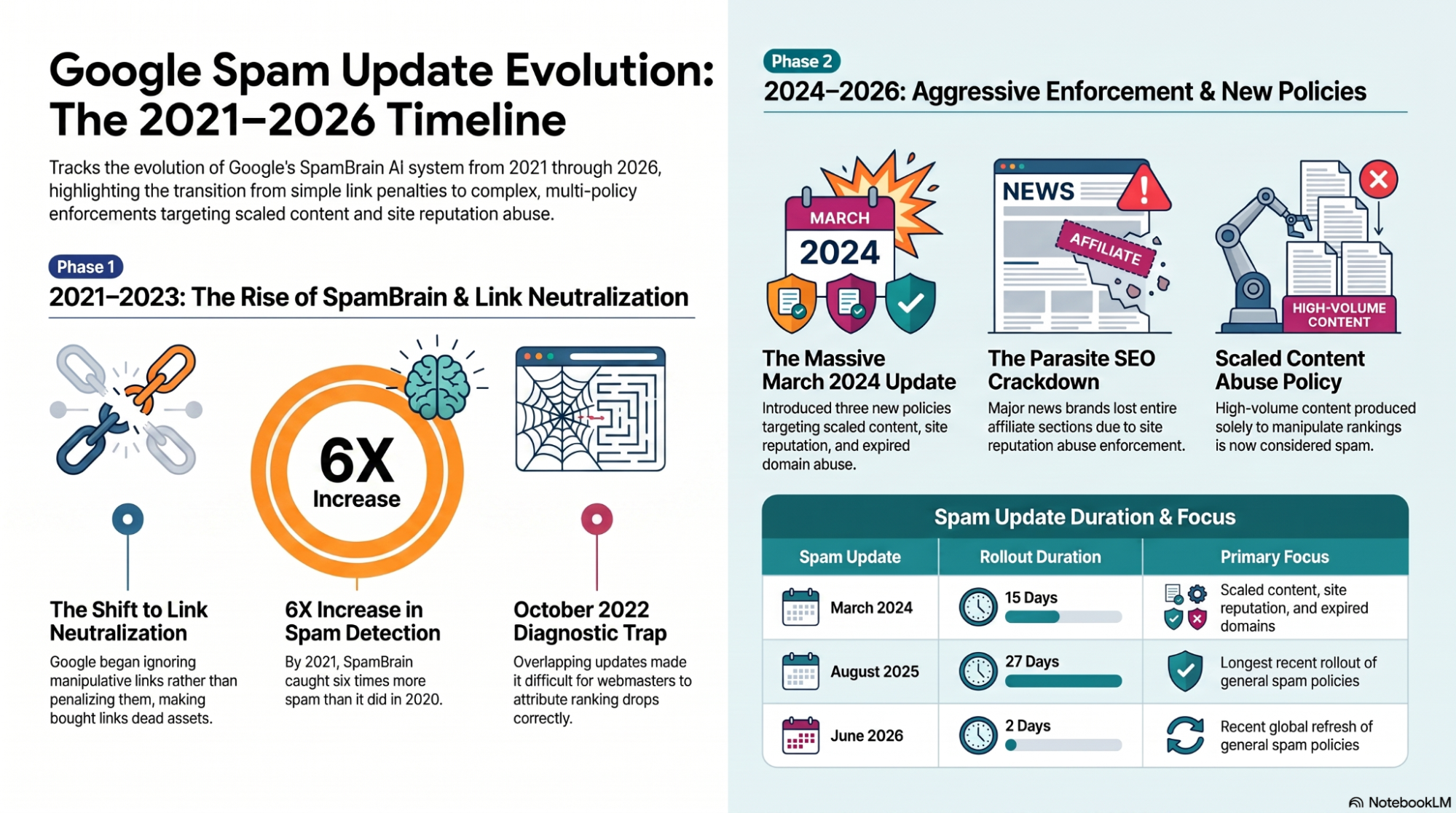
Source: Image created with the help of Notebook LM, Google
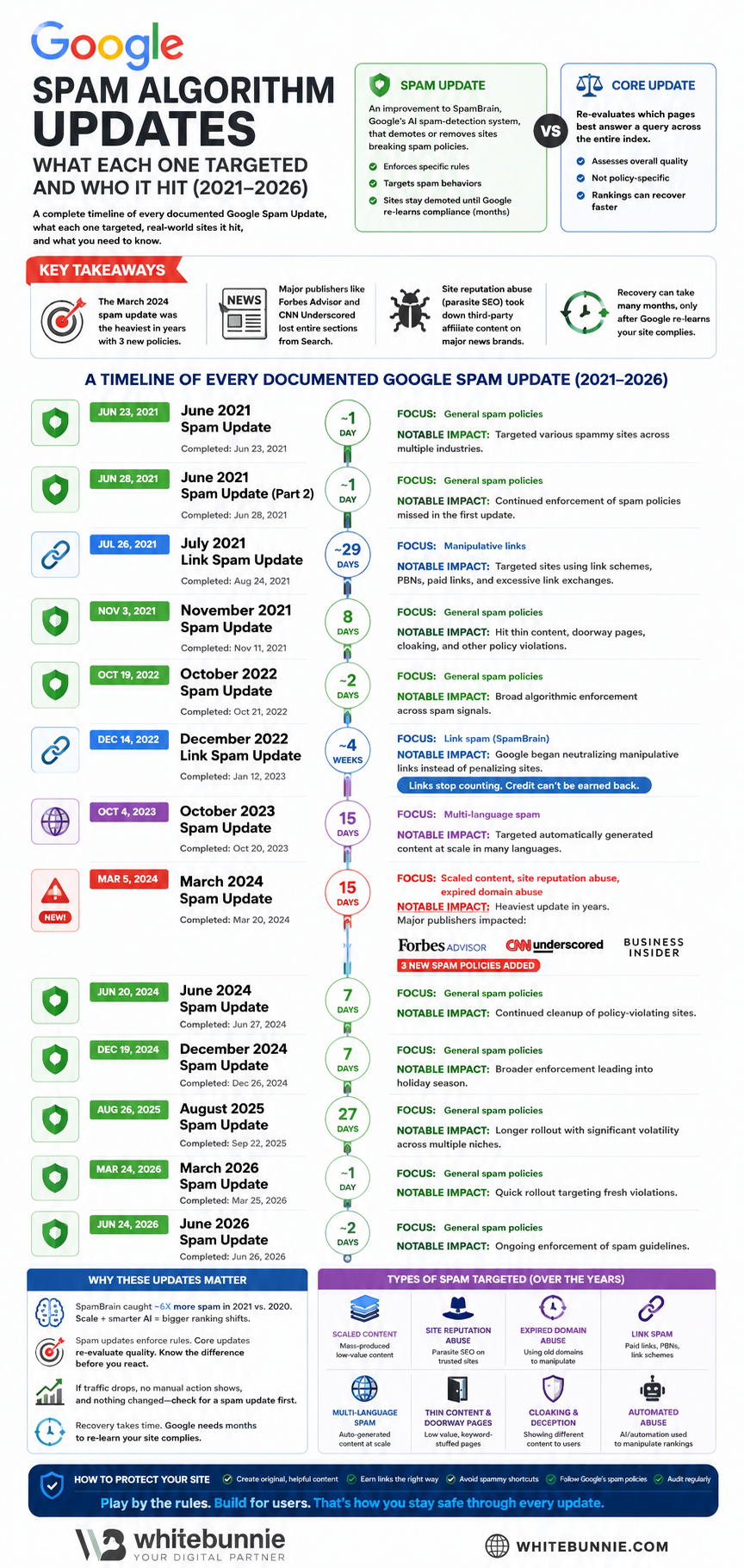
Here is the full run of spam updates Google has named since 2021, with rollout dates and what each one addressed. The duration tells you something useful on its own: longer rollouts have tended to move rankings more.
| Spam update | Started | Completed | Rollout | Focus |
|---|---|---|---|---|
| June 2021 spam update | Jun 23, 2021 | Jun 23, 2021 | ~1 day | General spam policies |
| June 2021 spam update (part 2) | Jun 28, 2021 | Jun 28, 2021 | ~1 day | General spam policies |
| July 2021 link spam update | Jul 26, 2021 | Aug 24, 2021 | ~29 days | Manipulative links |
| November 2021 spam update | Nov 3, 2021 | Nov 11, 2021 | 8 days | General spam policies |
| October 2022 spam update | Oct 19, 2022 | Oct 21, 2022 | ~2 days | General spam policies |
| December 2022 link spam update | Dec 14, 2022 | Jan 12, 2023 | ~4 weeks | Link spam (SpamBrain) |
| October 2023 spam update | Oct 4, 2023 | Oct 20, 2023 | 15 days | Multi-language spam |
| March 2024 spam update | Mar 5, 2024 | Mar 20, 2024 | 15 days | Scaled content, site reputation, and expired domain abuse |
| June 2024 spam update | Jun 20, 2024 | Jun 27, 2024 | 7 days | General spam policies |
| December 2024 spam update | Dec 19, 2024 | Dec 26, 2024 | 7 days | General spam policies |
| August 2025 spam update | Aug 26, 2025 | Sep 22, 2025 | 27 days | General spam policies |
| March 2026 spam update | Mar 24, 2026 | Mar 25, 2026 | ~1 day | General spam policies |
| June 2026 spam update | Jun 24, 2026 | Jun 26, 2026 | ~2 days | General spam policies |
The link spam updates changed the rules of the link game. Instead of penalizing a site for unnatural links, Google’s December 2022 link spam update used SpamBrain to neutralize them. The links simply stop counting, and any ranking they were propping up disappears.
This distinction matters for recovery. With a neutralized link, there is no penalty to lift. The credit those links passed is gone and cannot be regained, even after you change tactics. Sites that had quietly bought links for years watched rankings sink with nothing to “fix,” because the problem was the absence of real links, not the presence of a flag.
The practical takeaway for the sites is that bought links are now a dead asset, not a risk you can manage. Earned, contextual backlinks are the only links that survive a SpamBrain pass.
The October 2022 spam update was a global rollout of about two days that hit sites breaking Google’s general spam policies. It landed within days of the September 2022 core update and the August 2022 helpful content update, which made it hard to attribute any drop to a single change.
That overlap is the recurring trap. When a spam update, a core update, and a content system all move within the same window, teams blame the wrong one and fix the wrong thing. The diagnostic section below is built to stop that.
The March 2024 update was the one that genuinely frightened the industry. Google ran a core update and a spam update at the same time, then layered on three new spam policies: scaled content abuse, site reputation abuse, and expired domain abuse. Google said the goal was to cut low-quality, unoriginal content in results by about 40%.
The casualties were specific and large. Zac Johnson had published more than 60,000 articles between September 2023 and March 2024, an average of more than 300 pieces a day across unrelated topics, and was deindexed as a textbook scaled-content case. FreshersLive received a pure-spam manual action despite traffic larger than many mainstream outlets.
Scaled content abuse is the policy most relevant to anyone tempted to mass-produce AI articles. Google’s position is that producing content at scale to manipulate rankings is spam, whether a human or an AI model wrote it. If you are publishing AI-assisted content, the safeguard is genuine expertise and original input, which is the same standard behind E-E-A-T in 2026.
Site reputation abuse, better known as parasite SEO, is when a trusted domain rents its ranking strength to third-party content it does not really stand behind. Google announced the policy in March 2024, further enhanced the enforcement with June 2024 and December 2024 spam updates.
Forbes Advisor, run as a large affiliate operation that Stone Press estimated at roughly $236 million a year, was hit hard, with its / health supplement directory wiped from Search. CNN Underscored dropped to about 10 indexed URLs. WSJ Buy Side, USA Today’s Reviewed, and US News 360 Reviews were among the affiliate sections demoted. According to the UK Press Gazette, many of these penalties landed days before Black Friday, removing a major revenue line with no time to pivot.
The lesson for sites is sharper than “avoid coupons”. Google is signalling that topical authority on your own domain beats borrowed authority on someone else’s. If you have read about parasite SEO, this is the enforcement that closed the window on the abusive version of it.
The August 2025 spam update ran for 27 days, from August 26 to September 22, the longest of the recent runs. Long rollouts make attribution harder because rankings keep shifting for weeks, and any unrelated change you make mid-rollout gets falsely credited or blamed. The operational rule during a long rollout was to hold steady. Changing many things during a 27-day rollout has left you unable to tell which one mattered.
Google ran the March 2026 spam update in a single day on March 24, then the June 2026 spam update from June 24 to June 26. Google described June 2026 as a normal spam update that does not target link spam or the site reputation abuse policy, applied globally and to all languages, and confirmed it finished in about two days.
Both followed the same pattern as every general spam update before them: a SpamBrain refresh against Google’s existing spam policies, with no list of named targets from Google. When a fresh spam update lands, the move is always the same: check Search Console for a manual action, then compare your drop against the confirmed rollout dates before changing anything.
Spam updates enforce the spam policies listed in Google’s documentation. Reading them against your own site is the fastest way to find your exposure. Here are the policies that catch the most sites, each with a real-world pattern.
If your audit surfaces a cluster of thin or near-duplicate pages, deliberate content pruning is the fix. But the major issue here is “how to identify and cut them without harming the rest of the cluster”.
The single fastest check is Search Console’s manual actions report. A manual action means a human reviewer flagged your site, and you will see the reason named there. No manual action, but a sharp drop aligned with a confirmed update date, points to an algorithmic spam or core update instead.
From there, three signals separate a spam hit from a core hit. A spam update tends to affect specific sections or pages that match a policy, not the whole site’s quality profile. A core update tends to re-rank broadly across topics. And the timing has to line up with a confirmed update window on Google’s status page, not just a date that feels right.
Pull the drop in Google Search Console by date and compare it against the confirmed rollout. Our walkthroughs on diagnosing sudden traffic drops with Search Console and the broader SEO health checklist for ranking drops give you the exact reports to open. Get this attribution right before you touch anything, because the recovery path for a spam update and for Google Core Updates is not the same.
Recovery from a spam update is slow by design, and Google says so plainly; changes may help only after its automated systems observe, over a period of months, that your site now complies. There is no reconsideration request for an algorithmic spam update, unlike a manual action. You fix the cause and wait for the next assessment.
The order of operations is what most teams get wrong. First, confirm the policy you breached, using the self-diagnosis list above. Second, remove or rebuild the offending content rather than tweaking it, because half-measures on scaled or thin content rarely clear the threshold. Third, if links were involved, understand that neutralized link credit is gone and your job is to earn real links, not to disavow your way back to a number that no longer exists.
One caution specific to site reputation abuse is, “do not move a penalized section to a new subdomain or subdirectory to dodge the action”. Google treats that as policy circumvention and can widen the enforcement across more of your site.
B2B, ITES and SaaS sites rarely get caught buying coupon traffic, so it is tempting to assume spam updates are someone else’s problem. The exposure is different but real. It shows up as scaled, AI-assisted content published faster than anyone can review it, and as thin programmatic pages built to chase a keyword list rather than answer a buyer.
The publisher’s casualties of 2024 made the underlying signal explicit. Google removed borrowed authority and rewarded sites with genuine topical depth on their own domain. For an ITES or SaaS company, the durable strategy is to own a topic with first-party expertise, not to scale output and hope volume substitutes for authority. The same entity and authority signals that protect you from spam enforcement are the ones that get you cited in AI Overviews and AI answers.
If you are publishing AI-assisted content at any volume, the question to answer on every page is whether a person with real expertise shaped it. If the honest answer is no, that page is the one a spam update finds first. For the wider context on how Google got here, see our companion piece on the major Google algorithm updates that built Google as we know it.

Saurabh Garg, the visionary Chief Technology Officer at Whitebunnie, is the driving force behind our cutting-edge innovations. With his profound expertise and relentless pursuit of excellence, he propels our company into the future, setting new standards in the digital realm.

The Confirmation B2B Marketers Have Been Waiting For For years, Google gave a consistent answer whenever anyone asked whether social […]
Read Post »
Google has officially rolled out its March 2025 Core Update, marking its first significant algorithm update of the year. This […]
Read Post »
Google’s algorithm is the single biggest variable in organic visibility, and it has not stopped moving since the company released […]
Read Post »
Copyright © 2026 White Bunnie -All Rights Reserved