
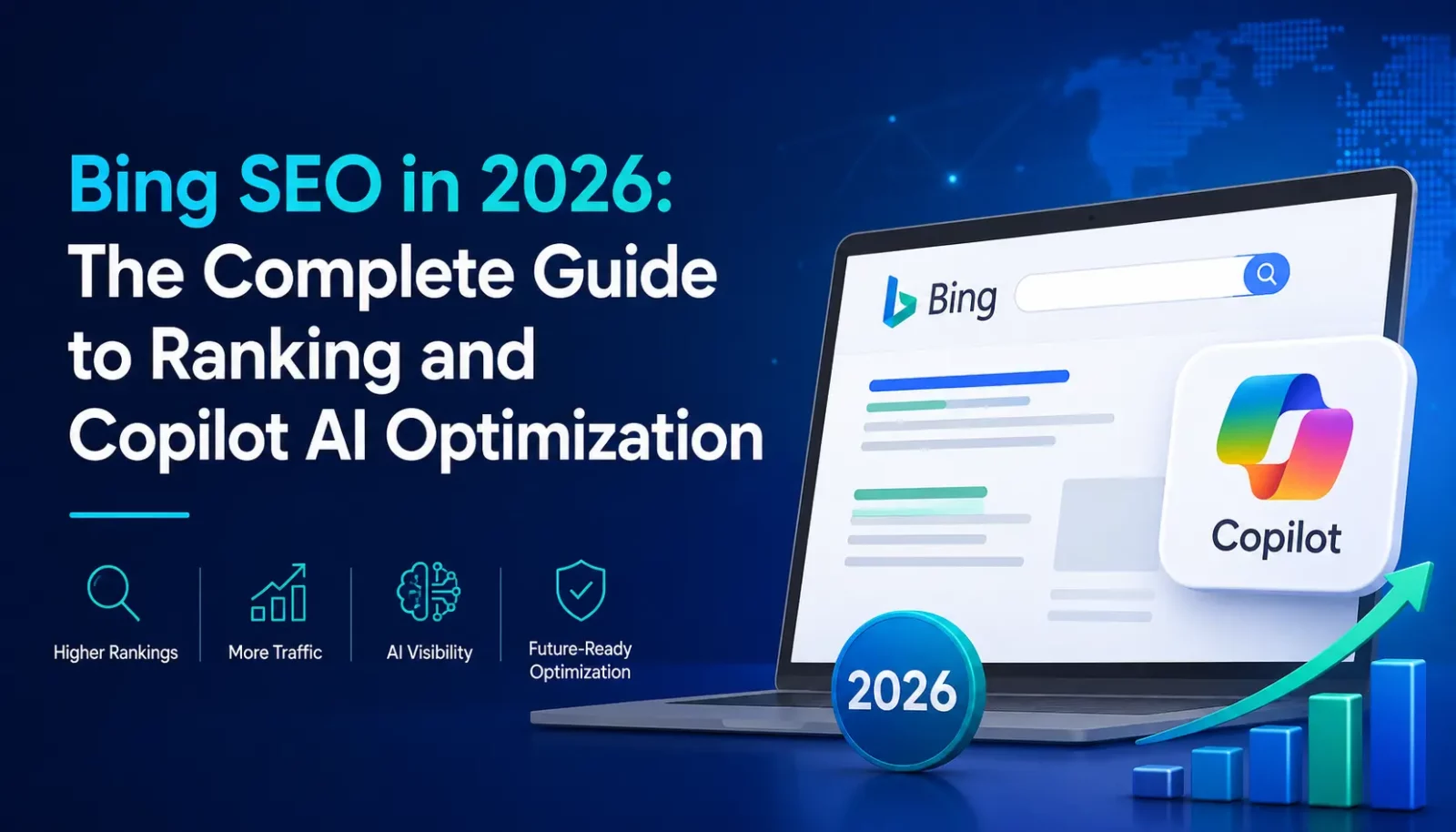
Bing SEO in 2026: The Complete Guide to Ranking and Copilot AI Optimization
-
Author
Neha Garg -
Publish
August 7, 2026 7:12 am -
Read Time
12 Min
 Lets talk









Fill in the Form below for a no-string attached free technical discussion.
Quick summary
- Bing holds a small share of search in India, roughly 1.2 percent, but its index now feeds Microsoft Copilot and ChatGPT Search. Ranking on Bing puts your brand inside AI answers, not just blue links.
- Copilot cites what Bing ranks. A page missing from Bing’s index cannot show up in Copilot, and in most cases it stays invisible to ChatGPT Search too.
- Setup is fast. Verify your site in Bing Webmaster Tools, import your settings from Google Search Console, submit a sitemap, and switch on IndexNow.
- Bing weights exact-match keywords in your title and H1, social engagement, older domains, and content freshness more heavily than Google does.
- Answer-first writing, visible authorship, and clean schema markup raise your odds of being cited by AI engines.
- Track your progress with tools like Semrush AI Visibility Toolkit, Ahrefs Brand Radar, and SE Ranking, plus Bing’s own AI Performance report.
Most Indian marketing teams pour every hour into Google. That makes sense on paper. Google handles close to 97 percent of searches in India, and Bing sits near 1.2 percent, per StatCounter data. If share were the whole story, Bing would be an easy skip.
Share is not the whole story anymore.
Bing’s index quietly became the plumbing behind a large chunk of AI search. Microsoft Copilot runs on it natively. ChatGPT Search pulls from it as its main real-time retrieval layer. So the question is no longer “how many people use Bing.” The question is “how many AI answers borrow from Bing.” That number is large and climbing.
This shift matters even more for B2B SaaS and IT services brands. Your buyers now ask Copilot and ChatGPT to shortlist vendors, compare tools, and summarise categories. If your pages sit outside Bing’s index, you are absent from that conversation before it starts.
We treat Bing less as a second search engine and more as a distribution channel for AI citations. The effort is small. The reach is not.
Here is the mechanism in plain terms.
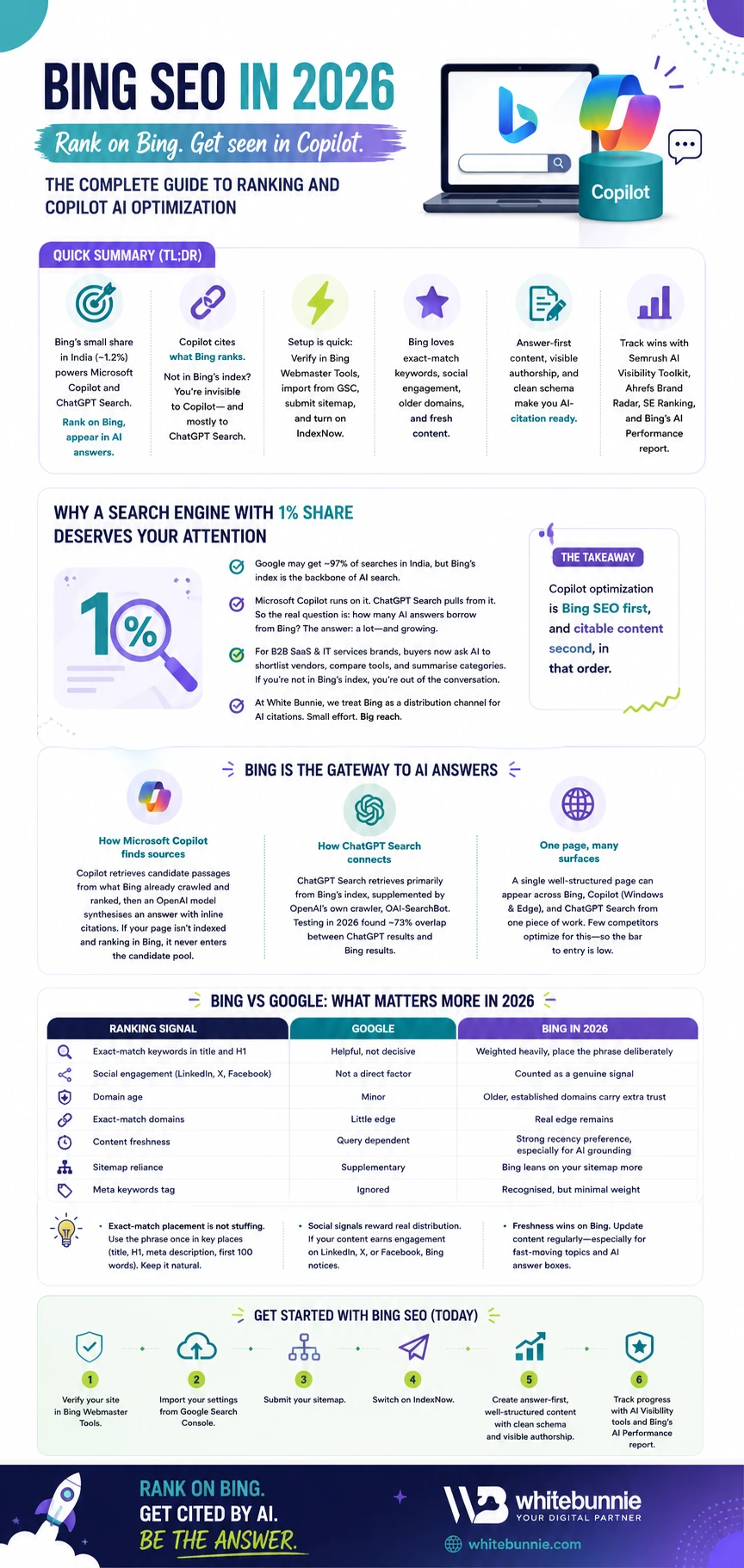
Copilot does not browse the live web for most queries. It retrieves candidate passages from what Bing already crawled and ranked, then an OpenAI model synthesises an answer with inline citations. If your page is not indexed and ranking in Bing for a query, it never enters the candidate pool.
ChatGPT Search retrieves primarily from Bing’s index, supplemented by OpenAI’s own crawler, OAI-SearchBot. Independent testing in 2026 found roughly 73 percent overlap between ChatGPT results and Bing results. OpenAI has been testing its own crawling infrastructure on some tiers, so this can shift, but Bing remains the safest single lever for ChatGPT visibility today.
A single well-structured page can surface across Bing, Copilot in Windows and Edge, and ChatGPT Search from one piece of work. Few competitors optimise for this, which keeps the bar to entry low.
The takeaway is direct. Copilot optimization is Bing SEO first, and citable content second, in that order. Get indexed, rank for the query, then write so a model can lift a clean answer from your page.
The fundamentals overlap. Crawlable structure, useful content, real backlinks, and fast pages help you on both engines. Get Google right and you are most of the way to Bing. The gap sits in a handful of Bing-specific preferences.
| Ranking signal | Bing in 2026 | |
| Exact-match keywords in title and H1 | Helpful, not decisive | Weighted heavily, place the phrase deliberately |
| Social engagement (LinkedIn, X, Facebook) | Not a direct factor | Counted as a genuine signal |
| Domain age | Minor | Older, established domains carry extra trust |
| Exact-match domains | Little edge | Real edge remains |
| Content freshness | Query dependent | Strong recency preference, especially for AI grounding |
| Sitemap reliance | Supplementary | Bing leans on your sitemap more |
| Meta keywords tag | Ignored | Recognised, but minimal weight |
A few practical notes on this table.
For a deeper technical view, see our guide on making your site AI-search ready.
You cannot rank on Bing or get cited by Copilot until Bing can crawl and index your site cleanly. Most teams skip this step, which is exactly why the surface is winnable.
IndexNow is an open protocol pioneered by Microsoft. It lets your site push URLs to Bing the moment you publish, update, or delete a page, with indexing often finished in minutes rather than days.
Microsoft is explicit that IndexNow freshness signals help Copilot ground answers in current information. For news, product catalogues, and frequently updated resources, that speed is an advantage Google workflows cannot match.
In February 2026, Microsoft launched the AI Performance report inside Bing Webmaster Tools. It is the first tool from a major search engine that shows how often your pages get cited in AI answers across Copilot and Bing’s AI summaries.
Use it the way you use the GSC queries report:
Ranking on Bing gets you into the pool. Getting cited by Copilot means writing so a model can extract a clean, sourced answer. Here is what moves the needle in 2026.

Copilot’s extraction layer is positionally biased. It weights the first substantive paragraph of a section far more than later paragraphs. If your page opens with three paragraphs of background before it states what your product does, Copilot may cite a competitor whose page leads with the answer.
The fix: Put the direct answer to the page’s main question in the first paragraph under the H1, before context. Then follow with supporting detail. Apply the same pattern to every H2 section.
E-E-A-T is not a slogan for AI search. Copilot favours content it can trust to cite without risk.
Pages with an evidence trail sit higher in the candidate pool than anonymous opinion pieces, even when both rank for the keyword.
Schema markup helps machines read your content, and our technical AEO checklist covers the JSON-LD setup in detail. In 2026, the practical wins are:
An e-commerce or SaaS page with clean Product or FAQ schema is far more likely to surface when a buyer asks Copilot to compare options.
Microsoft rewrote large sections of its webmaster guidelines in February 2026 and named Generative Engine Optimization directly. Two directives now affect AI answers specifically:
Audit your templates. A stray NOARCHIVE tag can quietly remove you from every AI answer.
Content not updated in the last 30 days is disadvantaged in Copilot’s recency-weighted retrieval. A quarterly refresh cycle on your priority pages protects your citation footprint.
Two structural habits repeatedly show up in cited pages, based on 2026 industry analysis.
A few more rules that hold up across Copilot, ChatGPT, Gemini, Perplexity, and Claude:
Focus on information density over raw length. A tight 2,000-word guide that answers the question beats a padded 4,000-word page that circles it.
If you want to measure and improve AI visibility, these are the platforms currently ranking at the top of Google for generative engine optimisation, along with what each one does best.
You do not need all of these. Pick one tracker that fits your existing stack, then use Bing’s free report as your ground truth.
For hands-on help choosing and running these, see our AI SEO services.
Work through this in order.
Yes, for a different reason than raw traffic. Bing’s small direct share understates its value, because its index powers Microsoft Copilot and ChatGPT Search. Ranking on Bing is how you get cited inside AI answers, which is where a growing slice of B2B research now happens.
Not automatically. The two engines share fundamentals, but Bing filters and weights signals differently. A clean Google Search Console report does not prove Bing has indexed you. You still need to verify your site in Bing Webmaster Tools and check that your pages are actually in Bing’s index.
Rank the page in Bing for the target query, then structure it for extraction. Lead with the answer, show clear authorship and dates, add relevant schema, keep the page fresh, and avoid NOARCHIVE tags. Copilot cites pages it can trust and lift a clean answer from.
IndexNow is an open protocol that instantly tells Bing when you publish, update, or delete a page, so indexing happens in minutes instead of days. If you publish or update content regularly, it is worth enabling. Most SEO plugins and Cloudflare support it with a simple toggle.
Semrush AI Visibility Toolkit, Ahrefs Brand Radar, and SE Ranking all track citations and share of voice across major AI engines. For Copilot specifically, the free AI Performance report inside Bing Webmaster Tools is the most direct source.
Bing stopped being a second-tier afterthought the moment its index became the retrieval layer for Copilot and ChatGPT Search. The direct traffic is still small in India. The AI reach is not. A short setup, answer-first content, clean schema, and a quarterly refresh can put your brand inside answers your competitors never think to target.
The teams that win here are not the ones with the biggest budgets. They are the ones who set up Bing Webmaster Tools, turned on IndexNow, and started writing for extraction while everyone else stared only at Google.
If you want a Bing and Copilot visibility program built and measured properly, White Bunnie runs SEO, AEO and GEO as one connected strategy, so a single piece of work shows up across search and AI answers alike.

Neha founded White Bunnie in 2018. The agency specializes in SEO, AEO, and GEO for B2B IT services, SaaS, and ITES companies targeting global markets. Their work has helped brands move from zero visibility to consistent AI citations across various popular AI platforms like ChatGPT, Perplexity, and Gemini.

The way we search for and consume online information is evolving rapidly. For years, search engine optimization (SEO) was the […]
Read Post »
The world of search has changed. By August 2025, “zero-click” searches—where a user gets their answer directly on the results […]
Read Post »
You might find it difficult to keep up with important news, industry shifts, and brand mentions. With the endless flow […]
Read Post »
Copyright © 2026 White Bunnie -All Rights Reserved