

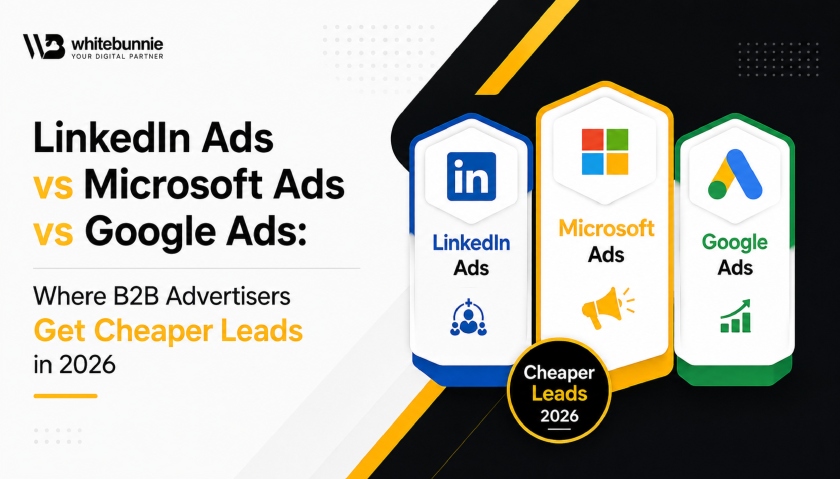
LinkedIn Ads vs Microsoft Ads vs Google Ads: Where B2B Advertisers Get Cheaper Leads in 2026
-
Author
Saurabh Garg -
Publish
September 4, 2026 6:45 am -
Read Time
13 Min
 Lets talk










Fill in the Form below for a no-string attached free technical discussion.
Every B2B marketer running paid search can already tell you that CPC isn’t CPL, and CPL isn’t CAC. That’s not where the mistake happens. It happens in budget meetings, where platforms get compared on whichever number looks best in the moment, usually cost per click, because it’s the number every dashboard leads with. The platform with the cheapest click isn’t always the platform with the cheapest paying customer.
In 2026, that gap has only widened. A cheap click can turn into an expensive lead, and an expensive click can turn into your cheapest customer. Before you move budget, you need to know what “cheap” actually means on each platform, and where each one genuinely saves you money.
That is how we plan a B2B PPC management budget: not by click price, but by where real revenue comes from.
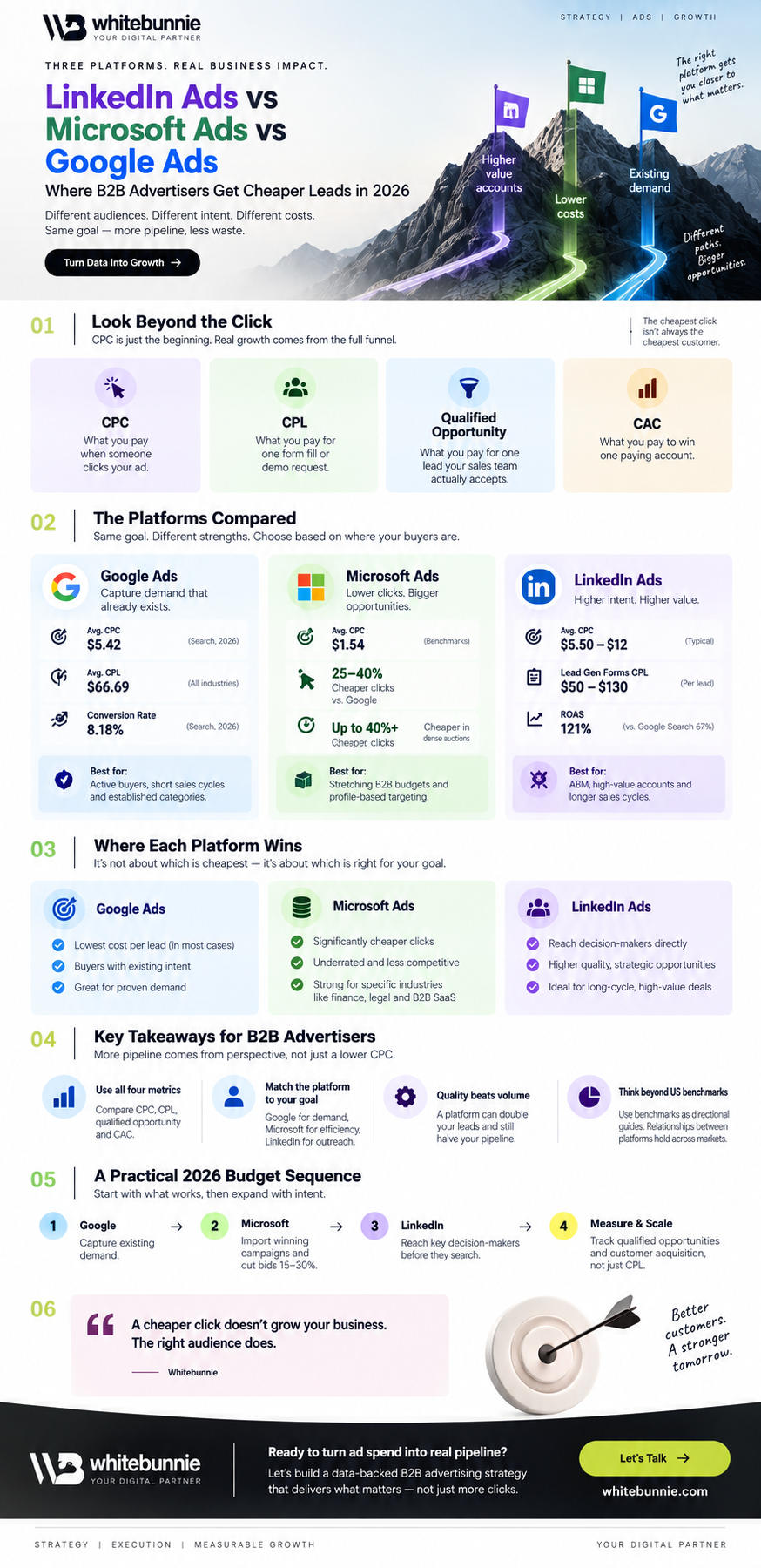
A single-metric comparison flatters whichever platform has the lowest sticker price and hides where the budget actually pays off. To compare platforms honestly, track all four:
CPC is the number everyone quotes. CAC is the number that decides whether you make money. The third one is the number most teams never calculate, and it is where the real answer lives: a platform can double your lead volume and halve your pipeline at the same time. If your B2B lead generation reporting stops at CPL, you are grading the wrong exam.
One note before the numbers: Every benchmark below is in US dollars and drawn from US-based campaign data. If you advertise primarily in India, the UK or the UAE, treat these as directional ratios rather than absolute targets. The relationships between platforms hold; the absolute figures will not.
Google runs on search intent. Someone types “invoice software for accountants” and your ad appears. That person already knows they have a problem, so they sit closer to a decision.
According to WordStream’s 2026 search advertising benchmarks, the all-industry average cost per lead on search is $66.69, with an average cost per click of $5.42 and a conversion rate of 8.18%. Business Services runs higher at $5.87 per click and $93.69 per lead, and Attorneys & Legal Services is the most expensive vertical measured, at $9.87 per click and $131.63 per lead.
An important caveat almost nobody mentions when quoting that $66.69: it is a median across 13,474 US campaigns running April 2025 to March 2026, and it blends Google Ads and Microsoft Ads together. The sample also skews toward local and SMB lead generation rather than enterprise software. It is a useful sanity check, not a B2B SaaS target.
The genuinely good news from the 2026 data is that average cost per lead fell for the first time in five years, while conversion rates improved in 87% of industries. Cheaper leads are coming from better conversion, not cheaper clicks, which means account quality is doing more work than bidding.
Short sales cycles, established categories, and buyers who are ready now. If people are already searching for what you sell, Google usually delivers your lowest cost per lead of the three. If your costs are drifting the wrong way, the fix is almost always structural. Our guide to lowering your Google Ads cost per acquisition covers the levers that move it, and our Google Ads management services page explains how we run it.
Google only harvests demand that already exists. It cannot put you in front of a specific job title at a specific company before that person starts searching. And with AI Overviews and AI Max reshaping the results page, the share of that demand you can reliably capture is shifting under you.
Microsoft Advertising, still called Bing Ads by most people, is the platform B2B teams skip, and that is precisely why it is cheaper.
On identical keyword sets, agencies running parallel campaigns typically report clicks 25 to 40% cheaper on Microsoft Ads than Google, with the gap widening past 40% in dense auctions like legal, finance and B2B software. The reason is structural, not qualitative: Microsoft Advertising holds a small share of global search volume against Google’s dominant position, so it is a thinner, cheaper auction.
You will see a headline figure of $1.54 average CPC on Microsoft Ads quoted widely, benchmarked against a $2.69 to $2.96 Google baseline. Treat this carefully. It comes from vendor benchmark roundups, not from either platform’s own reporting, and should not be set side by side with WordStream’s official $5.42 average Search CPC for 2026, which is measured differently. Putting the two together overstates the gap. The percentage discount agencies report on matched keyword sets is the reliable number; the absolute headline figures are not.
The audience helps too. Microsoft’s search users skew older, higher-income, more desktop-based and more likely to hold a management-level role, a reasonable match for B2B, though these are platform-level characterisations and your own campaign’s audience will depend on keyword intent.
Because Microsoft owns LinkedIn, it can layer LinkedIn profile data onto search targeting. Google cannot do this, and no other search platform can either. Per Microsoft’s own documentation on LinkedIn profile targeting, you can target by company, company size, industry and job function across Search, Dynamic Search, Shopping, Audience and Performance Max campaigns.
The newest addition matters most for B2B. In June 2026, Microsoft Advertising made job seniority targeting generally available for Search and Audience campaigns, covering ten standardised levels including CXO, VP, Director and Manager. Microsoft Advertising’s own August 2026 product update reconfirmed that the rollout is fully live and spans selected markets across the Americas, EMEA, and APAC.
Note what this is not: Microsoft does not offer job title targeting. Job function and seniority are broader than that, which is a real limitation if your ICP is narrow. There is also a hard cap of 1,000 companies per ad group or campaign, and company lists must be added manually rather than imported.
The practical play is to start with keywords that already convert, then apply seniority or industry as a bid modifier rather than a hard filter until you have thirty days of conversion data. How to layer LinkedIn targeting onto search campaigns walks through the setup. Hard-filtering on day one is the most common way teams strangle their own volume.
Where Microsoft wins: cost per click, almost always. It is the easiest place to stretch a B2B budget, particularly once a Google campaign already works. You can import it in a few clicks, and Microsoft itself recommends cutting bids 15 to 30% afterwards rather than carrying Google’s over.
The catch: volume. Microsoft gives you fewer clicks per month, so it works alongside Google rather than instead of it. And a lower CPC does not automatically produce a lower CAC: thinner query volume means slower learning and noisier data.
LinkedIn is the most expensive of the three per click, and it is not close. Sponsored Content typically runs $5.50 to $12 per click, climbing to $15 to $25 when you target C-suite or enterprise audiences, with CPMs between $28 and $60, figures that cluster consistently across 2026 LinkedIn Ads benchmark reports.
Cost per lead depends almost entirely on format, which is the detail most comparison posts flatten. Native Lead Gen Forms typically deliver $50 to $130 per lead, with a median around $75 to $110 and conversion rates of 8 to 15%. Send the same traffic to an external landing page and you are usually looking at $150 to $250 or more, converting at 2 to 6%. By offer type, gated content averages around $45, webinar registrations around $55, demo requests around $115 and “contact sales” around $150.
So why do experienced B2B teams still spend heavily here? Because the leads are more likely to be the right people, and the revenue data now backs that up.
The clearest evidence comes from Dreamdata’s 2026 LinkedIn Ads Benchmarks report, which analysed 66 million sessions across 3.5 million B2B customer journeys using closed-won deal attribution. LinkedIn returned 121% ROAS, the only major platform above break-even, against 67% for Google Search and 51% for Meta. Top-quartile accounts reached 279%. LinkedIn now takes 41% of B2B paid social budgets and influences 28.3% of new business deals, up from roughly 15% the year before.
Worth stating plainly: Dreamdata is a LinkedIn Marketing Partner, so read a LinkedIn-favourable finding from them with that in mind. The methodology is transparent and the sample is large, but it is not neutral third-party research.
The same report explains why LinkedIn looks so bad on a weekly dashboard. The median B2B buying journey now runs 272 days, up from 211, spanning 88 touchpoints across four channels and ten stakeholders, and buyers spend the first 220 days self-educating before they ever speak to sales. A platform that works at the front of a nine-month journey will always look expensive on a thirty-day report.
A $150 LinkedIn lead that becomes a $50,000 contract beats a $30 Google lead that never takes the second call. On paper, LinkedIn looks costly. Measured by cost per customer, it is often the cheapest of the three, especially for account-based marketing and long, high-value deals.
Where LinkedIn wins: at the customer level, for expensive products and long cycles. Our LinkedIn Ads agency page covers how we structure those campaigns, and paid performance improves noticeably when it runs alongside consistent LinkedIn marketing and page management rather than in isolation.
The catch: patience and plumbing. You need server-side conversion tracking to see any of this. LinkedIn’s Conversions API delivers roughly 20% lower CPA and 31% more attributed conversions simply by closing the measurement gap. Without it, you will cut the channel before it reports.
| Platform | Typical CPC | Typical CPL | Cheapest at | Best for |
| Google Ads | $5.42 all-industry; $5.87 business services | $66.69 blended; $93.69 business services | Cost per lead where demand exists | Active buyers, short cycles |
| Microsoft Ads | 25 to 40% below Google on the same keywords | Typically below Google; cost per conversion approx. 31% lower | Cost per click | Stretching budget, B2B profile targeting |
| LinkedIn Ads | $5.50 to $12; $15 to $25 for C-suite | $50 to $130 for Lead Gen Forms; $150 to $250+ for landing pages | Cost per customer (121% ROAS) | ABM, high-value and long-cycle deals |
Sources: WordStream / LocaliQ 2026 search advertising benchmarks; Dreamdata LinkedIn Ads Benchmarks Report 2026; aggregated 2026 Microsoft Advertising vendor benchmarks and Microsoft Learn documentation. Figures are in USD and US-sourced.
There is no single winner. It depends on your buyer and your deal size:
A cheap lead is not automatically a good one. The platform with the lowest cost per lead is rarely the one with the best return once deals close, which is exactly what the 121% versus 67% ROAS gap is telling you.
You do not have to pick one. A practical sequence looks like this:
For B2B, most teams weight Microsoft higher than a consumer split would suggest, because of the LinkedIn profile targeting, and give LinkedIn a real share for account-based work. The right ratio depends on your category and deal size, which is what performance marketing planning is for the split we build for a marketing for IT companies client with a six-month cycle looks nothing like one for a self-serve tool.
One thing paid media cannot do alone: if 220 of those 272 days are spent self-educating, most of that research now happens in search results and AI answers you are not paying for. AI SEO and answer-engine visibility plus consistent content marketing is what makes the paid budget land on a warm audience instead of a cold one.
Knowing the benchmarks is one thing. Running three platforms well at the same time is another, and it is where most B2B teams quietly lose money.
White Bunnie is an AI-first performance marketing agency working with B2B, IT and SaaS brands. Instead of judging platforms on click price, we track cost per qualified lead and cost per customer, so budget follows the leads that close rather than the ones that look cheap on a dashboard.
We manage Google Ads and LinkedIn Ads side by side, test Microsoft Ads to capture the same search intent for less, and report on leads, pipeline and return on ad spend every month. Our client case studies document the results, including a 783% increase in business leads for Collab and a 640% increase in online leads for Go Remote CR. We build a split for your industry and sales cycle rather than selling a fixed package.
Stop asking “which platform is cheapest?” and start asking “cheapest for what?” Microsoft wins on click price. Google wins on cost per lead where demand exists. LinkedIn wins on cost per customer, and the 2026 attribution data now shows that by a wide margin.
The B2B advertisers getting cheaper leads in 2026 are not the ones chasing the lowest CPC. They are the ones matching each platform to the job it does best, and measuring far enough down the funnel to tell the difference.
Google usually delivers the lowest cost per lead when buyers are actively searching: $66.69 blended across industries in 2026. LinkedIn typically wins on cost per customer for high-value deals, returning 121% ROAS against Google Search’s 67%.
Yes. Clicks run 25–40% cheaper than Google on the same keywords, and it is the only search platform offering LinkedIn profile targeting: company, company size, industry, job function and, since June 2026, job seniority.
You are paying for precision. Because you target verified professional attributes, leads are more likely to match your ICP and convert to opportunities, which is why LinkedIn looks expensive per lead and cheap per customer.
Only if people already search for what you sell. In new or niche categories with little search demand, there is nothing to capture, and you will need LinkedIn to create demand rather than harvest it.
Plan for at least one full sales cycle. The median B2B buying journey now runs 272 days across 88 touchpoints and 10 stakeholders, so a 30-day verdict on LinkedIn is almost always the wrong one.
LinkedIn tells you who someone is; Google tells you what they want. Microsoft Ads is the only place you get both at once, which is why it is worth testing even at lower volume.
Not directly. Every figure here is USD and US-sourced. The relationships between platforms hold in most markets, but absolute costs in India, the UK or the UAE will differ. Benchmark against your own trailing data instead.

Saurabh Garg, the visionary Chief Technology Officer at Whitebunnie, is the driving force behind our cutting-edge innovations. With his profound expertise and relentless pursuit of excellence, he propels our company into the future, setting new standards in the digital realm.

Indian startups are renowned for their agility and innovative approaches to stay competitive in the dynamic business landscape. As companies […]
Read Post »
Google Ads can be a powerful tool for driving leads and sales, but if your Cost Per Acquisition (CPA) is […]
Read Post »
You check Google Search Console on a Monday morning. The numbers look decent – 8,000 sessions last month, average position […]
Read Post »
Copyright © 2026 White Bunnie -All Rights Reserved