










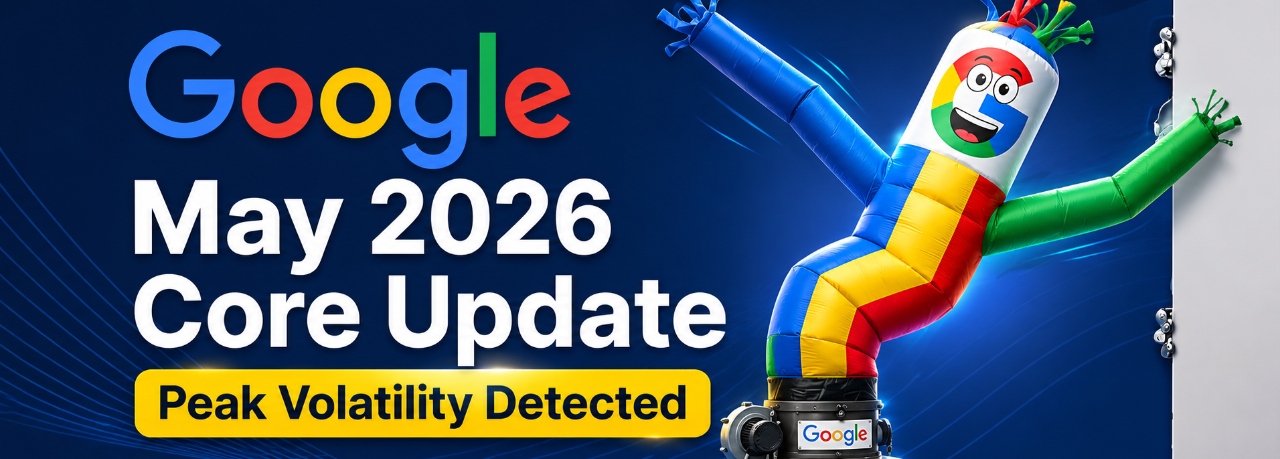
The May 2026 core update hit its peak volatility on Saturday 30 May. Semrush Sensor, RankRanger, and five other tools confirmed it simultaneously. The update is still rolling.
Week in Brief
- The May 2026 core update peaked over 30–31 May, with Semrush Sensor recording 6.6 desktop and 7.8 mobile SERP volatility. The highest readings since the March 2026 update. Few other tracking tools confirmed elevated movement on the same dates.<
- Google confirmed a Discover performance report logging error on 21 May that caused false drops in recorded clicks and impressions. This is the third Discover logging failure in under three weeks. Affected data may be permanently unrecoverable.
- The Search Console Links report broke on 21 May, showing fewer backlinks for many sites. Google has acknowledged the issue via John Mueller on Bluesky, but has not logged it on the official Data Anomalies page.
May 2026 Core Update: Hardest Hit on 30–31 May, Still Rolling
Google launched the May 2026 core update on 21 May (covered in full in last week’s edition). The first wave of meaningful ranking movement landed over the weekend of 23–25 May, with widespread community reports across X (earlier twitter).
By Saturday 30 May, Semrush SERP volatility Sensor recorded 6.6 on Desktop and 7.8 on Mobile, its highest readings since the March 2026 update.

Source: Semrush Sensor, SERP Volatility on Mobile, Data May, 2026
The update is still rolling as of 31 May. Google has not confirmed a completion date. Per Google’s core update guidance, data recorded during an active rollout is not a clean baseline, wait for the official completion notice on the Google Search Status Dashboard before drawing conclusions from Search Console.
What this Core Update Driven SERP volatility means for SEO rankings
Sites with thin, aggregated content are taking the largest drops. The March 2026 update, the last comparable broad core event, showed the clearest losses on pages with no original analysis, thin affiliate content, high ad density, and posts that covered a topic without adding a perspective unavailable elsewhere. The May data is tracking the same pattern.
Content clusters built around original delivery observations, named authors, and genuine topical depth are holding. If your informational pages answer the specific sub-questions buyers research during the evaluation phase, this rollout is unlikely to hurt you.
One distinction worth making explicit, ranking movement right now is the core update. Click-share drops on pages whose positions are stable are AI surface behaviour, specifically AI Mode and AI Overviews taking zero-click share. Do not merge both into the same cause in your reporting or you will mis-diagnose the fix.
Action or watch point after Completion of May Core Update
Mark 21 May as your baseline in Google Search Console, then audit your top 5 non-brand informational pages for clicks, impressions, CTR, and average position once Google confirms the rollout is complete. Identify the five informational pages that drove the most qualified traffic before the update and fix those first by integrating answer-first openings, FAQ schema, and specific sub-question coverage. Do not attempt a full site content overhaul on a constrained production schedule. Partial recovery on your highest-value pages is a better outcome than a complete rewrite that takes eight months to execute and misses two re-evaluation windows.
If you are running search or LinkedIn campaigns that feed into organic landing pages, GA4 is your reference, it recorded actual sessions and was not affected by the Search Console logging errors. Use GA4 to separate paid traffic performance from organic while Search Console data is unreliable. Do not pause or adjust paid spend based on Search Console data from 21 May onward until the rollout completes and the logging errors are confirmed resolved.

Three Search Console Bugs Confirmed in May: Discover Data, Links Report, and Impression Inflation
Google confirmed a logging error in the Discover performance report for 21 May 2026. Its statement, documented on the Google Data Anomalies in Search Console page, “A logging error caused a decrease in clicks and impressions on the Discover performance report for data on May 21, 2026. This issue affects data logging only.” The actual traffic was not affected.
This was the third Discover logging failure in under three weeks. The same surface had confirmed errors on 7–8 May 2026, and that data is permanently gone. The 21 May data may also be unrecoverable.
The Links report bug: On the same date, the Search Console Links report showed 87–90% fewer backlinks for many sites. Barry Schwartz at Search Engine Roundtable was first to document it publicly, reporting an 87.5% drop for his own site. John Mueller acknowledged the issue on Bluesky on 21 May at 4:27 PM “We’ll take a look to see if there’s anything unexpected happening” and confirmed the resolution on 23 May: “They’re working on resolving the actual issue and in the meantime switched back to the data from the week before.”
Google has not logged the Links report bug on its official Data Anomalies page. Mueller’s Bluesky posts are the only formal acknowledgement available.
What these bugs mean for B2B, ITES, and SaaS
Treat all Discover data from 7–8 May and 21 May as unreliable. The drops on those dates are logging artefacts, not content or traffic signals. Do not brief your team to investigate or recover from a performance problem that does not exist in your actual traffic.
For anyone reporting to leadership or clients on a monthly cadence, flag both bugs explicitly in your May reporting with the confirmed dates and their source. A drop in Discover clicks on 21 May is the logging error. A collapse in the Links report from 21 May is the confirmed Links report bug. Neither reflects real-world performance.
The broader issue is worth naming directly; three Discover bugs in three weeks, a broken Links report, and a year-long impressions inflation error, all in the same month, means Search Console cannot currently be treated as a single source of truth. Cross-referencing GA4 for traffic and third-party tools for backlinks is not optional right now, rather It is the responsible reporting practice.
Action or watch point
Bookmark the Google Data Anomalies in Search Console page and check it before investigating any unexplained drop in any Search Console report. Annotate 21 May permanently in both Search Console and GA4 so the bug dates are visible in every historical comparison you run.

On Our Radar for Next Week
May 2026 Core Update completion
The update has not been completed as of 31 May. Google has not confirmed an end date beyond “up to two weeks”. The March 2026 update completed in 12 days; the February Discover update ran for 22 days. Completion is likely between 2 and 12 June. Do not draw conclusions from current ranking movements, and check Search Console after completion is confirmed, then wait a further full week before comparing data ranges. Bookmark the Google Search Status Dashboard for the official notice.
AI Mode attribution gap
No tool currently tracks queries originating from AI Mode separately from standard organic search, including Google Search Console itself. The industry is watching for GSC to surface AI Mode as a distinct traffic source. If it does, B2B teams will need to separate AI surface performance from organic performance in their reporting i.e. two different audiences, two different content signals, two different click behaviours.
Agent-driven content consumption pattern
Information Agents are live, but there is no published data yet on how they select what to cite. Few of the early signals, worth watching are; whether FAQ, HowTo, and Special Announcement schema influences agent retrieval, and whether pages with discrete H2 sections earn agent-driven impressions more often than narrative-format content. We expect usable data within 30–45 days. Until then, the safe bet is to structure content for AI extraction, answer in the first two sentences of every section, one topic per H2, because that format works for AI Overviews, AI Mode, and agents alike.
White Bunnie Observation
Across the client accounts we monitor, the core update volatility visible in Semrush Sensor and community reports this week is not hitting uniformly.
The core update is having mixed results: More than half of the accounts with content clusters built on original delivery data; mostly case studies and first-hand process documentation, named authors, and good Core Web Vitals are showing stable or improved click data week-on-week. While few accounts with higher proportions of aggregated industry commentary, posts that cover a topic without adding a new perspective unavailable elsewhere are showing drops in the 10–14% range on their top informational pages.
This largely matches the pattern from the March 2026 update. We are watching whether it holds once the rollout completes and Search Console data settles.
Entity consistency is outperforming content quality: A founder-led EdTech site we track is outranking competitors with higher domain authority and more polished content on several training and business related queries. It is also appearing in AI Overviews. The founder has consistent named authorship across the website, LinkedIn, and third-party directories, no variation in name, title, or expertise description. That cross-web consistency is functioning as an authority signal that its competitors’ content strategies are not producing.
The implication for B2B teams is direct: if your senior practitioners are not named authors on your content, with consistent bios across every platform, no amount of schema mark-up closes that gap.
We are watching whether both patterns hold once the rollout completes.