
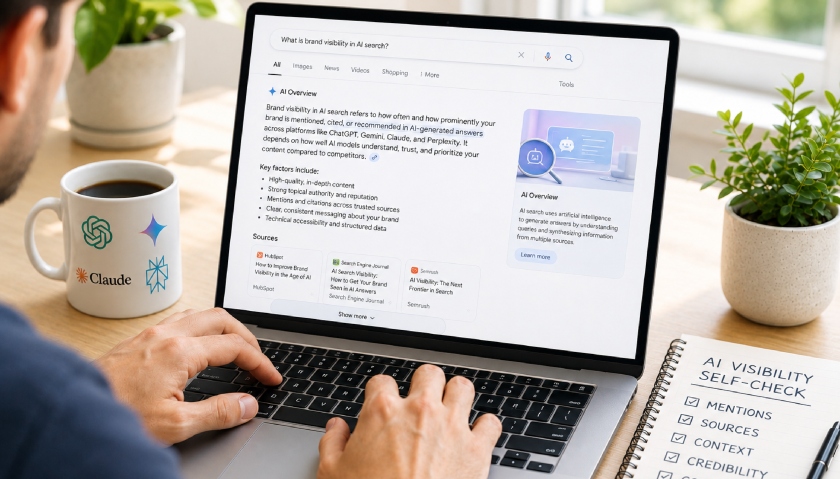
Is Your Brand Showing Up in AI Answers? Run This 15-Minute Self-Check
-
Author
Ankit Sain -
Publish
June 18, 2026 8:47 am -
Read Time
9 Min
 Lets talk






Fill in the Form below for a no-string attached free technical discussion.
TL;DR
AI assistants ChatGPT, Gemini, Perplexity and Claude now shortlist 3–4 brands per query and send buyers directly to them. If your brand isn’t in those answers, you’re invisible before the conversation even starts. This guide gives you a 6-step, 15-minute self-check to find out exactly where you stand no paid tools, no developer needed. The three fixes that move the needle fastest: serve content in crawlable HTML (not JavaScript), add proper JSON-LD schema, and earn mentions on third-party sites your buyers already trust.
More buyers now start with a question to an AI assistant instead of a search box. They ask ChatGPT for the “best payroll software for Indian startups” or ask Perplexity to “compare CRM tools under ₹2,000 a month.” The assistant replies with three or four named brands and a short reason for each.
If your brand is one of those names, you win the consideration set before a single click. If it isn’t, you don’t even know the conversation happened.
So here’s the real question: when someone asks an AI tool about your category, does your brand come up? You can find out in about 15 minutes. No paid software. No developer. Just a method.
When people search the old way, they scan a list of links and pick one. When they ask an AI engine, they often get a single written answer with a few brands cited inside it. That answer is the new front page.
Getting your brand into those answers is a discipline in itself. Most teams call it Answer Engine Optimisation (AEO), or Generative Engine Optimisation (GEO). It overlaps with SEO but isn’t the same thing. Classic SEO fights for a ranking position. AEO fights to be named and cited inside the answer itself.
Two things make this urgent in 2026:
For India specifically, the shift is sharper than the global average. ChatGPT and Perplexity referral traffic across India and Southeast Asia has been growing 200%+ year over year (upGrowth AI Traffic Report, 2026). The buyers are already there.
Why this matters more in India: India’s B2B SaaS market is maturing fast and buyers, especially at the SMB and mid-market level, are increasingly skipping vendor websites altogether and trusting AI summaries for shortlisting. If a competitor gets named and you don’t, you’re not losing a click. You’re losing a conversation.
Set a timer. Work through these six checks in order. By the end, you’ll know whether you have a visibility problem and roughly where it sits.
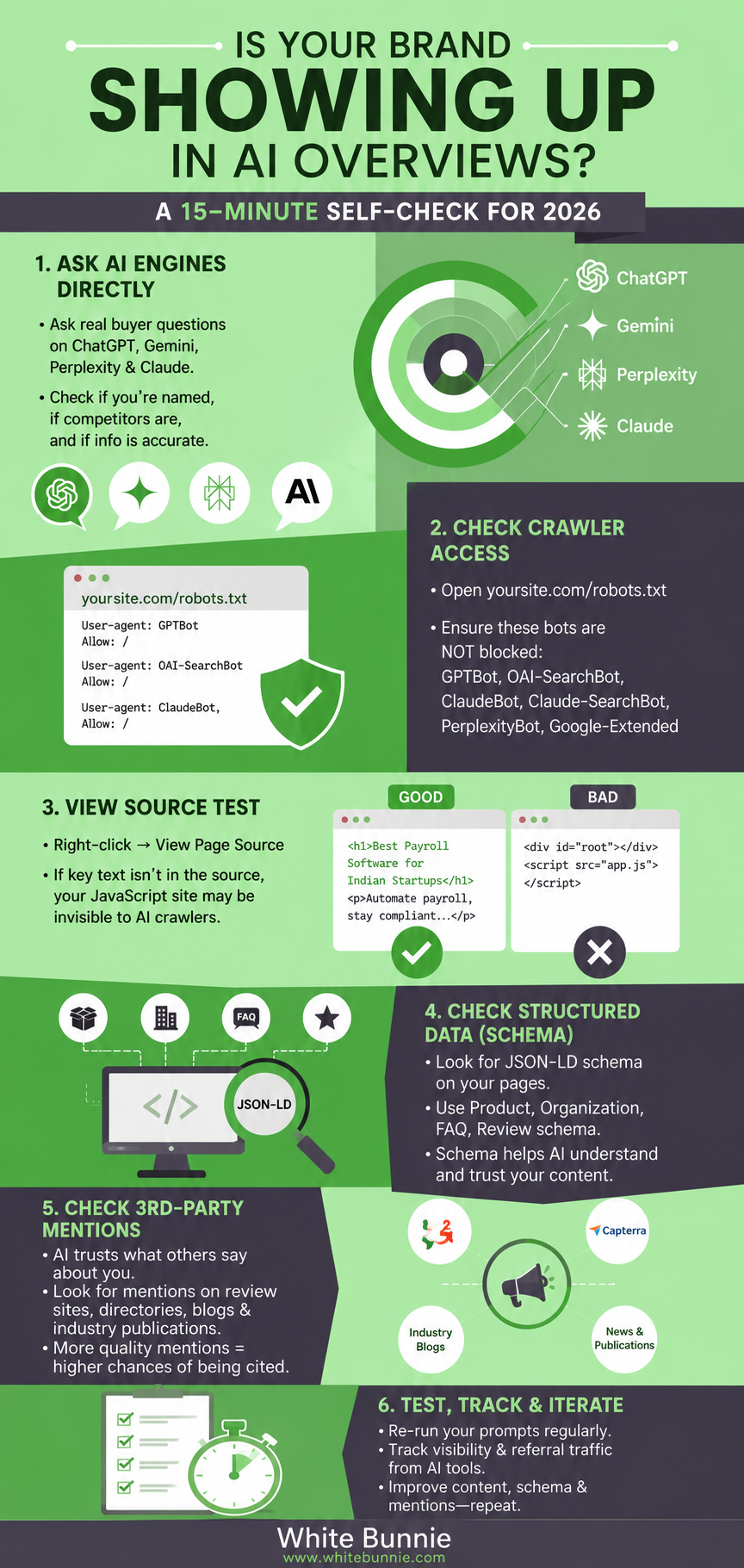
Open ChatGPT, Gemini, Perplexity, and Claude in four tabs. Ask each the same buyer questions a real customer would type:
Note three things: Are you named? Are your competitors named instead? Is anything the AI says about you wrong or out of date?
Run each prompt twice. AI answers are not stable the same question can return a different brand list on a second try. If you appear sometimes and vanish other times, you have a consistency problem, not a total blackout.
💡 Pro tip: Test the long tail, not just the obvious query
The branded “best X in India” query is competitive and hard to crack first. Also test ultra-specific prompts like “payroll software for a 20-person Indian startup under ₹5,000/month” or “CRM that integrates with Zoho Books.” Niche queries have less competition and are often where brands first break into AI answers. Document every query where a competitor appears and you don’t; that list becomes your AEO content roadmap.
If the bots can’t fetch your site, nothing else matters. Type your domain followed by /robots.txt into a browser (for example, yoursite.com/robots.txt).
Look for lines that block these names: GPTBot, OAI-SearchBot, ClaudeBot, Claude-SearchBot, PerplexityBot, Google-Extended. A Disallow: / under any of them means you’ve shut that engine out. Plenty of brands block these by accident through a default security setting and never realise it.
💡 Pro tip: Don’t just check; fix and verify
If you find a blocked crawler, update your robots.txt, then use each engine’s public tools (OpenAI’s API crawler status, Google Search Console) to confirm the bot is no longer blocked. Some teams fix the file but forget to purge a cached version served by a CDN the bots keep hitting the old blocked version for weeks. After updating, also run a full technical SEO audit on your Cloudflare or Akamai settings; WAF rules sometimes block AI crawlers at the network layer before robots.txt is even read.
This one catches more brands than any other. Open your homepage and a key product page, right-click, and choose View Page Source. Use your browser’s find function (Ctrl/Cmd + F) to search for a headline or product sentence you can see on the screen.
If the text shows up in the source, good. If it doesn’t, if you mostly see <div id=”root”></div> and a pile of script tags, your content is built in the browser with JavaScript, and most AI crawlers can’t see it.
This isn’t a guess. As of mid-2026, none of the major AI crawlers GPTBot, OAI-SearchBot, ClaudeBot, PerplexityBot, and the rest execute JavaScript (Lantern / Vercel + Merj analysis, 2026). They read your raw HTML and move on. Google’s own Gemini is the main exception, since it borrows Googlebot’s rendering. A React or Vue site that ranks fine on Google can be a blank page to every other engine.
Paste your page URL into Google’s Rich Results Test or Schema.org’s validator. You’re checking whether your page has clean JSON-LD schema markup that tells engines what your page is, in plain machine-readable terms.
Pages with complete, accurate structured data get cited noticeably more often, because the schema hands the engine your facts without making it parse a cluttered page. Look for Organization, Product, FAQPage, and Article types as a baseline.
One addition most teams miss: SoftwareApplication schema (for SaaS products) and Review/AggregateRating schema pulled from G2 or Capterra can make a significant difference. AI engines increasingly surface products with verifiable social proof signals; schema is one way to make those signals machine-readable on your own domain.
Open GA4 and filter your traffic sources for ChatGPT, Perplexity, Gemini and Claude. Even a trickle tells you the engines are sending real people. Zero across all of them when your category clearly shows up in AI answers is a flag.
One catch worth knowing: a lot of AI traffic loses its referrer and lands in your “Direct” bucket, so your true AI footprint is usually larger than the report shows.
A smarter workaround: Create UTM-tagged landing pages linked from your Perplexity profile, your G2 listing, and any AI-readable directories where you’re listed. That way, when an AI engine cites a third-party source that links to you, the visit arrives with a trackable parameter not as direct traffic.
Pick the rival who keeps getting named in Step 1. Look at how they publish: Do they answer specific questions in plain language near the top of the page? Do they show clear author names and credentials? Are they cited on third-party sites like G2, Reddit, or industry round-ups?
AI engines lean on those outside mentions heavily. Being talked about elsewhere often matters more than anything on your own site.
What to look for specifically: Check if your competitor has content structured around “X vs Y,” “best X for [use case],” or “how to choose X”; these are the query patterns AI engines answer most frequently. If they have 10 comparison pages and you have zero, that’s the gap closing your citations gap means filling.
A quick reality check, because the hype runs ahead of the data:
This is where the commercial case for AEO firms up. B2B SaaS teams are already turning AI mentions into demo requests, and the conversion maths is favourable when the traffic is this intent-rich.
If you want proof this isn’t theory, look at Mentimeter, the interactive presentation platform. Working with agency Siege Media, the team didn’t chase a new channel with new content. They restructured what they already had so AI engines could read and quote it.
The work was unglamorous and specific:
The reported result roughly 124,000 ChatGPT-referred sessions and 3,400 conversions in a single month (Siege Media case study, 2026).
Notice that none of these moves required a rebuild or a big ad budget. They map almost one-to-one onto the self-check above answer-first writing, structured data, and outside mentions. That’s the point. The brands winning AI citations are doing ordinary content work with an AI reader in mind.
What Indian B2B SaaS teams can learn from this: Mentimeter operates in a crowded global market. Indian SaaS brands often compete in categories where English-language AI content is still thin payroll, GST compliance, HRMS, regional logistics. That means the bar for getting cited is actually lower right now. A single well-structured comparison page or use-case guide in an underserved sub-category can land citations that a global brand would need months to earn. The window is open. Act before it narrows.
If your self-check turned up problems, three fixes cover most of them:
A fourth fix many teams overlook: Your content’s answer density. AI engines prefer pages that answer a specific question in the first 1–2 sentences of a section, then expand. If your product pages are structured around features (“We offer X, Y, Z”) rather than buyer questions (“How does X help teams doing Y?”), rewriting those intros is one of the highest-leverage edits you can make.
A quick word on llms.txt – The proposed text file that summarises your site for AI models. It’s fashionable, but be honest about it. Adoption sits near 10% of sites, and Google has said on the record it doesn’t use the file (SE Ranking / Google statements, 2026). It’s cheap to add and useful as a clean routing map for AI coding agents, but it won’t earn you citations on its own. Fix crawler access and schema first.
Build it in-house or bring in help?
Once you see the gaps, the next question is who does the work. Running AEO in-house means hiring or training people across content, technical SEO, and analytics a real salary line, and a slow ramp while they learn a field that barely existed two years ago. An external partner costs a monthly retainer but starts with the playbook already built.
There’s no single right answer; it depends on your team’s bandwidth and how central AI search is to your pipeline. At White Bunnie, we usually tell teams to run the cheap fixes themselves and bring in help only where the technical or editorial lift gets heavy.
A reasonable starting point for most Indian SaaS teams: Fix robots.txt and JavaScript rendering yourself (one-time, low cost). Add schema to your top 10 pages yourself (half a day with a developer). Outsource the content restructuring and third-party citation building those are ongoing, require editorial judgment, and take time to compound.
How do I know if ChatGPT recommends my brand?
Ask it directly. Open ChatGPT and type a buyer question for your category, such as “best [your product type] in India,” then run it two or three times. If your brand isn’t named across those tries, you have an AEO gap to close. Also try question variants “which [product type] should a 50-person Indian startup use” since phrasing affects outputs.
Why does my site rank on Google but never appear in ChatGPT or Claude?
Most likely your content loads through JavaScript. Google can render it; the major AI crawlers can’t. Check with the View Source test above. If your visible text is missing from the page source, switch to server-side rendering or pre-rendering.
Is AEO different from SEO?
They overlap but aren’t identical. SEO aims to rank a link in a list. AEO aims to get your brand named and cited inside an AI-written answer. Strong fundamentals crawlable HTML, schema, clear writing, and third-party mentions feed both. The key difference: AEO rewards answer-first writing far more than SEO does. A page optimised purely for keyword density can rank well on Google and be completely ignored by AI engines.
Does llms.txt help my brand show up in AI answers?
Not on its own, as of 2026. No major AI engine has committed to reading it, and Google says it doesn’t use it. Treat it as optional housekeeping. Crawler access, structured data, and content quality matter far more.
How long does AEO take to show results?
Faster than traditional SEO, but not instant. Technical fixes (crawler access, rendering, schema) can show impact within 4–6 weeks as engines re-crawl. Content changes typically take 2–3 months to surface in citation patterns. Third-party mentions compound over 3–6 months. The brands seeing results fastest are those who fixed the technical floor first, then layered content on top.
You can’t fix what you can’t see. The 15-minute self-check tells you, plainly, whether the AI tools your buyers already use know your brand exists. Run it this week. Note where you’re invisible. Then fix the cheap, high-impact gaps first, usually rendering and schema before you spend on anything fancier.
The brands getting named in AI answers right now mostly aren’t doing anything magic. They made their content easy for machines to read and worth quoting for humans. That’s the whole game.
If you’d like a second pair of eyes on your results, that’s the kind of audit White Bunnie runs every day, but the first look costs you nothing but 15 minutes.

Ankit Sain is an SEO specialist with over 6 years of hands-on experience in driving organic growth through data-driven and AI SEO strategies. He helps businesses improve visibility, rankings, and conversions with sustainable search solutions.

When it comes to mastering SEO, backlinks are crucial yet often confusing. Backlinks are key signals that search engines use […]
Read Post »
Reddit is an underrated yet powerful tool for SEO. It can help improve rankings, drive high-quality traffic, and provide valuable […]
Read Post »
What Is AI Crawl Budget? AI crawl budget refers to the amount of attention and resources AI systems (especially large […]
Read Post »
Copyright © 2026 White Bunnie -All Rights Reserved