

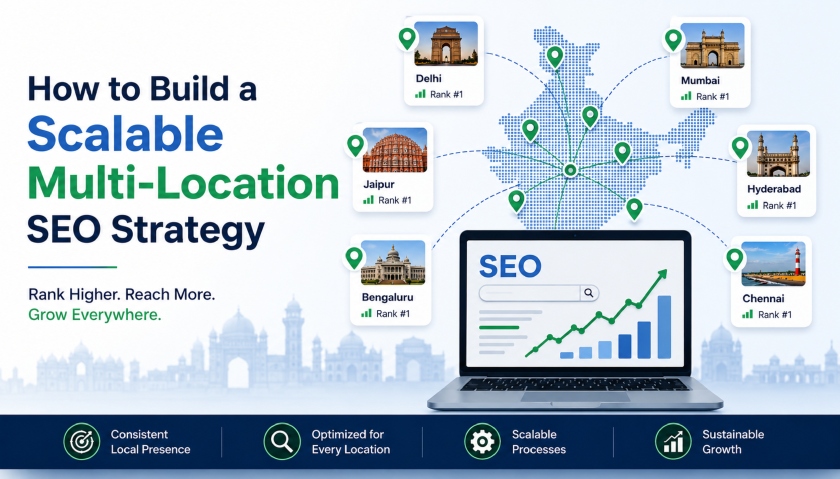
How to Build a Scalable Multi-Location SEO Strategy
-
Author
Saurabh Garg -
Publish
June 27, 2026 11:40 am -
Read Time
8 Min
 Lets talk










Fill in the Form below for a no-string attached free technical discussion.
Quick Summary
• Give every location its own page and its own Google Business Profile; never bundle multiple addresses into one.
• Write real, city-specific content for each page. City-swap copies are thin content and hurt your whole site.
• Keep your NAP (Name, Address, Phone) identical across every directory, even “Ste.” vs “Suite” splits your signal.
• Map a distinct keyword set per location so your own pages stop competing with each other.
• Add LocalBusiness, FAQPage, and BreadcrumbList schema, Google’s AI Overviews and the local pack pull directly from structured data.
• Build internal links between location pages and track rankings at the city level, not just the domain level.
Running a business in multiple Indian cities is not the same as running multiple websites. But from a search engine’s point of view, each city you operate in deserves its own optimised presence. Without that, you will always lose local searches to competitors who got this right first.
This guide lays out exactly how to structure a multi-location SEO strategy, one that works at scale, stays consistent, and actually ranks in Google across India’s diverse metros and tier-2 cities.
Multi-location SEO is the practice of making your business visible in Google search results for every city, district, or region where you operate, not just your head office. Google treats location as a core ranking signal. If someone in Pune searches for “interior designers near me” and your only optimised page targets Mumbai, you will not show up. This is why investing in local SEO services from the start saves you from rebuilding later.
India has over 50 cities with populations above 1 million. Tier-2 cities like Indore, Coimbatore, Lucknow, and Bhubaneswar are seeing rapid growth in internet users. A 2024 Google India report confirmed that “near me” searches have grown over 200% in the past three years, with tier-2 and tier-3 cities leading the surge.
Source: Google India’s Year in Search 2024
One thing trips up most teams: your main domain authority does not automatically flow down to each branch. Each Google Business Profile and each location page builds its own local standing over time. A strong head office does not carry a weak branch. Each one earns its rank.
Start with the map of the site, not the words on it. A clean structure lets you add a branch without breaking the rest. For most Indian businesses, the subfolder approach is stronger:
Lenskart, one of India’s largest eyewear chains, uses subfolder-style location pages under its main domain. Each city page is distinct and indexed separately one reason they rank in multiple metros for competitive terms. Good technical SEO at the architecture stage is what makes this possible without performance issues as the site grows.
Link every location page from one central location directory. Location pages should link to the services they offer, and service pages should link back to the branches that run them.
This is where most businesses go wrong. They duplicate a template and change only the city name. Google reads that pattern fast; near-duplicate pages count as thin content and can drag the whole site down.
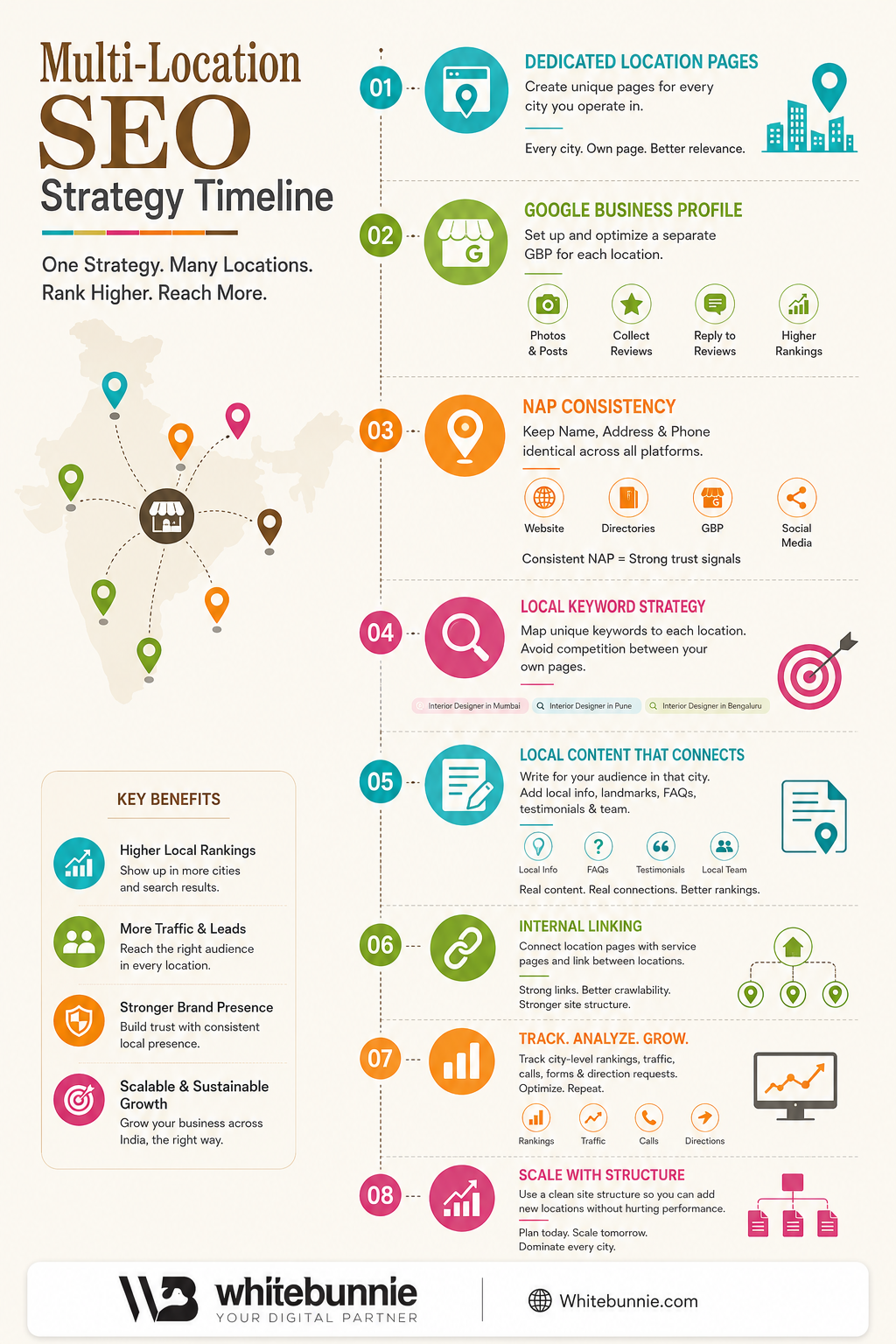
What a strong location page includes:
Each page should have at least 500–800 words of original content. Solid on-page SEO title tags, meta descriptions, headers, and structured content carry the same weight for location pages as it does for any other page on your site.
Google Business Profile (GBP) is the single most important tool for local SEO. Treat each profile as its own asset, not a corporate listing. GBP signals make up the largest share of local pack rankings, close to a third, according to the 2026 Whitespark and BrightLocal Local Search Ranking Factors study.
For each location:
Source: Google Business Profile Help — How Google determines local ranking
NAP stands for Name, Address, Phone number. When Google sees inconsistent NAP across the web, your website says one address, Justdial says another, IndiaMart says a third, it loses confidence in your business and rankings suffer.
Where NAP must be consistent in India:
Run a citation audit every six months. A proper SEO audit will surface NAP mismatches across directories that you would never find manually, and flag which ones are sending conflicting signals to Google.
A related problem is keyword cannibalization, where two branch pages chase the same term so neither wins. The fix is geographic specificity: target the neighbourhood or district, not just the city. Map a distinct keyword set per page, then check Google Search Console to confirm which page ranks and back it with internal links.
Schema markup is structured data you add to your page’s HTML. It tells Google exactly what your page is about in a language it understands instantly and it is now more important than ever with Google’s AI Overviews rolling out across India through 2025 and 2026. This sits at the heart of both AEO and generative engine optimization (GEO), where your pages need to answer questions before a user even clicks.
Schema types every location page needs:
When a user asks Google “which CA firm is near Bandra?”, Google pulls structured data from the LocalBusiness schema to construct its AI answer. The AI search ranking factors in 2026 make structured data one of the fastest wins available. ChatGPT local business discovery grew from 6% of searches in January 2025 to 45% by January 2026
Validate your schema using Google’s Rich Results Test after adding it. Even one error can prevent the markup from being processed.
Internal linking is often the most neglected part of multi-location SEO. A clear geographic hierarchy helps Google crawl and understand your coverage.
A simple structure that works:
For local backlinks, a link from a Mumbai-based news site carries more local relevance for your Mumbai page than a generic national link. Topical authority built through consistent, city-specific content also strengthens how Google interprets your brand’s expertise in each market.
Where to look for local backlinks in India:
According to an Ahrefs 2024 study on local SEO ranking factors, pages with at least three locally relevant referring domains ranked in the top 3 local results 68% more often than pages with no local links.
Reviews and citations prove you are real. Both need a system once you pass a handful of branches.
For reviews:
For citations:
Citation signals make up around 7% of local pack rankings (Whitespark and BrightLocal, 2026). Every mismatch works against you, so the cost of inconsistency adds up quickly.
Track at the location level, not the domain level. Aggregate numbers hide your weak markets. If you track rankings from a single location (usually your own computer or a Delhi-based server), you get Delhi results. Your Kochi page might be ranking badly and you would not know.
What to track per location:
A location page you wrote in 2023 with old hours, a changed address, or a closed branch will hurt you. Google checks page freshness, and users who arrive on a page with wrong information leave immediately.
Quarterly update checklist:
Multi-location SEO sounds complex. It is not if you build it in phases. The businesses that try to launch 30 city pages at once with thin content almost always end up invisible. The ones that go city-by-city with substance end up owning local searches in each market.
| Phase | Action |
| Phase 1 | Fix your URL structure and build GBP listings for every active location. |
| Phase 2 | Write original location pages for your top 5 cities by revenue. |
| Phase 3 | Add schema markup and sort out NAP consistency. |
| Phase 4 | Start building local backlinks and internal links. |
| Phase 5 | Track, update, and expand to your next 5 cities. |
Start with the cities that matter most to your revenue. Get those right before you scale. Build the frame once, and every branch you add rides the same rails. That is the quiet edge a good system gives you, SEO that does not need constant rebuilding, because it compounds over time.

Saurabh Garg, the visionary Chief Technology Officer at Whitebunnie, is the driving force behind our cutting-edge innovations. With his profound expertise and relentless pursuit of excellence, he propels our company into the future, setting new standards in the digital realm.

IT industry marketing is building visibility and credibility with technical buyers across a 6-12 month decision process. It is fundamentally […]
Read Post »
AI-driven website builders make it fast and simple to create a professional site. They use tools like chat interfaces and […]
Read Post »
The world of search has changed. By August 2025, “zero-click” searches—where a user gets their answer directly on the results […]
Read Post »
Copyright © 2026 White Bunnie -All Rights Reserved