

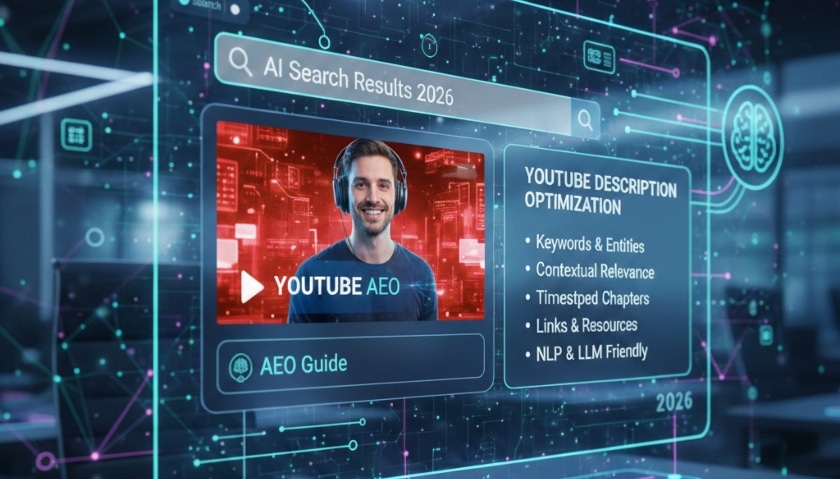
How YouTube Descriptions Help You Rank in AI Search Results (AEO Guide for 2026)
-
Author
Ankit Sain -
Date
February 26, 2026 -
Read Time
6 Min
 Lets talk








Fill in the Form below for a no-string attached free technical discussion.
Search is not what it was two years ago. Google, Perplexity, ChatGPT, and other AI tools now pull answers from multiple sources — and YouTube descriptions are one of them.
Most creators write their YouTube descriptions as an afterthought. They paste a link, maybe drop in a few hashtags, and call it done. That works fine if you only care about YouTube search. But if you want AI tools to surface your content as an answer to a specific question, your description needs to do much more.
This guide covers what Answer Engine Optimisation (AEO) means for YouTube creators in 2026, and how to write descriptions that give AI systems a clear reason to cite your content.
AEO stands for Answer Engine Optimisation. It is the practice of structuring your content so that AI-powered search tools can read it, understand it, and quote it when someone asks a related question.
Traditional SEO targets Google’s ranking algorithm. AEO targets the language models and retrieval systems behind tools like Perplexity, Google AI Overviews, Bing Copilot, and ChatGPT search. These tools do not rank ten blue links. They read available text, pick the most useful passages, and return a direct answer to the user.
YouTube video descriptions are public, indexable text. Search engines and AI crawlers can read them. If your description clearly explains what a question is and then answers it, AI tools have a reason to pull from it. This is a core component of Video SEO in 2026, where structured clarity often outperforms keyword repetition.
That is a real opportunity. Most video descriptions contain no structured information at all. The ones that do are rare, and AI tools are more likely to use them.
When an AI answer engine processes your description, it looks for specific things:
AI retrieval does not reward long descriptions. It rewards descriptions that are dense with useful, specific information. A 500-word block of generic filler serves no one. A focused 250-word description built around real questions earns citations. This is exactly how to approach How to Do Video SEO in the current landscape.
After testing descriptions across multiple channels, a clear pattern has emerged at White Bunnie. Here is the structure we recommend:
Your first sentence should answer the core question your video addresses. Do not write a teaser or a hook. Write the answer. AI tools weight the first 150 characters more than the rest of the description, and users who find your video through an AI answer will arrive already knowing the core point. That builds trust.
After your opening sentence, write three to five questions that your video answers. Use the same words your audience would type or speak. “How do I write a YouTube description for AI search?” is better than “Description optimisation for AI-driven traffic acquisition.” Plain language matches more real queries.
Timestamps are not just for viewer navigation. They tell AI tools that your video contains specific answers at specific points. When Google’s AI Overviews or Perplexity cite a video, they often link to a timestamp. If you have no timestamps, they have less reason to quote your content.
Label each timestamp with a short phrase that mirrors a real question. “02:14 What goes in the first line of a YouTube description” is more useful than “02:14 Part 2.”
Named entities help AI tools understand what your content is about without guessing. Mention the tools you discuss, the platforms you reference, the year or specific context, and the niche you are in. Vague descriptions do not get cited. Specific ones do.
Here is a real example from a YouTube channel in the personal finance space.
In this video I talk about index funds and why they are a great investment for beginners. Make sure to subscribe and hit the bell icon for more videos like this. Check out my other videos on investing!
Index funds are low-cost investment vehicles that track a market index like the S&P 500, and are a practical starting point for UK beginner investors in 2026.
This video answers:
Timestamps: 00:00 Intro | 01:22 What is an index fund | 03:45 ISA vs GIA explained | 06:10 Best UK platforms for beginners in 2026
The second version gives AI tools a topic, a context, specific questions, named entities (ISA, GIA, S&P 500, UK), and timestamped answers. It takes under five minutes to write and it does real work. This same approach applies whether you are creating long-form tutorials or trying to Rank Short-Form Videos in competitive niches.
A few common habits work against your AEO performance:
Some creators worry that writing for AI tools means ignoring traditional YouTube SEO. That is not the case. A description built around specific questions, real answers, and relevant named entities also contains the natural-language keywords that YouTube’s own algorithm favours. You do not need to choose between the two.
The shift worth noting is that keyword density matters less than it did in 2022 or 2023. What matters now is topical depth and clarity. If your description covers a topic with enough specificity that an AI tool can extract a clean answer from it, that description is also a strong YouTube SEO asset.
Run through this before every upload:
YouTube descriptions have always been underused. In 2026, that gap is wider than ever because AI search tools are now part of most users’ daily workflow, and they pull from description text when they answer questions.
Writing a strong description takes ten minutes. It covers your content in YouTube search, traditional Google results, and AI answer engines at the same time. For the time invested, it is one of the better returns available to creators right now.
Start with one video. Rewrite its description using the structure above. Check your YouTube Studio analytics after 30 days and compare impressions against similar videos where you did not change the description. The data will tell you whether it is worth applying to your whole archive. It usually is.

Ankit Sain is an SEO specialist with over 6 years of hands-on experience in driving organic growth through data-driven and AI SEO strategies. He helps businesses improve visibility, rankings, and conversions with sustainable search solutions.
A sudden drop in your website’s organic traffic can feel like an emergency. One day, your analytics are steady; the […]
Read Post »
Noida’s local marketplace is crowded and competitive. Whether you run a café in Sector 18 or a clinic in Pari […]
Read Post »
Before giving credit to one between AI and traditional SEO one must realize that each has its own scope in […]
Read Post »
Powered by Creativity. Connected With Cities Worldwide.
Copyright © 2026 White Bunnie -All Rights Reserved


